Overview
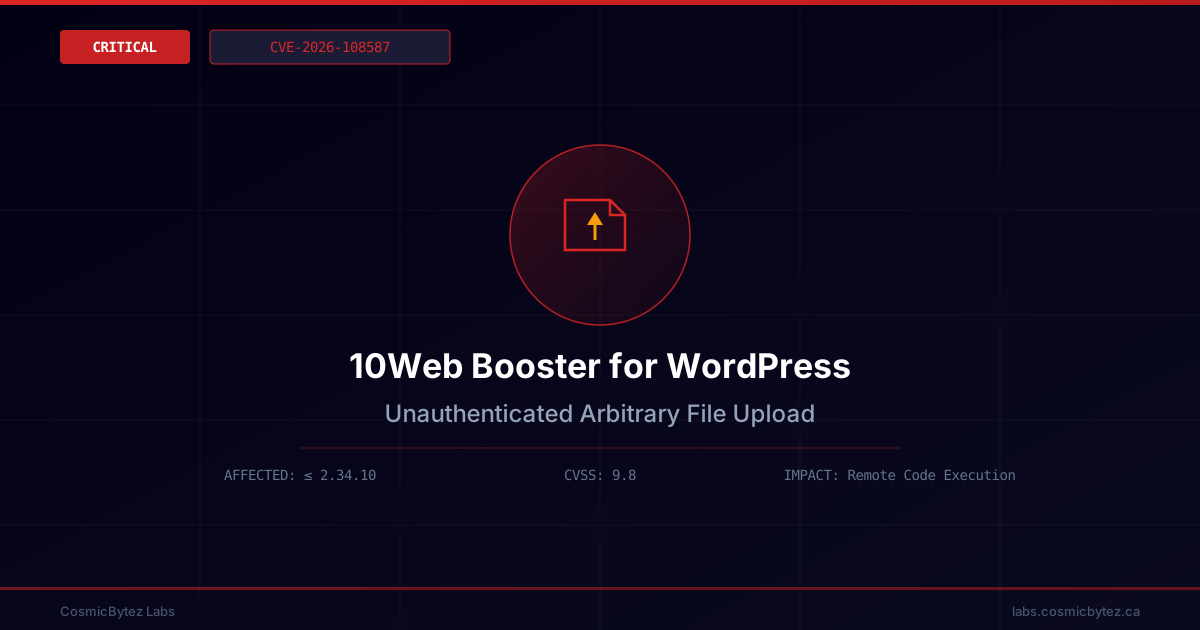
A critical vulnerability has been disclosed in 10Web Booster (also distributed as "10Web Booster – Website speed optimization, Cache & Page Speed optimizer"), a WordPress performance plugin. Tracked as CVE-2026-108587 with a maximum-severity CVSS score of 9.8, the flaw lets an unauthenticated attacker upload arbitrary files, including executable code, through the plugin's compressCustom function — resulting in full remote code execution on the underlying WordPress site.
The vulnerability was identified and assigned by Wordfence and affects all versions up to and including 2.34.10.
Technical Details
| Field | Value |
|---|---|
| CVE ID | CVE-2026-108587 |
| Severity | Critical (CVSS 9.8) |
| CVSS Vector | CVSS:3.1/AV:N/AC:L/PR:N/UI:N/S:U/C:H/I:H/A:H |
| CWE | CWE-434 — Unrestricted Upload of File with Dangerous Type |
| Attack Vector | Network |
| Authentication | None Required |
| Privileges Required | None |
| User Interaction | None |
| Affected Versions | All versions ≤ 2.34.10 |
| Assigner | Wordfence |
| KEV Status | Not listed |
How It Works
The flaw is a chain of two compounding issues rather than a single missing check:
- Missing file-type validation. The plugin's
compressCustomfunction processes a caller-suppliedpage_idparameter without validating file type or filtering extensions, so an attacker can submit a file that WordPress will treat as executable. - Nonce leakage that defeats the auth check. The upload endpoint is gated behind a REST nonce (
tenwebio_rest). Under normal conditions that nonce requires an authenticated session — but the plugin generates it inside a cron/loopback context where the associated user ID is set to0, producing a nonce that is valid for unauthenticated visitors. Worse, whenever a bulk optimization batch pauses, that nonce is serialized and written to a world-readable file underwp-content/uploads/, where any remote visitor can retrieve it.
Combined, these two bugs mean an attacker only needs to fetch the leaked nonce from a predictable, publicly accessible path and then call compressCustom with a malicious file — no credentials, no session, and no user interaction required.
Impact Assessment
| Impact Area | Description |
|---|---|
| Confidentiality | Full site compromise exposes the entire WordPress database and configuration |
| Integrity | Attacker can upload and execute arbitrary code, modify site content, or plant persistent backdoors |
| Availability | Attacker-controlled code execution can be used to disable or destroy the site |
| Scope | Any WordPress installation running the affected plugin with the uploads directory web-accessible (the default configuration) |
| Exploitability | Easy — no authentication, no user interaction, and the prerequisite nonce is self-leaking via a predictable path |
| Public Exploit | None confirmed as of publication |
Mitigation
Immediate Actions
- Update 10Web Booster to the patched version referenced in the WordPress plugin repository changeset as soon as it is available in your site's plugin updates.
- Audit
wp-content/uploads/for unexpected files, particularly PHP or other executable files that should never appear in a media uploads directory. - Restrict direct execution of uploaded files in the uploads directory via server configuration (e.g., disabling PHP execution in
wp-content/uploads/through.htaccessor equivalent web-server rules) as a defense-in-depth measure regardless of patch status.
Detection Opportunities
- Review web server access logs for requests to
compressCustom-related REST endpoints from IPs with no prior authenticated session. - Search for world-readable files under
wp-content/uploads/containing serialized nonce data, and treat their presence as a leading indicator of exposure even absent confirmed exploitation. - Monitor for newly created executable files (
.php,.phtml, etc.) appearing in uploads directories outside of expected media management workflows.
Defence-in-Depth
- Apply the principle of least privilege to the web server process account so that even successful code execution has limited reach into the host system.
- Keep a web application firewall (WAF) rule set current for WordPress plugin upload vulnerabilities, which this plugin class is frequently targeted by once a CVE is public.
- Regularly audit installed plugins for unmaintained or infrequently updated code, especially those handling file uploads or REST API endpoints.
Discovery & Disclosure
The vulnerability was reserved on October 10, 2026 and published on October 15, 2026, with Wordfence serving as the CVE assigner. As of publication, CVE-2026-108587 is not listed in the CISA Known Exploited Vulnerabilities (KEV) catalog and no public proof-of-concept exploit has been confirmed — but the unauthenticated, zero-interaction attack path combined with the maximum CVSS score makes this a priority patch for any site running the plugin.