Executive Summary
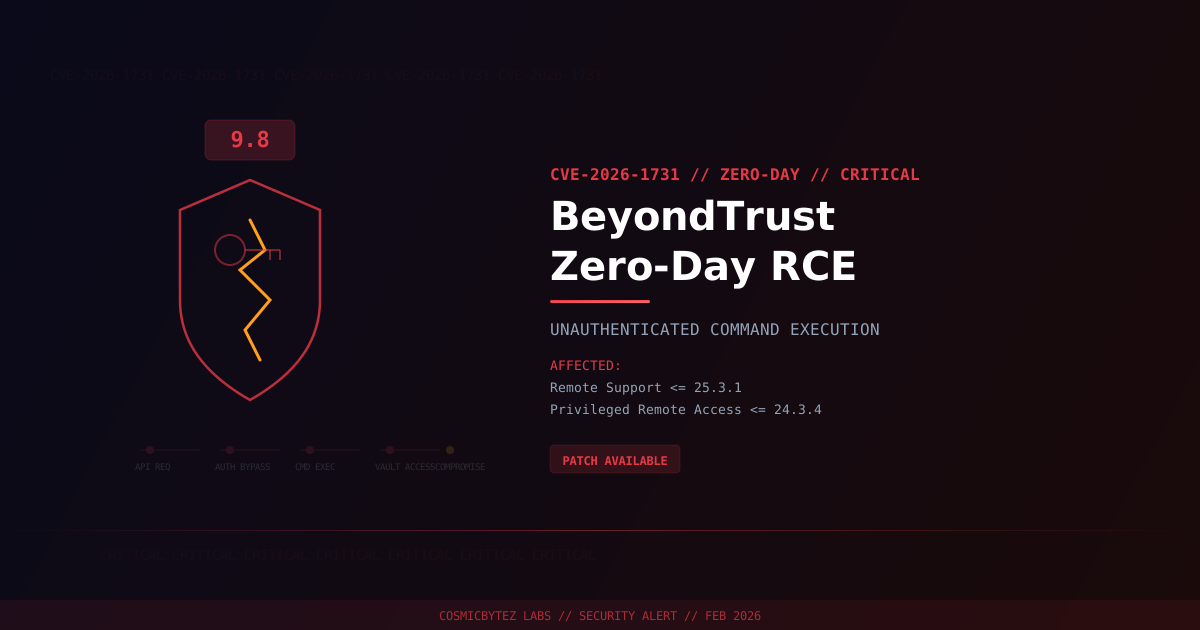
A critical zero-day vulnerability has been disclosed in BeyondTrust's Remote Support and Privileged Remote Access platforms that allows attackers to execute commands without authentication. Given BeyondTrust's role in managing privileged access across enterprise networks, successful exploitation could compromise entire organizational infrastructures.
CVSS Score: 9.8 (Critical)
BeyondTrust deployed automatic patches to SaaS customers on February 2, 2026. Self-hosted deployments require immediate manual patching.
Vulnerability Overview
Root Cause
CVE-2026-1731 is an unauthenticated command execution vulnerability in BeyondTrust's Remote Support and Privileged Remote Access products. The flaw was discovered through variant analysis by security researchers Harsh Jaiswal and Hacktron AI, who identified a bypass in the authentication layer of the management API.
Why BeyondTrust Compromise Is Critical
BeyondTrust products are specifically designed to manage the most sensitive access in an organization:
| Capability | Risk If Compromised |
|---|---|
| Remote Support sessions | Attacker can hijack active support sessions to access customer systems |
| Privileged credential vault | Stored credentials for servers, databases, and network devices exposed |
| Session recording | Access to recordings of privileged sessions containing sensitive operations |
| Jump items and endpoints | Direct access to pre-configured connections to critical infrastructure |
| AD/LDAP integration | Potential pivot to Active Directory via service account credentials |
Technical Details
Affected Versions
| Product | Affected Versions | Fixed Version |
|---|---|---|
| BeyondTrust Remote Support | <= 25.3.1 | Patch BT26-02-RS |
| BeyondTrust Privileged Remote Access | <= 24.3.4 | Patch BT26-02-PRA |
Attack Vector
1. Attacker sends crafted request to BeyondTrust management API
2. Authentication bypass exploits flaw in session validation
3. Unauthenticated command execution achieved on the appliance
4. Attacker gains access to privileged credential vault
5. Lateral movement using stored credentials for managed endpoints
6. Full infrastructure compromise via privileged session hijackingContext: Previous BeyondTrust Incidents
This is not the first critical vulnerability in BeyondTrust products. In December 2024, the U.S. Treasury Department was breached through a compromised BeyondTrust API key (CVE-2024-12356), demonstrating the real-world impact of BeyondTrust compromises at the highest levels of government.
Immediate Remediation
SaaS Customers
BeyondTrust automatically deployed patches to all SaaS instances on February 2, 2026. No action required, but verify your instance is on the latest version.
Self-Hosted Deployments
Apply the relevant patch immediately:
| Product | Patch ID | Download |
|---|---|---|
| Remote Support | BT26-02-RS | BeyondTrust Support Portal |
| Privileged Remote Access | BT26-02-PRA | BeyondTrust Support Portal |
Older versions that are no longer on a supported release require an upgrade before the patch can be applied.
If Immediate Patching Is Not Possible
- Restrict management API access to trusted IP ranges only
- Disable external-facing management interfaces if not required
- Monitor for anomalous API calls to the management endpoint
- Enable multi-factor authentication on all administrative accounts
- Review and rotate all credentials stored in the privileged vault
Detection and Investigation
Log Review
Check BeyondTrust appliance logs for indicators of exploitation:
- Unexpected API calls to the management interface from external IPs
- New administrative accounts created without authorization
- Credential vault access outside of normal business hours
- Session hijacking attempts or unauthorized remote support sessions
- Configuration changes to security policies or access controls
Network Indicators
| Indicator | Description |
|---|---|
| Unusual outbound connections from BeyondTrust appliance | Data exfiltration or C2 communication |
| API requests without valid session tokens | Exploitation attempts |
| Mass credential access from vault | Post-exploitation credential harvesting |
| New jump items or endpoints added | Persistence mechanism establishment |
Post-Remediation Steps
- Rotate all credentials stored in the BeyondTrust vault
- Review session recordings for the past 30 days for unauthorized access
- Audit administrative accounts for unauthorized additions or changes
- Check managed endpoints for signs of lateral movement
- Review Active Directory for unauthorized changes if BeyondTrust is AD-integrated
- Enable enhanced logging and forward to SIEM for ongoing monitoring
- Conduct threat hunt across infrastructure accessible via BeyondTrust
Enterprise Impact Assessment
Organizations using BeyondTrust for privileged access management should treat this as a Severity 1 incident and immediately assess:
- Whether the management API was exposed to the internet
- Whether any stored credentials were accessed
- Whether active support sessions were compromised
- Whether the vulnerability was exploited before patches were applied
Given BeyondTrust's position as a privileged access management platform, a compromise of this system is functionally equivalent to a compromise of every system it manages.