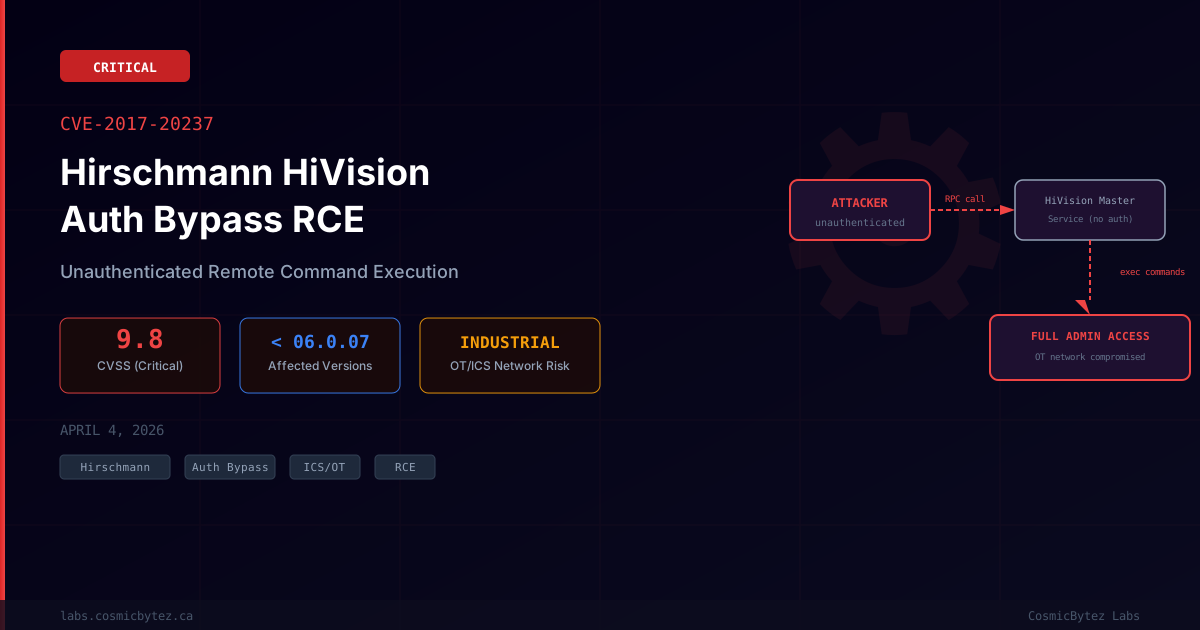
CVE-2017-20237: Hirschmann HiVision Authentication Bypass Enables Unauthenticated RCE
A critical vulnerability tracked as CVE-2017-20237 (CVSS 9.8) has been disclosed in Hirschmann Industrial HiVision, a widely deployed network management platform for industrial Ethernet environments. The flaw exists in the application's master service, which exposes interface methods over its internal RPC mechanism without requiring any form of authentication.
Successful exploitation allows an unauthenticated remote attacker to invoke privileged service methods, effectively gaining full administrative command execution over the HiVision management server — and by extension, the industrial network it manages.
Vulnerability Overview
| Attribute | Value |
|---|---|
| CVE ID | CVE-2017-20237 |
| CVSS Score | 9.8 (Critical) |
| Affected Product | Hirschmann Industrial HiVision |
| Affected Versions | All versions prior to 06.0.07 and 07.0.03 |
| Fixed Versions | 06.0.07, 07.0.03 |
| Attack Vector | Network — no authentication required |
| CWE Classification | CWE-306 — Missing Authentication for Critical Function |
| In-the-Wild Exploitation | Not confirmed at time of publication |
Technical Background
Hirschmann HiVision is a network management system designed for industrial Ethernet infrastructure — commonly deployed in manufacturing, energy, transportation, and utility environments where operational technology (OT) and IT networks converge.
The vulnerability stems from the master service component, which handles privileged administrative operations. In affected versions, the service exposes its internal RPC interface methods to the network without enforcing any authentication layer. Any client that can reach the service port is treated as implicitly trusted.
An attacker able to communicate with the HiVision master service can:
- Enumerate exposed interface methods via the unauthenticated RPC endpoint
- Invoke administrative commands with no credential challenge
- Execute arbitrary OS-level commands with the privileges of the HiVision service account
- Pivot into connected OT/IT infrastructure using credentials and configuration data managed by HiVision
Attack Flow
1. Attacker scans for HiVision master service on accessible network segments

2. Attacker connects to the RPC interface without providing credentials

3. Attacker enumerates available service methods — authentication is not checked

4. Attacker invokes privileged administrative method (e.g., command execution,
   configuration change, credential dump)

5. HiVision master service executes the requested action with admin privileges

6. Attacker achieves full control of the network management platform

7. Attacker uses HiVision's visibility into the industrial network to pivot to
PLCs, switches, or other managed OT devicesScope and Impact in Industrial Environments
Hirschmann HiVision is broadly deployed in:
- Manufacturing facilities — managing industrial Ethernet backbones
- Power and utility networks — monitoring grid infrastructure
- Transportation infrastructure — rail and traffic network management
- Oil and gas operations — remote site connectivity
The severity of this vulnerability extends beyond a typical IT compromise. Full control of HiVision means:
| Impact Area | Description |
|---|---|
| Network Visibility | Attacker gains full topology map of the managed industrial network |
| Device Access | Managed switches, routers, and endpoints reachable through HiVision |
| Credential Theft | SNMP communities, device credentials stored in HiVision accessible |
| Configuration Tampering | Network segmentation policies can be altered or disabled |
| OT Disruption | Potential to cause controlled disruption of industrial processes |
| Lateral Movement | Springboard for attacks on PLCs and industrial controllers |
Remediation
Primary Fix: Upgrade HiVision
Belden (Hirschmann's parent company) has released patched versions that properly enforce authentication on the master service RPC interface.
- HiVision 06.x: Upgrade to 06.0.07 or later
- HiVision 07.x: Upgrade to 07.0.03 or later
Contact Belden/Hirschmann support to obtain the patched installer packages.
Interim Mitigations
If immediate patching is not possible:
- Network segmentation: Restrict access to the HiVision server port to only trusted management workstations using firewall rules or VLAN segmentation
- Host-based firewall: Enable Windows Firewall rules on the HiVision host to block external access to the master service port
- Air-gap management traffic: Ensure the management VLAN is not reachable from production OT segments or untrusted networks
- Monitor RPC access: Deploy network monitoring to detect unexpected connections to the HiVision server — alert on any connections from non-whitelisted hosts
Detection
Indicators of potential exploitation include:
- Unexpected outbound connections from the HiVision host to external IPs
- New administrative accounts created in HiVision without change requests
- Unexplained network configuration changes on managed devices
- RPC connections to the HiVision master service from unauthorized source IPs
- Unusual process execution spawned by the HiVision service accountReview Windows Event Logs on the HiVision server for unexpected process creation events under the HiVision service account. Network IDS signatures for the RPC protocol used by HiVision can help detect unauthenticated invocations.
Key Takeaways
- CVE-2017-20237 is a CVSS 9.8 Critical authentication bypass in Hirschmann HiVision's master service RPC interface
- No credentials required — any network-reachable attacker can execute arbitrary commands with admin privileges
- ICS/OT risk is severe — HiVision manages industrial network infrastructure; compromise enables pivoting to PLCs, switches, and operational technology
- Patches available: Upgrade to HiVision 06.0.07+ (06.x branch) or 07.0.03+ (07.x branch)
- Isolate immediately: Network segmentation should be applied as an emergency control if patching is delayed
Sources
- CVE-2017-20237 — NIST NVD
- Belden / Hirschmann Product Security
- ICS-CERT Industrial Control System Advisories