Executive Summary
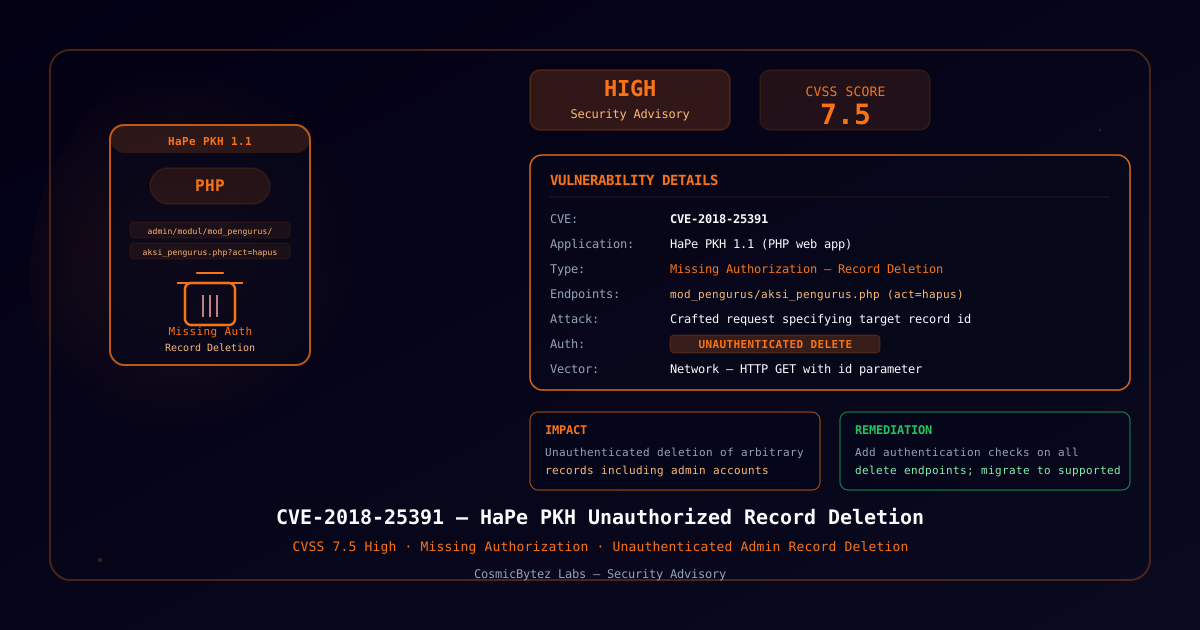
CVE-2018-25391 is a high-severity missing authorization vulnerability (CVSS 7.5) in HaPe PKH 1.1, a PHP-based web application. The application's administrative record deletion endpoints — specifically within the mod_pengurus module — perform no authentication or authorization checks before deleting records from the database. An unauthenticated attacker can delete any record by crafting a simple HTTP request containing the target record's integer ID.
While this CVE was originally identified in a legacy PHP application from 2018, it has been formally published to NVD in 2026, reflecting the ongoing backlog of historical vulnerability disclosures reaching public databases. The underlying weakness — missing authorization on destructive operations — remains a frequently exploited class of vulnerability in web applications of all ages and frameworks.
Vulnerability Details
| Field | Details |
|---|---|
| CVE | CVE-2018-25391 |
| CVSS Score | 7.5 (High) |
| Type | Missing Authorization (CWE-862) |
| Application | HaPe PKH 1.1 (PHP web application) |
| Module | mod_pengurus administrative module |
| Authentication | Not required |
| Attack Vector | Network |
| Impact | Unauthenticated deletion of arbitrary database records |
Technical Analysis
Affected Endpoints
The vulnerability affects the following administrative deletion endpoints:
| Endpoint | Parameter | Function |
|---|---|---|
admin/modul/mod_pengurus/aksi_pengurus.php | module=pengurus&act=hapus&id={id} | Delete administrator/user record |
Both endpoints accept a record identifier via the id parameter and delete the corresponding database record without verifying that the requesting user is authenticated or authorized to perform the operation.
Root Cause
The PHP source code for the deletion handlers lacks any session validation, authentication token verification, or role-based access control check. The flow is:
HTTP Request → aksi_pengurus.php?act=hapus&id=1
  ↓
No authentication check
  ↓
SQL DELETE FROM pengurus WHERE id = 1
  ↓
Record permanently deleted
Because record IDs are typically sequential integers, an attacker can enumerate and delete all records in the targeted table without any prior knowledge of the application's data.
Impact Assessment
The lack of authentication on deletion operations enables:
- Administrator account deletion — Locking legitimate administrators out of the application
- Mass record deletion — Scripted sequential deletion of all records in affected tables
- Data integrity destruction — Permanent loss of application data without backup recovery
- Privilege escalation setup — In some implementations, deleting all admin accounts may enable creation of a new admin account with no existing competition
Context: Legacy PHP Applications
HaPe PKH is representative of a large class of PHP web applications developed in the 2010s that were built without a security-first mindset and lack modern security controls. Many such applications remain deployed on production servers, often managing sensitive administrative or institutional data.
The publication of this CVE in 2026, eight years after the original vulnerability was present, reflects the NVD's ongoing backlog of historical disclosures. For organizations still running legacy PHP applications of this generation, this advisory is a reminder to audit deletion endpoints and administrative controllers for missing authorization checks.
Common patterns in this vulnerability class include:
- PHP files that directly process
$_GETor$_POSTparameters without session validation - Admin modules with no middleware or authentication decorator pattern
- Database operations triggered directly by query parameters without nonce or CSRF verification
Remediation
For HaPe PKH 1.1 Deployments
- Decommission if possible — HaPe PKH 1.1 is legacy software with no known active maintenance. If it can be replaced with a supported application, that is the recommended path.
- Apply access controls at the web server level — Restrict access to
admin/modul/paths to known trusted IPs using.htaccessor nginx/Apache configuration:
# Restrict admin module access by IP
<Location "/admin/modul/">
    Require ip 192.168.1.0/24
    Require ip 10.0.0.0/8
</Location>- Add session validation to all deletion handlers if the application must remain in service:
// Add to top of aksi_pengurus.php
session_start();
if (!isset($_SESSION['admin_logged_in']) || !$_SESSION['admin_logged_in']) {
    http_response_code(403);
    exit('Access denied');
}For General PHP Applications
This vulnerability class is preventable through:
- Centralized authentication middleware that enforces session validation before any administrative handler executes
- Audit of all deletion, update, and create endpoints for missing authorization checks
- CSRF token validation for all state-changing operations
- Web application firewall (WAF) rules that block access to admin paths from unauthenticated sessions
Detection
To identify instances of vulnerable HaPe PKH deployments:
# Check for the mod_pengurus module
find . -name "aksi_pengurus.php" -path "*/mod_pengurus/*"

# Test for unauthenticated deletion (safe, non-destructive: use a non-existent ID)
curl -I "http://target/admin/modul/mod_pengurus/aksi_pengurus.php?module=pengurus&act=hapus&id=999999"
# If response is 200 rather than 401/403, the endpoint lacks authentication