Overview
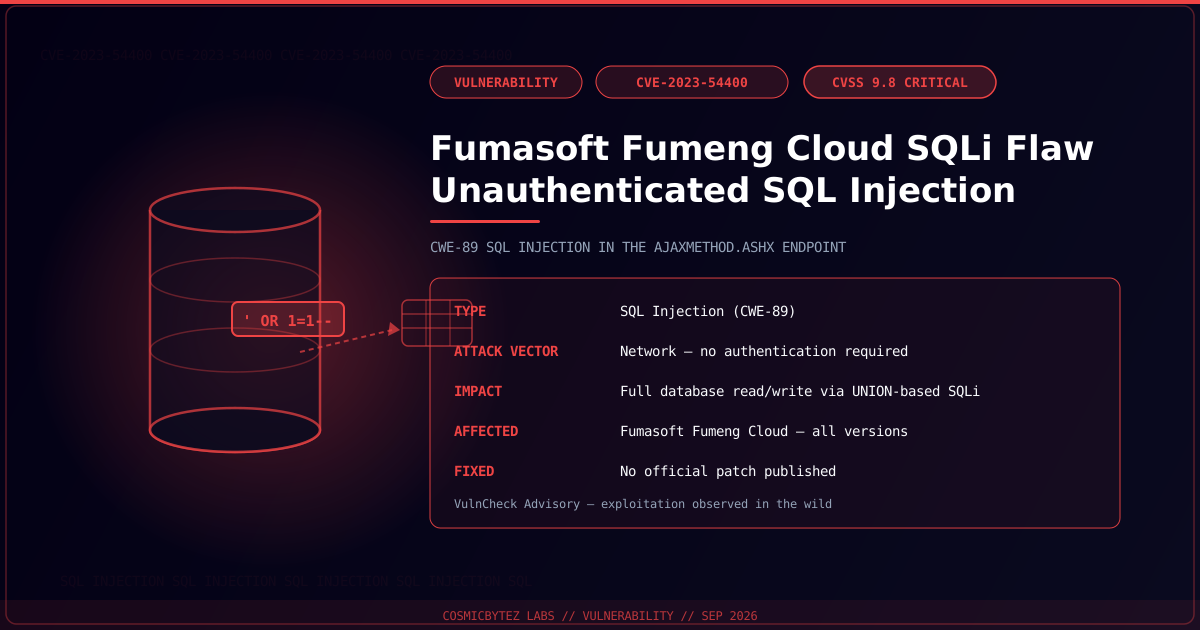
CVE-2023-54400 is a critical, unauthenticated SQL injection vulnerability in Fumasoft Fumeng Cloud that allows a remote attacker, with no credentials whatsoever, to inject arbitrary SQL through the platform's AjaxMethod.ashx endpoint. According to the NVD record, the flaw sits in the getEmpByname action, where the Name parameter is passed into a backend SQL Server query without proper sanitization — opening the door to classic UNION-based SQL injection techniques against the underlying Microsoft SQL Server database.
The vulnerability carries a CVSS 3.1 score of 9.8 (Critical), with the vector CVSS:3.1/AV:N/AC:L/PR:N/UI:N/S:U/C:H/I:H/A:H — a network-reachable attack requiring low complexity, no privileges, and no user interaction, with high impact to confidentiality, integrity, and availability. A parallel CVSS 4.0 score of 9.3 (Critical) (CVSS:4.0/AV:N/AC:L/AT:N/PR:N/UI:N/VC:H/VI:H/VA:H/SC:N/SI:N/SA:N) was also published, consistent across the aggregator sources that carry this record. The CWE classification is CWE-89 — Improper Neutralization of Special Elements used in an SQL Command.
The record was assigned by VulnCheck and shows a reserved, published, and updated date of September 29, 2026 in the CVE metadata. Notably, several tracking sources report that exploitation evidence was independently observed years earlier — on October 18, 2023 — by the Shadowserver Foundation, meaning this appears to be a case of a long-known, actively-probed flaw only receiving a formal CVE identifier and public write-up recently. Organizations should not assume "newly published" means "newly dangerous" — this bug may have been exploitable, and exploited, in the wild for some time before this advisory existed.
Public commentary on Fumasoft Fumeng Cloud itself is limited — it does not appear to have the broad vendor documentation or media coverage that larger enterprise platforms receive. What is confirmed across independent sources (VulnCheck's own advisory, plus third-party CVE trackers mirroring it) is the vulnerable endpoint, the injectable parameter, the unauthenticated attack path, and the CVSS 9.8 severity. HPE-style patch-version specifics — i.e., a precise "fixed in version X" statement from the vendor — were not published upstream; every source reviewed for this advisory lists the affected scope simply as "all versions," with no confirmed fixed release.
Technical Details
| Attribute | Value |
|---|---|
| CVE ID | CVE-2023-54400 |
| Severity | Critical |
| CVSS 3.1 Score | 9.8 (CVSS:3.1/AV:N/AC:L/PR:N/UI:N/S:U/C:H/I:H/A:H) |
| CVSS 4.0 Score | 9.3 (CVSS:4.0/AV:N/AC:L/AT:N/PR:N/UI:N/VC:H/VI:H/VA:H/SC:N/SI:N/SA:N) |
| CWE | CWE-89 — Improper Neutralization of Special Elements used in an SQL Command (SQL Injection) |
| Vulnerable Component | AjaxMethod.ashx, getEmpByname action |
| Injectable Parameter | Name |
| Backend | Microsoft SQL Server |
| Authentication Required | None |
| User Interaction Required | None |
| Assigner | VulnCheck |
| Published / Updated | September 29, 2026 (per NVD/CVE record) |
| First Observed Exploitation | October 18, 2023, per the Shadowserver Foundation |
| CISA KEV Status | Not listed on CISA's Known Exploited Vulnerabilities catalog as of this writing; reported as tracked in VulnCheck's own (separate) KEV data |
How It Works
The vulnerable request
Public proof-of-concept material — including a Goby scanner module and a Nuclei detection template (fumasoft-sqli.yaml) — targets a simple GET request pattern against the vulnerable endpoint, roughly of the form /Ajax/AjaxMethod.ashx?action=getEmpByname&Name= followed by an injected payload. Detection tooling reportedly confirms the flaw by appending a single quote to the Name value and checking for a resulting server error, a textbook signal that user input is being concatenated directly into a SQL statement rather than passed through a parameterized query.
From detection to extraction
Once the injection point is confirmed, an attacker can escalate from an error-based probe to a UNION-based SQL injection, appending crafted UNION SELECT statements to the vulnerable query to pull arbitrary data out of the Microsoft SQL Server backend — table names, column contents, credentials, or any other data the application's database account can read. Because the endpoint requires no authentication, this entire chain is available to any unauthenticated remote attacker who can reach the service over the network.
Why the "getEmpByname" naming matters
The action name getEmpByname — read as "get employee by name" — suggests Fumeng Cloud functions as some form of employee or HR-facing management platform, though CosmicBytez Labs was not able to confirm Fumasoft's own product description from independent vendor documentation. If that inference is correct, a successful attack could expose employee records, internal directory data, or other HR-adjacent information in addition to whatever else lives in the same database instance — which, depending on deployment, could include unrelated business data if the application shares a database server with other systems.
Beyond data theft
SQL injection with high confidentiality, integrity, and availability impact (as reflected in the CVSS vector) typically means an attacker isn't limited to reading data. Depending on the database account's privileges, UNION-based SQLi against Microsoft SQL Server can potentially be leveraged for data modification, and in permissive configurations, techniques like xp_cmdshell abuse have historically enabled attackers to pivot from SQL injection to command execution on the underlying host. CosmicBytez Labs has not seen confirmation that this specific flaw has been chained to remote code execution, so administrators should treat that as a plausible worst case to defend against, not a confirmed outcome.
Impact Assessment
| Impact Area | Description |
|---|---|
| Confidentiality | Rated High — UNION-based SQLi can extract the full contents of any table the application's database account can read |
| Integrity | Rated High — the same injection path can be used to modify or delete data, depending on backend permissions |
| Availability | Rated High — malformed or resource-intensive injected queries can degrade or crash the backend database |
| Authentication Barrier | None — the endpoint is reachable and exploitable by any unauthenticated remote attacker |
| Exploitation Maturity | Public PoC tooling exists (Goby module, Nuclei template), and exploitation was reportedly observed in the wild years before formal disclosure |
| Blast Radius | Scoped to whatever data and privileges the Fumeng Cloud application's SQL Server account has access to — potentially broader if the database is shared with other applications |
Recommendations
For Fumasoft Fumeng Cloud administrators
- Identify all Fumeng Cloud deployments in your environment and treat every instance as vulnerable — the affected scope is reported as all versions, with no confirmed patched release.
- Restrict network exposure of the
AjaxMethod.ashxendpoint immediately — place the application behind a VPN, internal-only network segment, or an authenticating reverse proxy rather than exposing it directly to the internet. - Deploy a WAF or reverse-proxy rule blocking requests to
action=getEmpByname(and ideally allAjaxMethod.ashxactions) that contain SQL metacharacters orUNION/SELECTkeywords in parameter values, as a stopgap while a permanent fix is pursued. - Contact Fumasoft directly to request patch guidance or a fixed build, since no vendor advisory with version-specific remediation was located as part of this research.
- Audit the SQL Server account used by the Fumeng Cloud application and apply least-privilege — remove any unnecessary write, DDL, or extended-procedure permissions that could widen the impact of a successful injection.
For security teams
- Scan for exposed Fumeng Cloud instances on your network and treat any internet-facing instance as an urgent priority.
- Monitor database and web logs for requests to
AjaxMethod.ashxcontaining SQL syntax, single quotes, orUNION SELECTpatterns in theNameparameter or other action parameters. - Assume prior compromise is possible — because exploitation evidence reportedly predates this CVE's publication by roughly three years, review historical logs and database audit trails for signs of earlier SQL injection activity against this system, not just activity since the September 2026 disclosure.
- Add detection coverage using the public Nuclei template or equivalent signatures to confirm whether internal instances are vulnerable before an attacker does.
For general IT hygiene
- Never expose internal line-of-business applications directly to the internet without a compensating control such as a VPN, SSO/forward-auth proxy, or IP allowlisting.
- Inventory third-party and niche vendor software the same way you inventory major platforms — smaller vendors like Fumasoft often receive less security scrutiny and slower patch cycles.
- Apply defense in depth — a web application firewall, network segmentation, and least-privilege database accounts each reduce the impact of an SQL injection flaw even before a code-level fix is available.
Key Takeaways
- CVE-2023-54400 is a CVSS 9.8 (Critical) unauthenticated SQL injection flaw (CWE-89) in Fumasoft Fumeng Cloud's
AjaxMethod.ashxendpoint, via theNameparameter of thegetEmpBynameaction. - The flaw requires no authentication and no user interaction, and enables UNION-based SQL injection against a Microsoft SQL Server backend.
- Affected scope is reported as all versions of Fumeng Cloud, with no official patched version published upstream as of this writing.
- Exploitation evidence was reportedly observed by the Shadowserver Foundation on October 18, 2023 — years before the CVE record itself was published on September 29, 2026 — suggesting this flaw may have been actively probed or exploited well before formal disclosure.
- Public proof-of-concept tooling (a Goby scanner module and a Nuclei detection template) already exists, lowering the bar for opportunistic exploitation.
- Because no vendor patch is confirmed, network-level mitigation — restricting exposure, WAF rules, and least-privilege database accounts — is the primary defense available to administrators today.
Sources
- NVD — CVE-2023-54400
- VulnCheck Advisory — Fumeng Cloud SQL Injection via AjaxMethod.ashx (getEmpByname)
- Goby PoC — fumengyun AjaxMethod.ashx SQL injection
- Nuclei Templates — fumasoft-sqli.yaml
CosmicBytez Labs will update this advisory if Fumasoft publishes a patched version or if additional technical detail becomes available.