Executive Summary
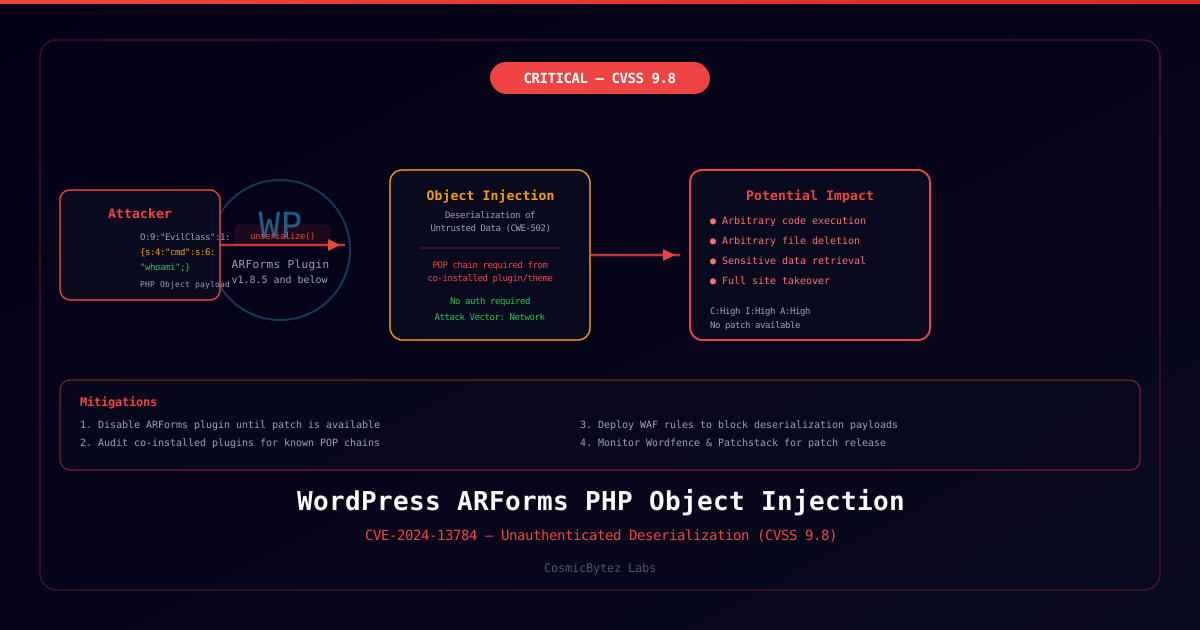
A critical unauthenticated PHP object injection vulnerability has been disclosed in the ARForms – Contact Form, Survey, Quiz & Popup Form Builder WordPress plugin by ReputeInfoSystems. Tracked as CVE-2024-13784 (CVSS 9.8), the flaw allows any remote attacker without authentication to inject arbitrary PHP objects through the plugin's deserialization of untrusted form input. Successful exploitation — depending on the presence of a Property-Oriented Programming (POP) chain from a co-installed plugin or theme — can lead to arbitrary code execution, file deletion, or sensitive data disclosure.
Vulnerability Details
| Field | Value |
|---|---|
| CVE ID | CVE-2024-13784 |
| CVSS v3.1 Score | 9.8 (Critical) |
| Vector | AV:N/AC:L/PR:N/UI:N/S:U/C:H/I:H/A:H |
| CWE | CWE-502 — Deserialization of Untrusted Data |
| Affected Versions | ARForms ≤ 1.8.5 |
| Published | August 16, 2026 |
| Assigner | Wordfence |
| Patch Available | No |
Technical Analysis
The vulnerability resides in ARForms' handling of submitted form data. The plugin passes user-supplied input directly to PHP's unserialize() function without adequate sanitization or validation. An attacker can craft a malicious serialized PHP object payload embedded in a form submission and send it to any site running the vulnerable plugin.
Exploitation Requirements
Exploitation requires a POP (Property-Oriented Programming) chain to be present in the WordPress environment — typically through another installed plugin or theme. The ARForms plugin itself does not ship a usable POP chain. However, given the vast WordPress plugin ecosystem, many sites will have co-installed components that introduce exploitable chains. When a suitable chain exists, an attacker can leverage object injection to:
- Execute arbitrary PHP code on the server
- Delete arbitrary files, potentially destroying the WordPress installation
- Retrieve sensitive data including credentials, API keys, and private content
Attack Vector
The attack is fully network-accessible with:
- No authentication required
- No prior knowledge of the site
- No user interaction needed
- Low attack complexity
This places the vulnerability among the most dangerous classes of WordPress plugin flaws.
Affected Software
| Component | Affected Versions |
|---|---|
| ARForms – Contact Form, Survey, Quiz & Popup Form Builder | All versions ≤ 1.8.5 |
Mitigation
No official patch has been released as of this advisory. Administrators running ARForms should take immediate defensive action:
- Disable the ARForms plugin temporarily if it is not business-critical, until a patched version is released.
- Audit co-installed plugins and themes for known POP chains — tools like Wordfence and Patchstack can assist with this.
- Deploy a Web Application Firewall (WAF) configured to block PHP serialization payloads (
O:<length>:"ClassName"patterns) at the HTTP layer. - Monitor vendor advisory channels — watch the ARForms plugin page on WordPress.org, Wordfence, and Patchstack for an updated release.
- Limit form submission exposure — ensure the plugin's form endpoints are not exposed to unauthenticated traffic if possible.
Detection
Look for suspicious POST requests containing PHP serialized object patterns in web server logs. Indicators include:
- Request bodies containing
O:<number>:patterns characteristic of PHP object serialization - Unusual POST payloads targeting ARForms endpoints
- Unexpected file creation or deletion events following form submissions