Executive Summary
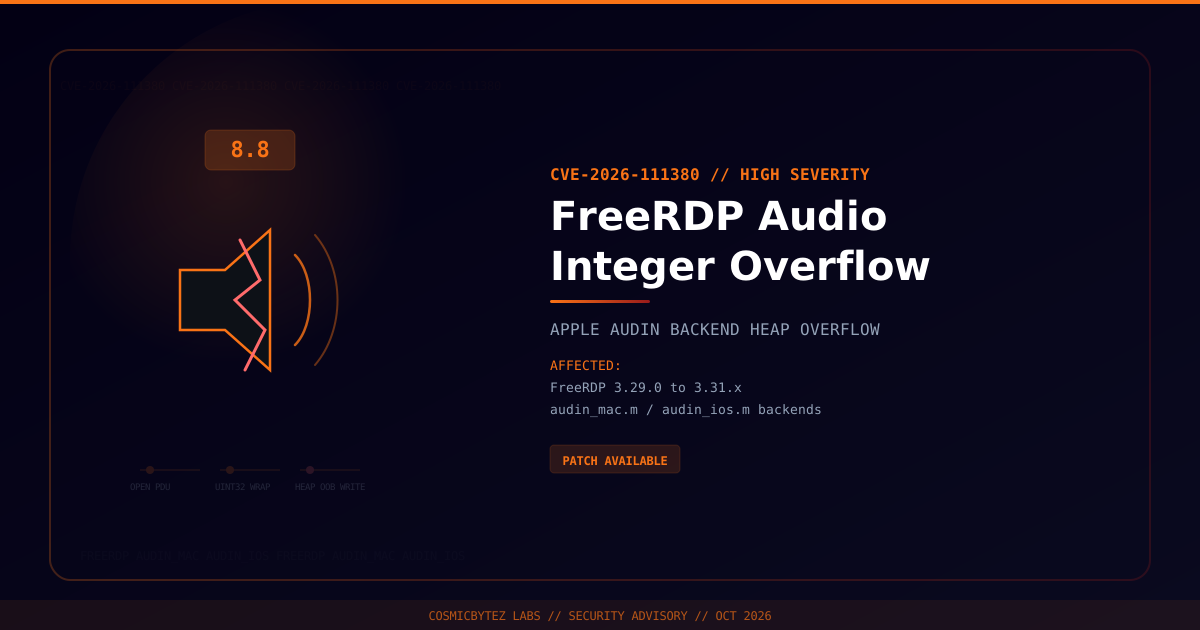
A newly disclosed FreeRDP vulnerability, CVE-2026-111380, re-opens a bug that an earlier patch was supposed to have closed. The flaw lives in the Apple audio input (audin) backends — audin_mac.m for macOS and audin_ios.m for iOS clients — and allows a malicious RDP server to trigger a heap-based out-of-bounds write on a connecting client, with no authentication required.
CVSS Score: 8.8 (High)
The project has fixed the issue in FreeRDP 3.32.0. There is no indication of in-the-wild exploitation yet, but the bug is remotely triggerable and the fix it bypasses (CVE-2026-91962) was only months old, making this a priority patch for any macOS or iOS environment running FreeRDP-based RDP clients.
Vulnerability Overview
Root Cause
FreeRDP's Apple audio input backends compute the size of an audio queue buffer using the formula FramesPerPacket * 2 * nChannels, performed entirely in 32-bit unsigned integer (UINT32) arithmetic. A remote RDP server controls the FramesPerPacket value via the audio redirection channel's Open PDU.
By sending a crafted FramesPerPacket value close to 2³⁰, the multiplication overflows and wraps around to a small number. FreeRDP then allocates an audio buffer sized according to that wrapped (undersized) value via AudioQueueAllocateBuffer, while the client continues writing audio data sized to the attacker-controlled, pre-overflow value — producing a heap out-of-bounds write once playback begins.
A Fix That Didn't Fully Fix It
This is the second time this exact code path has needed patching:
| CVE | Status | Description |
|---|---|---|
| CVE-2026-91962 | Fixed in FreeRDP 3.31.0 | Original integer overflow in MSG_SNDIN_OPEN handling for the Apple audin backends (CWE-131, CVSS 6.3) |
| CVE-2026-111380 | Fixed in FreeRDP 3.32.0 | A second overflow in the same audin_mac.m / audin_ios.m buffer-size calculation, which bypasses the CVE-2026-91962 fix (CWE-190, CVSS 8.8) |
The earlier fix addressed one arithmetic path but left the FramesPerPacket * 2 * nChannels computation exploitable through a different input combination — a reminder that integer-overflow patches need to validate every operand in a multiplication chain, not just the one that triggered the original report.
Details
| Attribute | Value |
|---|---|
| CVE ID | CVE-2026-111380 |
| CVSS Score | 8.8 (High) |
| CWE | CWE-190 (Integer Overflow or Wraparound) |
| Affected Component | Apple audin backends: audin_mac.m (macOS), audin_ios.m (iOS) |
| Affected Versions | FreeRDP 3.29.0 up to (not including) 3.32.0 |
| Fixed Version | FreeRDP 3.32.0 |
| Attack Vector | Network — malicious/compromised RDP server targeting a connecting client |
| Authentication Required | None |
| Impact | Heap-based out-of-bounds write; memory corruption, crash (DoS), potential remote code execution |
| Related Advisory | GitHub Security Advisory GHSA-72qv-gcph-rfwf |
| Bypasses | CVE-2026-91962 (fixed in 3.31.0) |
How the Attack Works
- A victim connects to an RDP server using a FreeRDP-based client built with the Apple audio input backend enabled (macOS or iOS).
- The server sends an audio redirection Open PDU with a
FramesPerPacketvalue set to roughly 2³⁰. - FreeRDP computes the required buffer size as
FramesPerPacket * 2 * nChannelsinUINT32arithmetic. The multiplication overflows and wraps to a small value. AudioQueueAllocateBufferallocates a buffer sized to the wrapped (small) value.- When subsequent audio data is written into the undersized buffer at the size the server originally implied, the write runs past the allocation — a classic heap out-of-bounds write.
Because the trigger is entirely server-controlled and requires no client-side interaction beyond an established RDP session, any organization that connects to third-party or untrusted RDP endpoints from a macOS or iOS FreeRDP client is exposed.
Who Is Affected
- FreeRDP client builds from 3.29.0 up to 3.31.x that include the Apple audin backend — this covers macOS and iOS FreeRDP-based clients, including downstream apps that embed the FreeRDP library for RDP connectivity.
- Builds that do not compile in the Apple audio backend, or environments where audio redirection is disabled, are not affected by this specific code path.
- Server-side FreeRDP deployments are not directly affected; the risk sits with clients connecting outward to a server that could be malicious or compromised.
Remediation
- Upgrade to FreeRDP 3.32.0 or later on any macOS or iOS client build. This is the only complete fix, since it closes the gap left by the CVE-2026-91962 patch.
- If an immediate upgrade isn't possible, disable audio redirection (the
audinchannel) for RDP sessions from affected clients as a temporary mitigation. - Audit any downstream application that statically links or vendors FreeRDP — the vulnerable code ships inside the library, so app-level version numbers won't tell you whether the fix is present.
- Restrict outbound RDP connections to known, trusted servers where feasible, since exploitation requires control of (or a foothold on) the RDP server side.
Key Takeaways
- CVE-2026-111380 is a second overflow in the same FreeRDP Apple audio buffer-size calculation that CVE-2026-91962 was supposed to have fixed back in version 3.31.0.
- Exploitation requires only a malicious RDP server sending a crafted
FramesPerPacketvalue — no user interaction, no authentication. - The impact is a heap out-of-bounds write, which the FreeRDP project and NVD rate as capable of memory corruption, denial of service, and likely remote code execution.
- FreeRDP 3.32.0 contains the complete fix; disabling audio redirection is a viable short-term mitigation for clients that cannot upgrade immediately.