Executive Summary
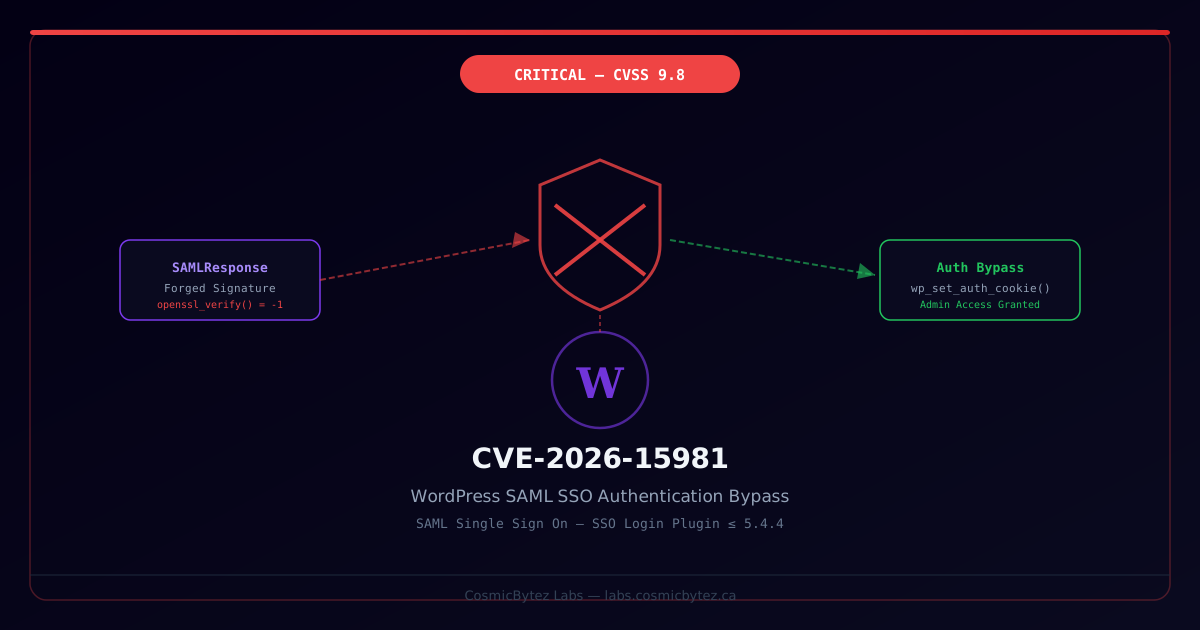
The SAML Single Sign On – SSO Login plugin for WordPress (versions up to and including 5.4.4) contains a critical authentication bypass vulnerability assigned CVE-2026-15981 with a CVSS score of 9.8 (Critical). An unauthenticated attacker can craft a malicious SAMLResponse containing a forged or malformed signature that causes the plugin to grant a fully authenticated WordPress session for any existing account — including site administrators — without knowing any credentials.
The root cause is a loose boolean coercion applied to the tri-state integer returned by PHP's openssl_verify() function inside mo_saml_validate_signature().
Vulnerability Details
Root Cause
PHP's openssl_verify() returns three possible values:
| Return Value | Meaning |
|---|---|
1 | Signature is valid |
0 | Signature is invalid |
-1 | An error occurred during verification |
The vulnerable code evaluates this return as a plain boolean. In PHP, -1 is truthy — so an OpenSSL processing error (such as a deliberately malformed signature or unsupported algorithm) causes the signature check to pass, as if the signature were legitimate.
Attack Chain
1. Attacker identifies WordPress site using SAML SSO – SSO Login plugin
2. Crafts a SAMLResponse with attacker-chosen NameID (any valid WP username/email)
3. Includes a signature designed to trigger an OpenSSL error state (returns -1)
4. Plugin evaluates openssl_verify() result as boolean — -1 is truthy
5. Signature validation passes despite the invalid signature
6. Plugin calls wp_set_auth_cookie() for the target account
7. Attacker is now authenticated as that user — including adminsRelated Vulnerability
A sibling flaw, CVE-2026-15013 (also CVSS 9.8, affecting versions ≤ 5.4.3), targets the Mo_SAML_Utilities::mo_saml_cast_key() function. That function reads the SignatureMethod Algorithm attribute directly from the attacker-controlled SAMLResponse rather than enforcing the locally configured algorithm. This enables an algorithm-confusion attack: the attacker recasts the IdP's RSA public key as an HMAC-SHA1 shared secret, then forges a valid-looking HMAC-SHA1 signature accepted by the plugin.
Together, these two CVEs represent a complete breakdown of the plugin's signature validation pipeline.
Affected Versions
| Version Range | Affected | CVE |
|---|---|---|
| ≤ 5.4.4 | Yes | CVE-2026-15981 |
| ≤ 5.4.3 | Yes | CVE-2026-15013 (sibling) |
| > 5.4.4 | No (patched) | — |
Immediate Remediation
1. Update the Plugin (Recommended)
Navigate to WordPress Admin → Plugins → Updates and update the SAML Single Sign On – SSO Login plugin to the latest version beyond 5.4.4. Alternatively, update via WP-CLI:
wp plugin update miniorange-saml-20-single-sign-on2. Temporary Mitigation
If patching is not immediately possible:
- Disable the plugin entirely until the update can be applied
- Restrict the WordPress login page and SAML assertion endpoint to trusted IP ranges at the web server or WAF level
- Monitor authentication logs for unexpected logins, particularly administrator accounts
3. Post-Patch Actions
After updating:
- Audit recent administrator logins for anomalous sessions
- Rotate any privileged WordPress account passwords
- Review and revoke any suspicious application passwords or API tokens created during the exposure window
Detection
Look for Unexpected Admin Sessions
# WordPress debug log or server access log
# Look for wp-login.php and xmlrpc.php hits with unexpected session origins
grep "wp-login.php" /var/log/nginx/access.log | grep -v "your-idp-ip"SIEM Query (Splunk)
index=web sourcetype=access_combined uri_path="/wp-login.php" OR uri_path="*saml*"
| stats count by src_ip, user_agent, status
| where status=302 AND count > 3WAF Rule (ModSecurity)
# Block SAMLResponse without valid Referer from known IdP
SecRule REQUEST_URI "@contains SAMLResponse" \
  "id:2026159801,phase:2,deny,status:403,\
  msg:'Potential SAML Authentication Bypass Attempt',\
  logdata:'%{TX.MATCHED_VAR}'"
References
- NIST NVD — CVE-2026-15981
- Wordfence Security Advisory
- WPScan Plugin Vulnerability Database
- CVE-2026-15013 — Sibling Algorithm Confusion Flaw