Executive Summary
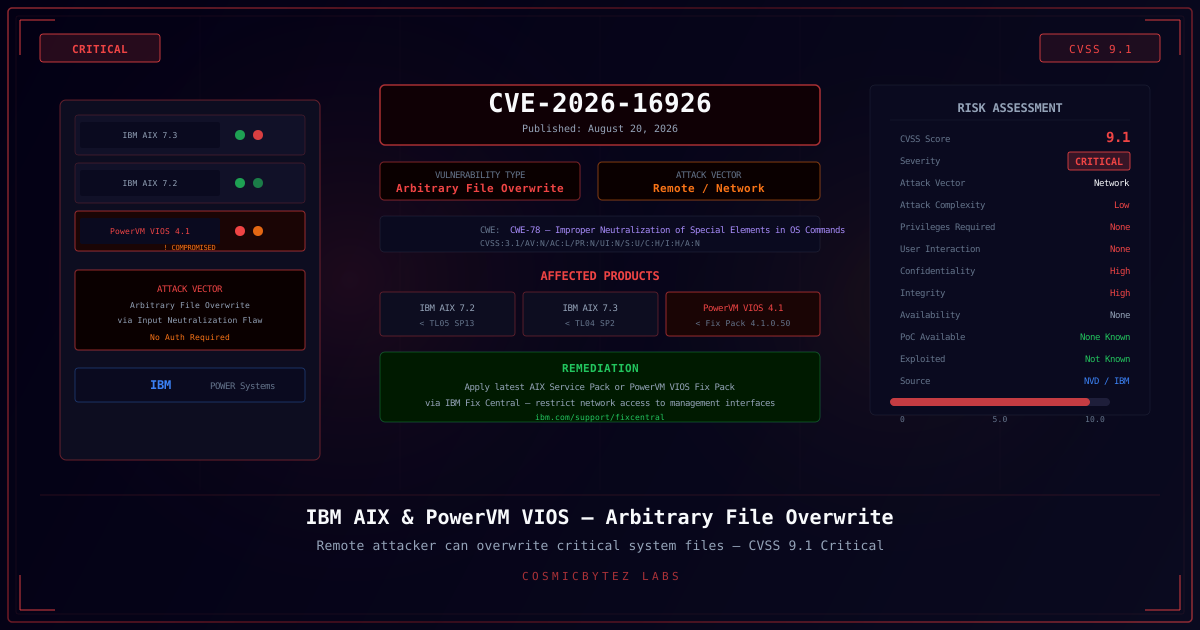
A critical security vulnerability tracked as CVE-2026-16926 has been disclosed affecting IBM AIX 7.2, AIX 7.3, and IBM PowerVM Virtual I/O Server (VIOS) 4.1. The flaw allows a remote, unauthenticated attacker to overwrite arbitrary files on the system due to improper neutralization of special elements in input processing. With a CVSS 3.1 base score of 9.1 (Critical), this vulnerability requires immediate attention from organizations running IBM Power Systems infrastructure.
The advisory was published on August 20, 2026 as part of a broader batch of IBM AIX and PowerVM VIOS disclosures. Patches are available via IBM Fix Central.
Vulnerability Details
| Field | Value |
|---|---|
| CVE ID | CVE-2026-16926 |
| CVSS Score | 9.1 (Critical) |
| Attack Vector | Network |
| Attack Complexity | Low |
| Privileges Required | None |
| User Interaction | None |
| Confidentiality Impact | High |
| Integrity Impact | High |
| Availability Impact | None |
| Published | August 20, 2026 |
Description
CVE-2026-16926 stems from improper neutralization of special elements in input (CWE-78). An unauthenticated remote attacker can exploit this flaw to overwrite critical system resources on affected IBM AIX and PowerVM VIOS installations. The combination of network accessibility, no authentication requirement, and high integrity impact makes this a severe risk for any exposed system.
The vulnerability is part of a larger wave of IBM AIX/PowerVM VIOS CVEs published in August 2026. While no public proof-of-concept or active exploitation has been confirmed at time of publication, the low attack complexity and no-authentication requirement significantly lower the bar for exploitation.
Affected Products
The following versions are confirmed vulnerable:
IBM AIX
- AIX 7.2 — versions prior to Technology Level 05 Service Pack 13
- AIX 7.3 — versions prior to TL04 SP2, TL03 SP3, or TL02 SP5
IBM PowerVM Virtual I/O Server (VIOS)
- VIOS 4.1 — versions prior to Fix Pack 4.1.0.50, 4.1.1.30, or 4.1.2.20
Remediation
Immediate Actions
-
Apply patches via IBM Fix Central — IBM has released Service Packs and Fix Packs addressing this vulnerability for all affected product lines. Access patches at ibm.com/support/fixcentral.
-
Restrict network access — As a temporary mitigation prior to patching, restrict network access to IBM AIX and PowerVM VIOS management interfaces using firewall ACLs. Limit exposure to trusted management networks only.
-
Monitor IBM Security Bulletins — The NVD record is currently unreviewed (published August 20, 2026). Monitor the IBM Security Bulletins portal and the PowerVM VIOS Security Vulnerabilities page for updated APAR IDs and additional guidance.
-
Inventory exposed systems — Identify all AIX and VIOS instances with management interfaces reachable from untrusted networks and prioritize patching accordingly.
Patch Verification
After applying fixes, verify the installed Service Pack or Fix Pack level matches or exceeds the minimum versions listed in the Affected Products section above.
Context
This CVE is one of several critical and high-severity issues disclosed in the August 2026 IBM AIX/PowerVM VIOS batch, including stack buffer overflow vulnerabilities (CVE-2026-16885, CVE-2026-16894, CVE-2026-16872) rated at CVSS 9.8. Organizations running IBM Power Systems should treat this batch as a coordinated remediation effort and apply all applicable fixes.
IBM Power Systems are widely deployed in enterprise, financial, and government environments. The VIOS component specifically underpins virtual machine I/O operations on PowerVM hypervisors, making any compromise potentially impactful across multiple hosted workloads.