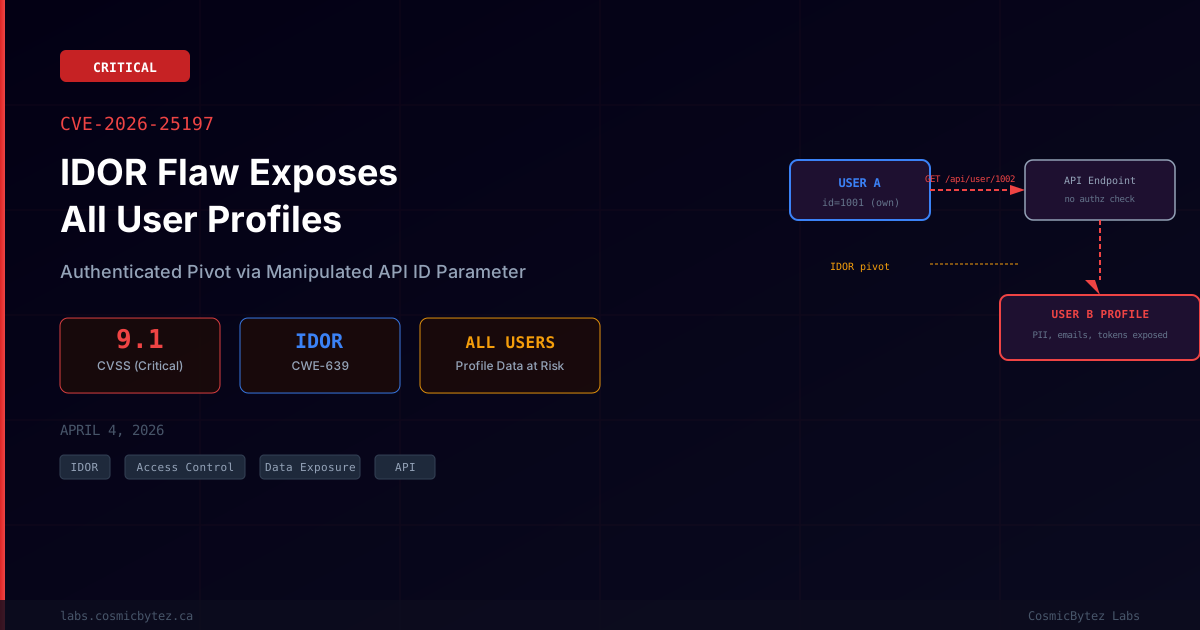
CVE-2026-25197: IDOR Vulnerability Enables Cross-User Profile Access
A critical insecure direct object reference (IDOR) vulnerability tracked as CVE-2026-25197 (CVSS 9.1) has been published to the NIST National Vulnerability Database. The flaw exists in an API endpoint that allows authenticated users to access any other user's profile by simply modifying the numeric id parameter in the API call — without any authorization check being performed by the server.
This class of vulnerability represents one of the most common and impactful API security failures, enabling lateral access to sensitive personal data across an entire user base with minimal attacker effort.
Vulnerability Overview
| Attribute | Value |
|---|---|
| CVE ID | CVE-2026-25197 |
| CVSS Score | 9.1 (Critical) |
| CWE Classification | CWE-639 — Authorization Bypass Through User-Controlled Key |
| Attack Type | Insecure Direct Object Reference (IDOR) |
| Attack Vector | Network — requires valid authentication (low privilege) |
| Privileges Required | Low (any authenticated user) |
| Data at Risk | All registered user profiles |
| Patch Status | To be confirmed |
Technical Background
The vulnerability exists in an API endpoint responsible for retrieving user profile data. The endpoint accepts a numeric user id as part of the API request but fails to verify that the requesting user is authorized to access the requested profile.
This means:
- Any authenticated user (even with the lowest privilege level) can send a request for any other user's profile
- By incrementing or enumerating the id parameter, an attacker can iterate through all registered user accounts
- No special privileges, admin access, or exploitation of additional vulnerabilities is required beyond having a valid session
The root cause is a failure to implement object-level authorization — a check that verifies the identity of the requester matches the resource being accessed before returning data.
Attack Flow
1. Attacker registers for (or otherwise obtains) a legitimate account on the platform

2. Attacker issues an authenticated API request for their own profile:
   GET /api/v1/user?id=1001   → returns attacker's own profile (expected behavior)

3. Attacker modifies the id parameter:
   GET /api/v1/user?id=1002   → returns another user's profile (unauthorized)

4. Attacker iterates through id values:
   GET /api/v1/user?id=1003
   GET /api/v1/user?id=1004
   ...

5. Attacker harvests all user profiles: names, email addresses, contact info,
   account details, and potentially authentication tokens or API keys

6. Harvested data is used for phishing, credential stuffing, identity theft,
or sold on underground marketplacesImpact Assessment
| Impact Area | Description |
|---|---|
| Full User Enumeration | Attacker can retrieve every registered user's profile |
| PII Exposure | Names, email addresses, phone numbers, addresses at risk |
| Account Takeover Risk | If profiles include session tokens or API keys, direct account takeover possible |
| Compliance Violation | Breach of GDPR, CCPA, and similar data protection regulations |
| Targeted Attacks | Harvested data enables highly targeted spear-phishing campaigns |
| Exploitation Barrier | Very low — only requires a valid account and HTTP requests |
What is an IDOR Vulnerability?
Insecure Direct Object Reference (IDOR) is a class of broken access control vulnerability in which an application uses user-supplied input to access objects (database records, files, API resources) without first verifying that the user is authorized to access the requested object.
IDOR vulnerabilities consistently rank in the OWASP API Security Top 10 (API3:2023 — Broken Object Level Authorization) and are responsible for some of the largest data breaches in recent years. They are typically:
- Easy to discover — often found during normal platform usage or basic API testing
- Easy to exploit — no special tools required beyond a web browser or curl
- Difficult to detect — legitimate and malicious requests look identical in server logs
- High impact — can expose entire user databases with minimal effort
Remediation
For Affected Application Owners
- Implement object-level authorization on every API endpoint: Before returning any resource, verify that the requesting user's session identity matches the resource owner
- Use indirect references: Replace numeric sequential IDs with UUIDs or opaque tokens that cannot be easily enumerated
- Server-side enforcement only: Never rely on the client to pass only its own ID — always re-validate ownership on the server
- Audit all data-returning endpoints: Review every API endpoint that returns user data for missing authorization checks
# Example: Correct authorization check (pseudocode)
def get_user_profile(request, user_id):
    # Verify the requesting user owns this resource
    if request.user.id != user_id and not request.user.is_admin:
        raise PermissionDenied("Access denied")
return UserProfile.objects.get(id=user_id)For Users of Affected Platforms
- Change passwords if the affected platform is identified
- Monitor for unexpected account activity or login attempts
- Be vigilant for phishing emails targeting your registered email address
- Review privacy settings and minimize personal data stored on the platform
Detection
IDOR exploitation is difficult to distinguish from legitimate traffic, but indicators include:
# Look for sequential ID enumeration patterns in API access logs
grep "GET /api.*user.*id=" access.log | \
  awk '{print $1, $7}' | sort | uniq -c | sort -rn | head -50

# Flag users making many profile requests in rapid succession
# Flag requests where the user's own ID differs from the requested resource IDImplementing rate limiting on profile endpoints and logging authorization decisions (including denied requests) will improve detection of enumeration attempts.
Key Takeaways
- CVE-2026-25197 is a CVSS 9.1 Critical IDOR vulnerability enabling any authenticated user to access any other user's profile
- Exploitation is trivial — changing a single numeric parameter in an API call is all that is required
- Full user base at risk — all registered account profiles are exposed to any attacker with a valid login
- Patch or mitigate immediately: Implement object-level authorization checks on the affected endpoint
- IDOR remains one of the most prevalent and impactful API security flaws — organizations should audit all API endpoints for similar patterns
Sources
- CVE-2026-25197 — NIST NVD
- OWASP API Security Top 10: API3:2023 — Broken Object Level Authorization
- CWE-639: Authorization Bypass Through User-Controlled Key