Executive Summary
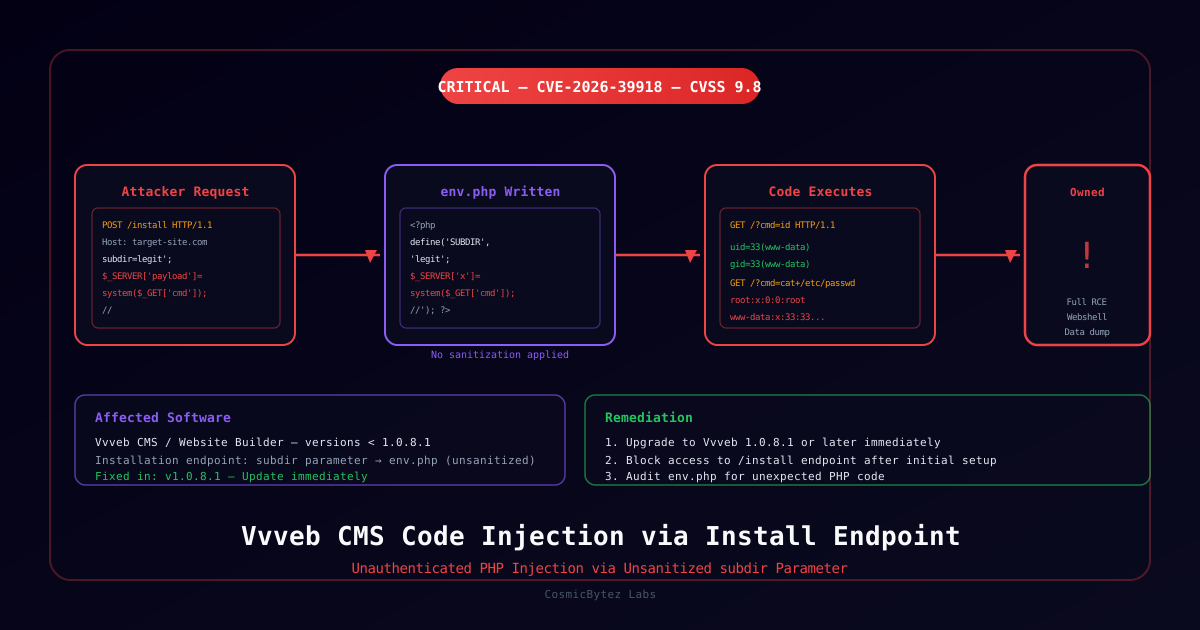
CVE-2026-39918 is a critical code injection vulnerability in Vvveb, an open-source PHP website builder and CMS. The installation endpoint accepts a subdir POST parameter that is written directly into the env.php configuration file without sanitization or validation. An unauthenticated attacker can exploit this to inject arbitrary PHP code, achieving remote code execution (RCE) on the underlying server.
CVSS Score: 9.8 (Critical) Fixed in: Vvveb v1.0.8.1
Vulnerability Overview
Root Cause
The Vvveb installation process writes configuration values supplied by the user directly into env.php. The subdir parameter is embedded inside a PHP string literal with no escaping or validation. Because the value is written verbatim into executable PHP code, an attacker who can break out of the string context can inject and execute arbitrary PHP statements.
The core issue follows a well-understood code injection pattern: user-supplied input is concatenated into executable code without sanitization. Once env.php is included by the application on subsequent requests, any injected PHP code executes in the context of the web server.
Attack Chain
1. Attacker identifies accessible Vvveb installation endpoint
2. Sends POST request with PHP payload injected into subdir parameter
3. Server writes payload unsanitized into env.php configuration file
4. Attacker triggers code execution via a follow-up HTTP request
5. Arbitrary OS commands execute as the web server process user
6. Full server compromise achieved — unauthenticatedExploitation Requirements
- Access to the Vvveb installation endpoint (
/installor equivalent) - No authentication required
- Works on any Vvveb version prior to 1.0.8.1
Technical Details
Affected Endpoint
The vulnerable endpoint handles initial site setup. Many deployments leave this endpoint accessible after installation, which is required for exploitation. Default Vvveb deployments may not restrict post-install access to this endpoint.
Impact of Successful Exploitation
| Capability | Detail |
|---|---|
| OS command execution | Arbitrary commands as web server user |
| File read/write | Full filesystem access |
| Webshell deployment | Persistent backdoor via additional file writes |
| Database access | Read DB credentials from config files |
| Lateral movement | Pivot to internal network from web server |
Affected Versions
| Version | Status |
|---|---|
| All versions prior to 1.0.8.1 | Vulnerable |
| v1.0.8.1 and later | Patched |
Remediation
Step 1: Upgrade Immediately
Update to Vvveb v1.0.8.1 which sanitizes the subdir parameter before writing to env.php.
# Via Git
git pull origin main
git checkout v1.0.8.1

# Verify env.php after upgrade — check for unexpected PHP code
grep -n "system\|passthru\|shell_exec\|base64_decode" env.phpStep 2: Block the Install Endpoint
Restrict access to the installation endpoint at the web server level after initial setup:
# Nginx — block install endpoint after setup
location ~ ^/install {
    deny all;
    return 403;
}# Apache .htaccess
<Location /install>
Require ip 192.168.1.0/24
Require all denied
</Location>Step 3: Audit env.php
Inspect your env.php for signs of prior exploitation:
# Look for injected code patterns (unexpected PHP functions)
grep -n "system\|passthru\|shell_exec\|base64_decode" env.php

# Compare file modification time against known-good deployment date
ls -la env.php

# Verify file hash
sha256sum env.phpDetection
Indicators of Exploitation
- Unexpected PHP functions in
env.phpbeyond expected configuration constants - POST requests to
/installfrom external IP addresses after the initial setup date - New PHP files created in the web root after deployment
- Web server process spawning unexpected child processes
Log Monitoring (Nginx/Apache)
# Look for POST requests to install endpoint from external IPs
grep 'POST /install' /var/log/nginx/access.log | grep -v "your-admin-ip"

# Look for unusual query parameters on recently accessed PHP files
grep '\?cmd=' /var/log/nginx/access.log
grep '\?c=' /var/log/nginx/access.logSIEM Query (Splunk)
index=web sourcetype=access_combined
| where match(uri_path, "install") AND http_method="POST"
| stats count by src_ip, dest_host, uri_path
| where count > 1