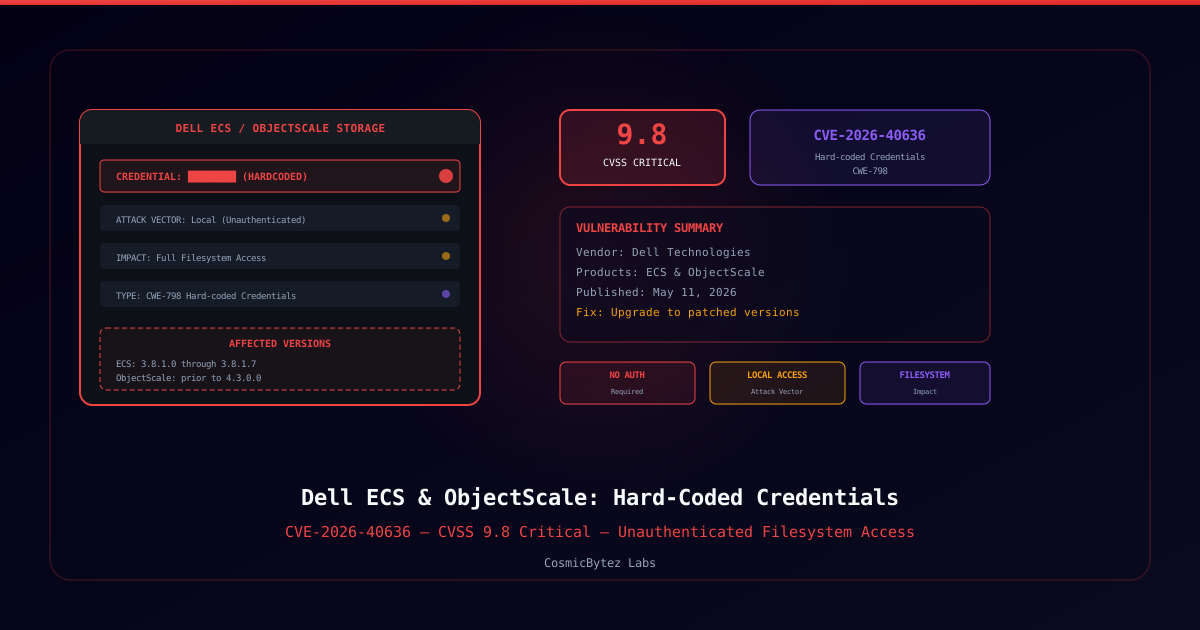
CVSS 9.8 Critical: Hard-Coded Credentials in Dell Enterprise Storage
Dell Technologies has disclosed a critical vulnerability in two of its enterprise storage products — Dell ECS (Elastic Cloud Storage) and Dell ObjectScale — that exposes systems to unauthenticated local filesystem access via hard-coded credentials embedded in the software.
The flaw, tracked as CVE-2026-40636, carries a CVSS score of 9.8 (Critical) and is classified under CWE-798 (Use of Hard-coded Credentials).
Vulnerability Details
| Attribute | Value |
|---|---|
| CVE | CVE-2026-40636 |
| CVSS Score | 9.8 (Critical) |
| CWE | CWE-798 — Use of Hard-coded Credentials |
| Attack Vector | Local |
| Privileges Required | None |
| User Interaction | None |
| Impact | Filesystem access for attacker |
| Published | May 11, 2026 |
Affected Products
| Product | Affected Versions | Fixed Version |
|---|---|---|
| Dell ECS | 3.8.1.0 through 3.8.1.7 | 3.8.1.8+ |
| Dell ObjectScale | Prior to 4.3.0.0 | 4.3.0.0 |
Technical Overview
The vulnerability stems from the use of hardcoded credentials within the affected Dell ECS and ObjectScale software. An unauthenticated attacker with local access to a vulnerable system can exploit these credentials to gain direct filesystem access, potentially enabling:
- Reading or modifying sensitive configuration files
- Accessing stored object data and metadata
- Escalating privileges to perform further compromise
- Pivoting to connected systems within the storage network
Attack Path:
1. Attacker gains local access to vulnerable ECS/ObjectScale node
2. Exploit embedded hard-coded credentials (no authentication needed)
3. Achieve arbitrary filesystem access
4. Read/modify object data, configurations, and secrets
5. Potential lateral movement to connected systemsProduct Background
Dell ECS (Elastic Cloud Storage) is an enterprise object storage platform widely deployed in data centers for unstructured data workloads, S3-compatible storage, and cloud-tier workloads. Dell ObjectScale is a software-defined object storage solution built on Kubernetes for modern hybrid cloud environments.
Both products are commonly deployed in regulated industries including healthcare, financial services, and government — making the impact of credential compromise particularly significant.
Risk Assessment
Hard-coded credentials represent a fundamental design security failure. Unlike weak passwords that can be rotated, hardcoded credentials:
- Cannot be changed by the customer without applying a vendor patch
- Are identical across all affected installations — a single discovered credential set affects every unpatched deployment globally
- Persist across reboots and standard security hygiene measures
- May be discoverable through binary analysis, firmware extraction, or source code leaks
The local access requirement provides some risk mitigation — remote, internet-based exploitation is not directly possible. However, threat actors who have already achieved initial access (through phishing, VPN compromise, or insider threats) could leverage this vulnerability to move laterally and deepen their foothold.
Immediate Actions
- Patch immediately — Upgrade Dell ECS to 3.8.1.8 or later; upgrade ObjectScale to 4.3.0.0 or later
- Apply network segmentation — Restrict local access to ECS and ObjectScale management interfaces
- Audit access logs — Review filesystem and authentication logs for anomalous local access patterns
- Implement least-privilege access — Limit who can physically or logically access storage nodes
- Monitor for exploitation — Alert on unauthorized credential usage patterns in storage audit logs
- Check for exposure — Inventory all ECS and ObjectScale deployments and confirm version levels