Executive Summary
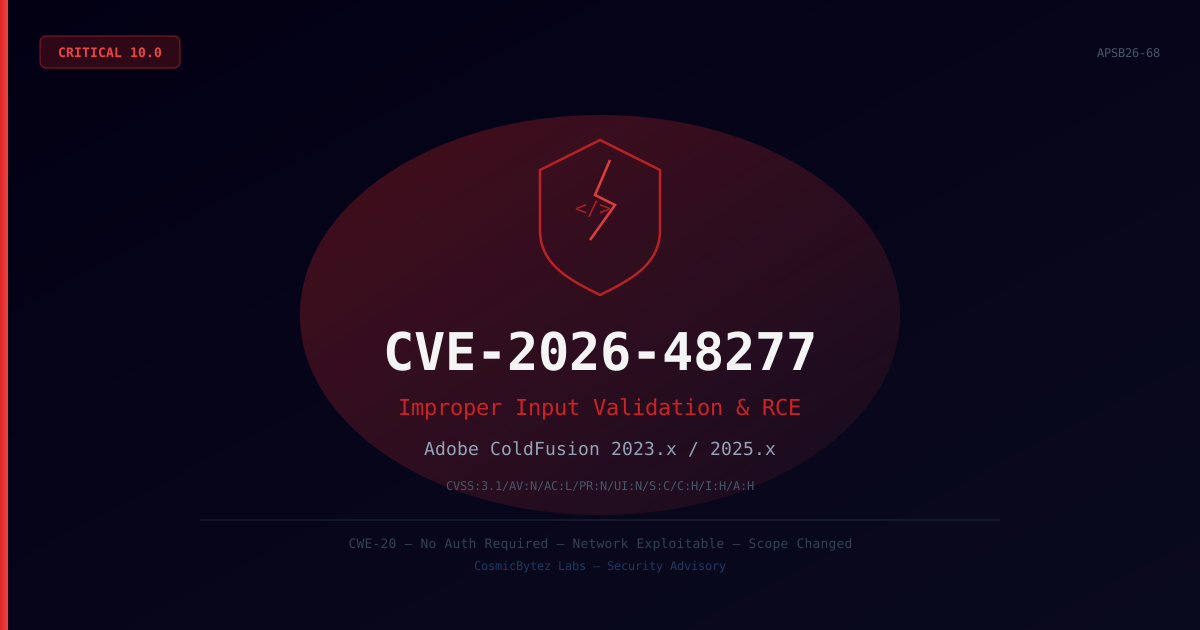
CVE-2026-48277 is a CVSS 10.0 Critical improper input validation vulnerability in Adobe ColdFusion (CWE-20) that enables unauthenticated remote code execution without user interaction. Disclosed as part of Adobe's APSB26-68 bulletin on June 30, 2026, the flaw affects ColdFusion 2023 (through Update 20) and ColdFusion 2025 (through Update 9).
With four simultaneous CVSS 10.0 CVEs published in a single advisory, organizations running internet-exposed ColdFusion should treat this as an emergency.
Vulnerability Overview
| Attribute | Value |
|---|---|
| CVE ID | CVE-2026-48277 |
| CVSS v3.1 Score | 10.0 (Critical) |
| CVSS Vector | AV:N/AC:L/PR:N/UI:N/S:C/C:H/I:H/A:H |
| CWE | CWE-20 — Improper Input Validation |
| Advisory | APSB26-68 |
| Published | June 30, 2026 |
| Authentication | None required |
| User Interaction | None |
| Scope | Changed |
Affected Versions
| Product | Affected | Patched |
|---|---|---|
| Adobe ColdFusion 2025 | 2025.9 and earlier (Updates 1–9) | Update 10+ |
| Adobe ColdFusion 2023 | 2023.20 and earlier (Updates 1–20) | Update 21+ |
Technical Analysis
Root Cause
CVE-2026-48277 is an improper input validation vulnerability (CWE-20). ColdFusion fails to adequately validate or sanitize attacker-controlled input before using it in a security-sensitive operation. This allows a remote attacker to supply specially crafted input that is interpreted by the server in an unintended way, ultimately achieving arbitrary code execution.
CWE-20 in the ColdFusion Context
Improper input validation in ColdFusion can manifest in several ways:
- CFML template injection — unvalidated input passed to CFML tags or functions
- Java object deserialization — crafted serialized objects triggering code execution
- Expression injection — input reaching ColdFusion expression evaluators (e.g.,
Evaluate(),IIF()) - HTTP header manipulation — malformed headers triggering unexpected code paths
Without authentication requirements, an attacker only needs network access to a ColdFusion endpoint to trigger the vulnerability.
Attack Chain
1. Attacker locates internet-accessible ColdFusion server
2. Sends HTTP request with crafted, malicious input payload
3. ColdFusion processes the input without adequate validation
4. Crafted input triggers unintended code execution path
5. Arbitrary code executes as the ColdFusion service account
6. Attacker establishes persistence, exfiltrates data, or pivots internallyWhy CVSS 10.0?
| Factor | Value | Reason |
|---|---|---|
| Attack Vector | Network | Exploitable remotely |
| Attack Complexity | Low | No special conditions required |
| Privileges Required | None | Pre-authentication |
| User Interaction | None | Fully automated exploitation |
| Scope | Changed | Affects resources beyond vulnerable component |
| Confidentiality | High | Full data access |
| Integrity | High | Full write access |
| Availability | High | Service can be taken down |
Impact
A successful exploit of CVE-2026-48277 gives an attacker:
- Full remote code execution on the ColdFusion application server
- Access to application data — databases, files, credentials stored in ColdFusion datasources
- Server-level persistence — ability to install backdoors, web shells, or scheduled tasks
- Lateral movement — ColdFusion servers often have broad internal network access
- Supply chain risk — if ColdFusion is part of a larger application stack, compromise extends downstream
Remediation
Priority Actions
- Patch immediately: Apply APSB26-68 — ColdFusion 2025 Update 10+, ColdFusion 2023 Update 21+
- Audit for compromise: Review logs for anomalous requests, unexpected process spawning, or new files
- Restrict access: If patching is delayed, place ColdFusion behind a WAF or remove from internet exposure
Temporary Mitigations
If you cannot patch immediately:
- Firewall ColdFusion ports from public internet access
- Deploy WAF rules to block requests with suspicious payload patterns
- Enable ColdFusion's built-in request filters in the ColdFusion Administrator
- Monitor file system for newly created CFML files in web-accessible paths
Post-Patch Verification
# Verify ColdFusion version after update
# ColdFusion Administrator > Server Settings > Server Information

# Check ColdFusion process for suspicious children (Linux)
pstree -p $(pgrep -f coldfusion)

# Review recent ColdFusion error logs
tail -500 /opt/coldfusion/cfusion/logs/application.log | grep -i "error\|exception"Detection
Indicators of Exploit Attempts
| Indicator | Description |
|---|---|
| Requests containing serialized Java payloads | Deserialization exploit attempt |
| Unusual characters in query strings or POST body | Input validation bypass |
Requests to /CFIDE/, /cfide/, or uncommon .cfm paths | Targeting CF endpoints |
| HTTP 500 errors with Java stack traces in response | Exception revealing code path |
Outbound connections from jrun.exe / CF process | Post-exploitation C2 |
SIEM Query Example
index=weblogs sourcetype=apache_access
(uri_path="*cfide*" OR uri_path="*.cfm" OR uri_path="*.cfc")
status=200
http_method=POST
bytes>10000
Context: Four Critical CVEs in APSB26-68
| CVE | Vulnerability Type | CVSS |
|---|---|---|
| CVE-2026-48276 | Unrestricted File Upload (CWE-434) | 10.0 |
| CVE-2026-48277 | Improper Input Validation (CWE-20) | 10.0 |
| CVE-2026-48281 | Improper Input Validation (CWE-20) | 10.0 |
| CVE-2026-48282 | Path Traversal (CWE-22) | 10.0 |
The volume and severity of simultaneous vulnerabilities in a single product suggests significant systemic input handling issues in ColdFusion's codebase. Organizations should reassess their ColdFusion exposure surface and consider whether these applications can be moved behind additional access controls permanently.
Key Takeaways
- CVSS 10.0 — pre-auth, no interaction, full RCE, maximum impact across all dimensions
- CWE-20 (Improper Input Validation) is the root cause — a common but preventable class of vulnerability
- Four simultaneous critical CVEs in ColdFusion represent a systemic risk, not an isolated incident
- Patch ColdFusion immediately — Update 10+ for 2025 series, Update 21+ for 2023 series
- Assume breach if ColdFusion instances were internet-exposed without recent patching