Executive Summary
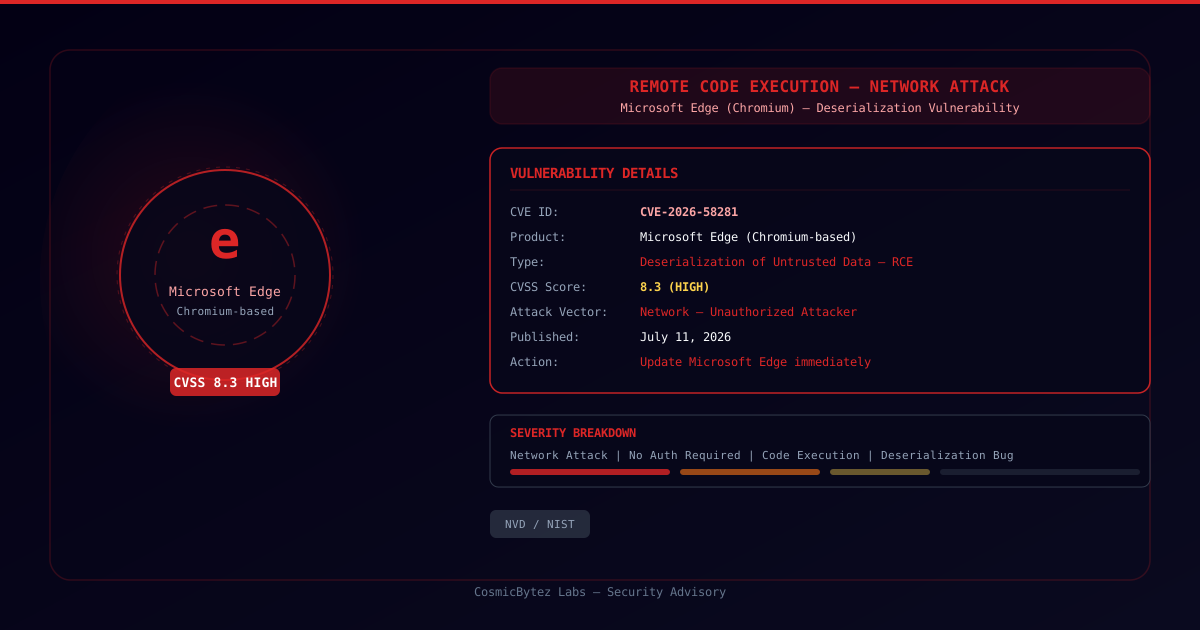
A high-severity remote code execution (RCE) vulnerability has been disclosed in Microsoft Edge (Chromium-based), tracked as CVE-2026-58281 with a CVSS score of 8.3 (HIGH). The flaw stems from deserialization of untrusted data, allowing an unauthorized attacker to execute arbitrary code over a network without requiring user authentication.
Published by the National Vulnerability Database (NVD) on July 11, 2026, this vulnerability affects one of the world's most widely deployed browsers.
Vulnerability Overview
| Attribute | Value |
|---|---|
| CVE ID | CVE-2026-58281 |
| CVSS Score | 8.3 (HIGH) |
| Type | Deserialization of Untrusted Data |
| Attack Vector | Network |
| Authentication | None required |
| Privileges Required | None |
| Impact | Remote Code Execution |
| Affected Product | Microsoft Edge (Chromium-based) |
| Published | July 11, 2026 |
Technical Details
Root Cause
CVE-2026-58281 is a deserialization vulnerability — a class of flaw where an application fails to safely process externally controlled serialized data. When Edge processes attacker-controlled serialized objects, it can be tricked into executing arbitrary code during the deserialization process.
Deserialization attacks are particularly dangerous because:
- They can occur without user interaction in some configurations
- The vulnerability exists at a network-reachable layer
- Exploitation can lead directly to arbitrary code execution on the victim system
Attack Scenario
1. Attacker crafts malicious serialized payload targeting Edge's parsing logic
2. Payload is delivered via network (e.g., crafted web content, WebSocket, or data channel)
3. Microsoft Edge deserializes the untrusted data
4. Deserialization triggers code execution in the context of the browser process
5. Attacker gains code execution with Edge's privileges on the target systemWhy Chromium-Based Browsers Are High-Value Targets
Microsoft Edge, built on the Chromium engine, shares significant codebase with Google Chrome. Edge holds substantial enterprise market share — especially in Windows environments where it ships as the default browser. Organizations relying on Edge for internal portals, web applications, and productivity tools face elevated risk.
Affected Versions
Microsoft has not yet specified exact affected version numbers at time of publication. All Microsoft Edge (Chromium-based) versions prior to the patched release should be considered vulnerable.
Check the Microsoft Security Update Guide for the authoritative list of affected builds and patched versions.
Remediation
Immediate Actions
- Update Microsoft Edge to the latest available version immediately
- Edge:
Settings → Help & Feedback → About Microsoft Edge→ triggers automatic update - Enterprise: Deploy via Windows Update, SCCM, Intune, or Group Policy
- Edge:
- Verify the update — confirm the installed version is at or above the patched release
- Audit browser versions across managed endpoints — identify unpatched instances
Enterprise Considerations
- Deploy the patch via Microsoft Endpoint Manager (Intune) or SCCM for fleet-wide coverage
- Use Microsoft Defender for Endpoint to identify endpoints running vulnerable Edge versions
- Consider temporary network isolation of high-risk systems if patching cannot occur immediately
Detection
Indicators to Monitor
| Indicator | Description |
|---|---|
Unexpected process spawning from msedge.exe | Post-exploitation activity |
| Outbound connections from Edge to unusual IPs | C2 communication |
| Anomalous network traffic associated with browser processes | Exploit delivery or C2 |
| EDR alerts for deserialization-related anomalies | Active exploitation attempt |
Patch Verification
# Check Microsoft Edge version on Windows
(Get-AppxPackage -Name Microsoft.MicrosoftEdge.Stable).Version

# Or via registry
Get-ItemProperty "HKLM:\SOFTWARE\Microsoft\EdgeUpdate\Clients\{56EB18F8-8008-4CBD-B6D2-8C97FE7E9062}" | Select-Object pvImpact Assessment
CVSS 8.3 HIGH reflects:
- Network-accessible attack surface — no local access required
- No authentication needed — any attacker with network reach can attempt exploitation
- Code execution — highest possible impact category (confidentiality, integrity, and availability all compromised)
Given Microsoft Edge's enterprise prevalence and its use in sensitive business workflows, this vulnerability poses significant organizational risk if left unpatched.
Key Takeaways
- CVSS 8.3 HIGH — deserialization RCE in Microsoft Edge, exploitable over the network
- No authentication required — low barrier to exploitation
- Update Edge immediately across all managed and unmanaged devices
- Monitor for post-exploitation activity on endpoints running Edge
- Enterprise teams should prioritize this in the current patch cycle