Executive Summary
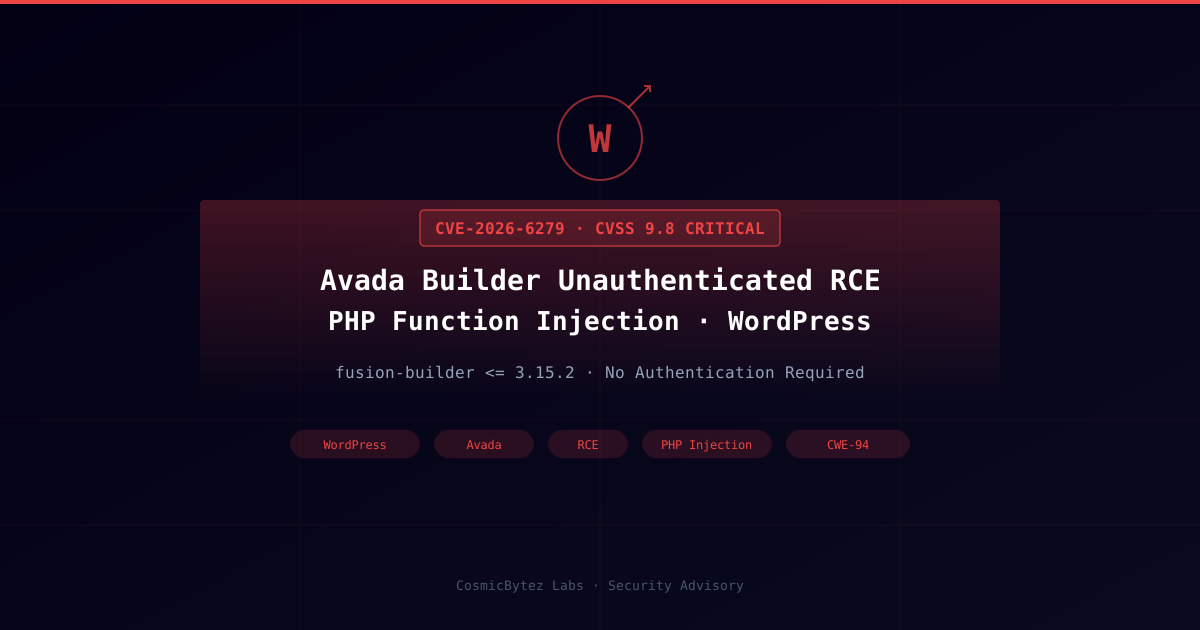
A critical remote code execution vulnerability (CVE-2026-6279) has been discovered in the Avada Builder (fusion-builder) plugin for WordPress, one of the most widely used page builder plugins powering the Avada theme ecosystem. The flaw carries a CVSS score of 9.8 and affects all versions up to and including 3.15.2.
The vulnerability resides in the wp_conditional_tags case within Fusion_Builder_Conditional_Render_Helper::get_value(), where attacker-controlled input is passed directly into a PHP function call without proper sanitization. An unauthenticated attacker can exploit this to execute arbitrary PHP code on the affected server.
All sites using Avada Builder versions 3.15.2 or earlier should update immediately.
Vulnerability Overview
| Attribute | Value |
|---|---|
| CVE ID | CVE-2026-6279 |
| CVSS Score | 9.8 (Critical) |
| CWE | CWE-94 — Improper Control of Generation of Code |
| Type | PHP Function Injection / Remote Code Execution |
| Attack Vector | Network |
| Privileges Required | None (unauthenticated) |
| User Interaction | None |
| Patch Available | Update to 3.15.3 or later |
Affected Versions
| Plugin | Affected Versions | Fixed Version |
|---|---|---|
| Avada Builder (fusion-builder) | <= 3.15.2 | 3.15.3+ |
Technical Analysis
Root Cause
The vulnerability exists in the Fusion_Builder_Conditional_Render_Helper::get_value() function, specifically in the handling of the wp_conditional_tags case. When processing shortcode attributes for conditional rendering, the method accepts a function name from attacker-controlled input and invokes it via PHP's dynamic function calling mechanism — without validating that the supplied value is a legitimate, allow-listed callback.
This constitutes a PHP Function Injection vulnerability: an attacker can supply any callable PHP function or user-defined function as the tag name, causing arbitrary code execution in the context of the web server.
Attack Flow
1. Attacker identifies a WordPress site running Avada Builder <= 3.15.2
2. Attacker crafts a malicious HTTP request targeting a public-facing endpoint
   that invokes the fusion-builder shortcode renderer
3. Attacker injects an arbitrary PHP function name (e.g., system, exec, passthru)
   as the wp_conditional_tags value
4. get_value() passes the input directly to a PHP call_user_func() or equivalent
5. The server executes the attacker's chosen PHP function with attacker-supplied arguments
6. Attacker achieves Remote Code Execution (RCE) on the serverExploitation Conditions
- Avada Builder version 3.15.2 or earlier must be installed and active
- No authentication is required — the vulnerable endpoint is accessible to unauthenticated users
- PHP functions like
system,exec,passthru, orshell_execmust not be individually disabled viadisable_functionsinphp.ini(though alternative exploitation paths may exist even with restrictions)
Impact Assessment
| Impact Area | Description |
|---|---|
| Remote Code Execution | Full server-side code execution as the web server user |
| Webshell Deployment | Attacker can write persistent PHP backdoors to the filesystem |
| Data Exfiltration | Access to WordPress database credentials, user data, and file system |
| Site Defacement | Full control over content, themes, and plugins |
| Lateral Movement | Shared hosting environments risk cross-site compromise |
| Cryptominer Deployment | Server resources can be hijacked for cryptocurrency mining |
| Ransomware Staging | Foothold for broader network intrusion or data encryption |
Immediate Remediation
Step 1: Update Avada Builder to 3.15.3 or Later
Update via the WordPress admin panel:
Plugins > Installed Plugins > Avada Builder > Update Now
Or via WP-CLI:
# Update fusion-builder plugin
wp plugin update fusion-builder

# Verify the installed version
wp plugin get fusion-builder --field=versionIf using the Avada theme package, update the full theme, which bundles the plugin.
Step 2: Audit for Exploitation Indicators
# Check for recently modified PHP files in the uploads directory (common webshell target)
find /var/www/html/wp-content/uploads/ -name "*.php" -type f

# Scan for recently modified files across the WordPress installation
find /var/www/html/ -name "*.php" -newer /var/www/html/wp-config.php -not -path "*/cache/*" -type f

# Review recent WordPress error logs for suspicious function calls
grep -i "system\|exec\|passthru\|shell_exec\|eval" /var/log/apache2/error.logStep 3: Harden PHP Configuration
If immediate patching is not possible, disable dangerous PHP functions:
# php.ini — add to restrict dangerous function execution
disable_functions = system,exec,shell_exec,passthru,popen,proc_open,eval,assertRestart the web server after applying changes.
Step 4: Deploy a Web Application Firewall
Temporarily block exploitation attempts with a WAF rule targeting the vulnerable parameter pattern. Wordfence, Cloudflare WAF, and Sucuri all offer WordPress-specific rule sets that should detect PHP Function Injection attempts.
Detection Indicators
| Indicator | Description |
|---|---|
PHP files in wp-content/uploads/ | Webshell deployment post-exploitation |
| Unusual outbound connections from the web server | Reverse shell or C2 communications |
system, exec, passthru in access logs | Active exploitation attempts |
| Unexpected new WordPress admin accounts | Persistence mechanism post-compromise |
| Elevated CPU or memory usage | Cryptominer or batch exploitation activity |
Post-Remediation Checklist
- Update Avada Builder to version 3.15.3 or later
- Audit
wp-content/uploads/for PHP files — remove any found - Review recently modified PHP files site-wide
- Check WordPress user accounts for unauthorized admins
- Reset WordPress secret keys and all admin passwords
- Invalidate active sessions to force re-authentication
- Enable a Web Application Firewall with WordPress rule sets
- Restrict PHP dangerous functions via
disable_functionsas defense-in-depth - Monitor access logs for continued exploitation attempts
- Verify database integrity for unauthorized content modifications