Executive Summary
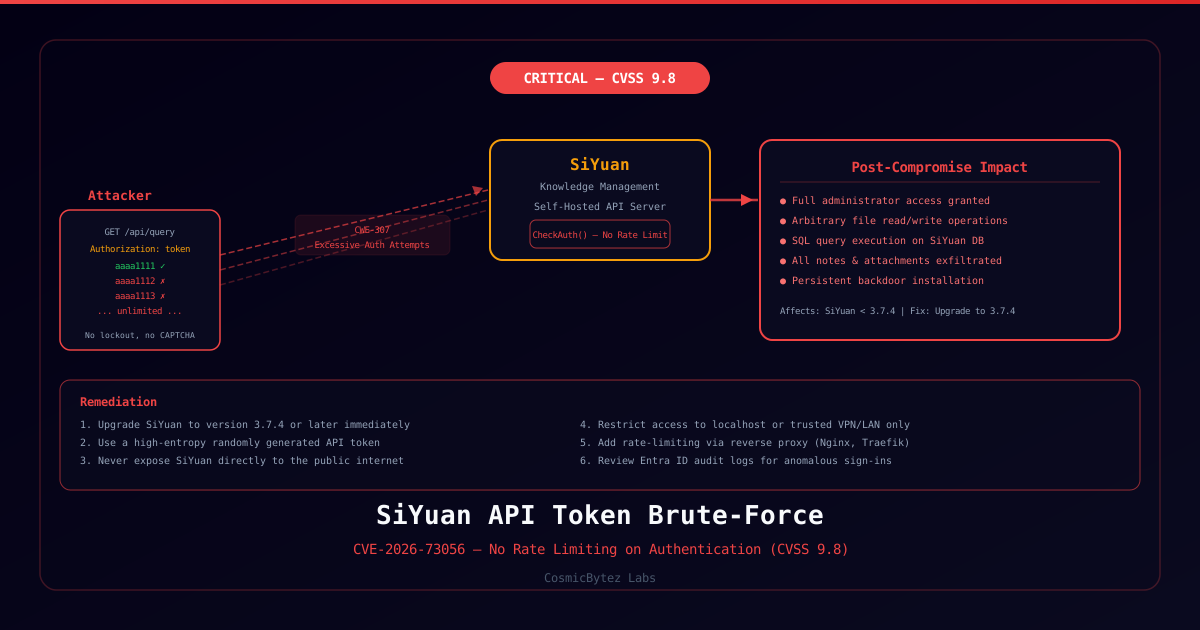
A critical unauthenticated brute-force vulnerability has been disclosed in SiYuan, the self-hosted personal knowledge management and note-taking application maintained by B3log (siyuan-note). Tracked as CVE-2026-73056 (CVSS v3.1: 9.8, CVSS v4.0: 9.3), the flaw stems from the CheckAuth() middleware's complete lack of rate-limiting, lockout mechanisms, or CAPTCHA on API token authentication. Any network-reachable attacker can make unlimited automated attempts to guess a SiYuan instance's API token, and upon success gains full administrator-level access to all stored notes and data.
Vulnerability Details
| Field | Value |
|---|---|
| CVE ID | CVE-2026-73056 |
| CVSS v3.1 Score | 9.8 (Critical) |
| CVSS v4.0 Score | 9.3 (Critical) |
| Vector (v3.1) | AV:N/AC:L/PR:N/UI:N/S:U/C:H/I:H/A:H |
| CWE | CWE-307 — Improper Restriction of Excessive Authentication Attempts |
| Affected Versions | SiYuan < 3.7.4 |
| GitHub Advisory | GHSA-m6w6-p7pc-fpg2 |
| Fixed Version | SiYuan 3.7.4 |
Technical Analysis
SiYuan's kernel exposes an API accepting authentication via Authorization headers or query parameters. The CheckAuth() middleware validates the API token but applies no throttling, no account lockout, and no CAPTCHA challenge on failed attempts. This allows an attacker to enumerate tokens at machine speed without triggering any defensive response.
Attack Flow
- Attacker identifies a SiYuan instance accessible on the network (or internet)
- Automated tooling submits requests to any SiYuan API endpoint with sequentially or randomly generated token values
- No lockout, delay, or detection mechanism interferes with enumeration
- Upon a successful match, the attacker gains full administrator access
Post-Exploitation Capabilities
With a valid API token, an attacker can:
- Read, modify, or delete all notes and notebooks stored in SiYuan
- Execute arbitrary file operations on the host system via SiYuan's kernel
- Run arbitrary SQL queries against SiYuan's embedded database
- Exfiltrate sensitive documents, personal notes, credentials, and attachments
- Install persistent backdoors or further compromise the host
Affected Software
| Component | Affected Versions |
|---|---|
| SiYuan (siyuan-note/siyuan) | All versions < 3.7.4 |
Mitigation
Immediate Fix
Upgrade to SiYuan 3.7.4 or later. The patch introduces proper restrictions on excessive authentication attempts, addressing the root cause.
Hardening Measures (All Versions)
- Generate a strong API token — use a long, high-entropy, randomly generated token. Short or predictable tokens dramatically reduce the time to brute-force success.
- Isolate SiYuan from the internet — bind the service to
localhostor restrict it to a trusted VPN/LAN segment. SiYuan is not designed to be a public-facing web service. - Add reverse-proxy rate limiting — if network access cannot be fully restricted, place SiYuan behind a reverse proxy (Nginx, Traefik, Caddy) with aggressive connection and request-rate limits.
- Audit access logs — review SiYuan logs for anomalous patterns of failed authentication attempts.
Detection
Watch for:
- High volumes of API requests with
Authorizationheaders from a single IP - Repeated 401 responses in SiYuan kernel logs
- Sudden successful authentication from an unfamiliar source IP