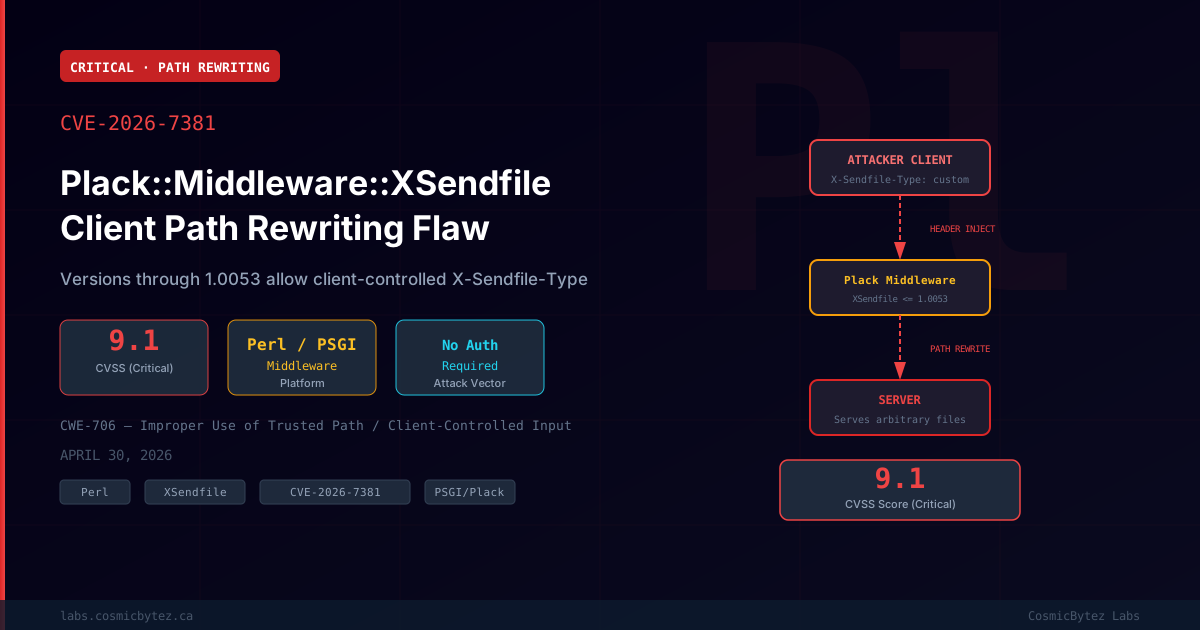
CVE-2026-7381: Plack::Middleware::XSendfile Client-Controlled Path Rewriting
A critical severity vulnerability has been disclosed in Plack::Middleware::XSendfile, a widely used Perl/PSGI middleware component for efficiently offloading file serving to a front-end web server. Tracked as CVE-2026-7381 and scoring CVSS 9.1 (Critical), the flaw affects all versions through 1.0053 and allows a remote attacker to control the sendfile variation (type) via the client-supplied X-Sendfile-Type HTTP header — bypassing any server-configured file access controls.
Vulnerability Overview
| Attribute | Value |
|---|---|
| CVE ID | CVE-2026-7381 |
| CVSS Score | 9.1 (Critical) |
| Affected Component | Plack::Middleware::XSendfile |
| Affected Versions | All versions through 1.0053 |
| Attack Vector | Network — No authentication required |
| In-the-Wild Exploitation | Not confirmed at time of disclosure |
| Published | April 29, 2026 |
Background: X-Sendfile and PSGI Middleware
X-Sendfile is a mechanism used by web frameworks to delegate the actual file transfer to a front-end server (Apache, Nginx, Lighttpd) after the application has performed authentication and authorization checks. The flow is:
1. Application receives request for a protected file
2. Application validates user authorization
3. Application responds with special header (X-Sendfile, X-Accel-Redirect, etc.)
4. Front-end server reads the header and serves the file directly from disk
5. File transfer bypasses the application layer entirelyThe variation (sendfile type) determines which header format the middleware sends:
X-Sendfile— used by Apache with mod_xsendfileX-Accel-Redirect— used by NginxX-LIGHTTPD-send-file— used by Lighttpd
In a secure configuration, the sendfile type is set at application startup and cannot be overridden at runtime.
Technical Analysis
The vulnerability in Plack::Middleware::XSendfile versions through 1.0053 is that the middleware reads the X-Sendfile-Type header from the incoming client request and applies it as the variation setting — even when the variation has not been explicitly configured in the middleware constructor.
The Flaw
# Vulnerable pattern in Plack::Middleware::XSendfile (conceptual)
sub call {
    my ($self, $env) = @_;

    # Dangerous: variation falls back to client-supplied header
    my $type = $self->{variation}
            || $env->{'HTTP_X_SENDFILE_TYPE'};  # attacker-controlled

    # ... file path rewriting logic using $type
}When variation is not set in the constructor, the middleware accepts the X-Sendfile-Type header from the client. This allows an attacker to:
- Choose the sendfile type — switching from the intended format to one that rewrites paths differently
- Trigger path manipulation — since different X-Sendfile variants handle file paths and base directories differently, an attacker-selected variation may cause the middleware to construct file paths outside the intended root
- Bypass access controls — files that would not normally be served through the application may become accessible if the server processes the attacker-crafted header
Exploitation Path
1. Attacker identifies a PSGI application running Plack::Middleware::XSendfile
   with no explicit variation configured

2. Attacker crafts a request to a file endpoint:
   GET /files/report.pdf HTTP/1.1
   Host: target.example.com
   X-Sendfile-Type: X-Accel-Redirect  (or other variation)

3. XSendfile middleware reads the attacker-supplied X-Sendfile-Type

4. Middleware applies that variation's path-rewriting logic,
   potentially constructing a file path outside the intended directory

5. Front-end server (Nginx/Apache) reads the rewritten path header
and serves a file from an unintended locationThe CVSS 9.1 score reflects a network-accessible attack requiring no authentication, with high confidentiality impact (arbitrary file read potential) and network-level attack complexity.
Affected Deployments
Any Perl/PSGI web application using Plack::Middleware::XSendfile <= 1.0053 is potentially affected if:
- The
variationoption is not explicitly set in the middleware constructor - The application serves files through an X-Sendfile mechanism
- A front-end web server (Apache, Nginx, Lighttpd) is configured to process X-Sendfile headers
Applications that explicitly set variation in the constructor during initialization are not vulnerable, as the client-supplied header is ignored in that code path.
Remediation
Primary Fix: Update to a Patched Version
# Update via CPAN
cpan Plack::Middleware::XSendfile

# Or via cpanm
cpanm Plack::Middleware::XSendfile

# Or via Carton (if using a Cartonfile)
carton install

# Verify installed version
perl -MPlack::Middleware::XSendfile -e 'print $Plack::Middleware::XSendfile::VERSION, "\n"'Immediate Mitigation: Explicitly Configure the Variation
If patching immediately is not possible, explicitly set the variation in the middleware constructor to remove the client-controlled code path:
# Secure configuration — variation is server-side only
builder {
    enable 'XSendfile', variation => 'X-Accel-Redirect';  # Set for Nginx
    # Or 'X-Sendfile' for Apache, 'X-LIGHTTPD-send-file' for Lighttpd
    $app;
};Network-Level Controls
- Strip the
X-Sendfile-Typeheader at the reverse proxy before it reaches the PSGI application:# Nginx — remove client-supplied header proxy_set_header X-Sendfile-Type ""; - Restrict X-Sendfile base directories at the front-end server to limit the scope of any path manipulation
- Apply WAF rules to block or sanitize the
X-Sendfile-Typerequest header
Detection
Identify Vulnerable Installations
# Check installed version
perl -MPlack::Middleware::XSendfile -e 'print $Plack::Middleware::XSendfile::VERSION, "\n"'

# Scan Cartonfile or cpanfile for Plack dependency
grep -r "XSendfile" cpanfile Cartonfile.snapshot

# Search application code for XSendfile middleware without variation
grep -rn "XSendfile" lib/ app/ --include="*.pm" --include="*.pl"Monitor for Exploitation Attempts
# Check access logs for X-Sendfile-Type header in requests
grep -i "X-Sendfile-Type" /var/log/nginx/access.log
grep -i "HTTP_X_SENDFILE_TYPE" /var/log/app/access.log

# Look for unusual file paths in X-Accel-Redirect or X-Sendfile response headers
grep "X-Accel-Redirect\|X-Sendfile" /var/log/nginx/access.log | grep "\.\."Requests containing X-Sendfile-Type in the headers should be treated as suspicious and investigated.
Impact Assessment
| Impact Area | Description |
|---|---|
| Arbitrary File Read | Attacker can rewrite paths to access files outside the intended directory |
| Authentication Bypass | Files normally gated behind application auth may be served directly |
| Information Disclosure | Configuration files, credentials, private keys may be exposed |
| CVSS 9.1 | Network-accessible, no authentication, high confidentiality impact |
| Affected Ecosystem | All Perl/PSGI applications using the middleware without explicit variation |
Key Takeaways
- CVE-2026-7381 is a CVSS 9.1 Critical flaw in
Plack::Middleware::XSendfile(all versions ≤ 1.0053) for Perl - The vulnerability allows the client to set the
X-Sendfile-Typeheader, overriding the server's intended sendfile variation - This enables client-controlled path rewriting, potentially exposing files outside the intended web root
- Update to a patched version immediately, or explicitly configure the
variationsetting in the middleware constructor - Network-level controls (stripping the header at the proxy) can serve as a compensating control while patching is underway