Executive Summary
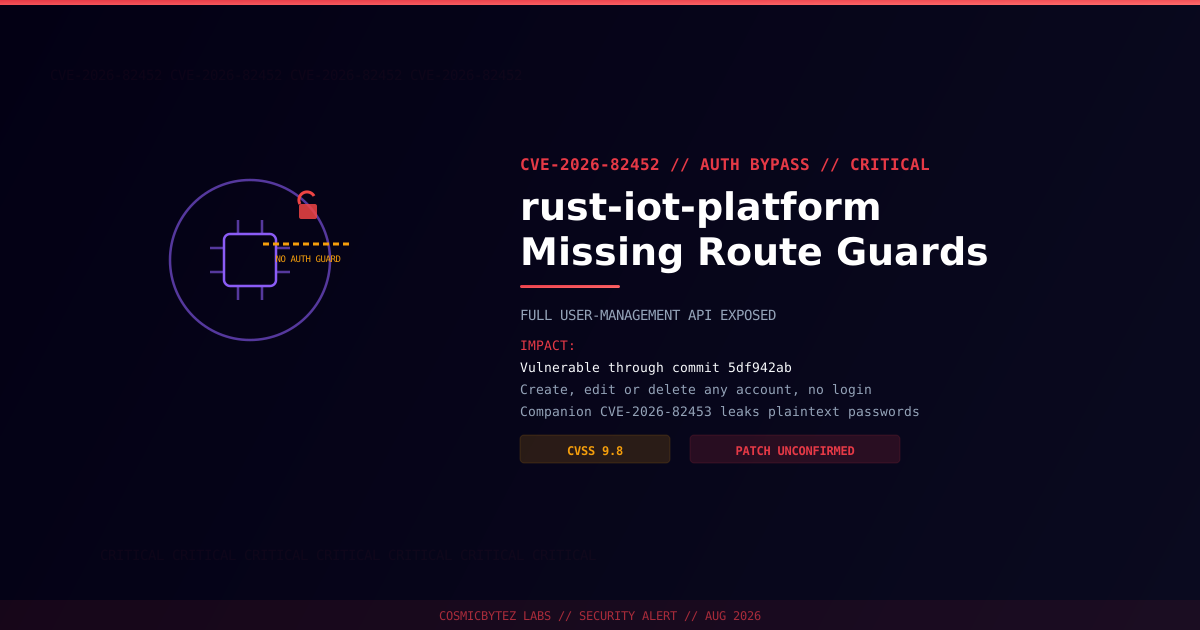
CVE-2026-82452 affects rust-iot-platform through commit 5df942ab and carries a maximum-severity CVSS score of 9.8. Most of the platform's REST API routes lack authentication guards in their handler signatures — meaning the application never checks whether a request is authenticated before processing it, for nearly the entire user-management surface.
CVSS Score: 9.8 (Critical)
An unauthenticated attacker with only network access to a rust-iot-platform instance can create, update, list, retrieve, and delete user accounts directly, without any valid credentials. In practice this hands an attacker full control over the platform's identity layer — new administrator accounts can be created, existing roles or passwords altered, or the entire user table wiped. The vulnerability was published alongside a companion flaw, CVE-2026-82453 (CVSS 7.5), where user passwords are stored in cleartext — meaning the same unauthenticated endpoints that lack auth guards can also be used to read every account's plaintext password.
Vulnerability Overview
| Attribute | Value |
|---|---|
| CVE ID | CVE-2026-82452 |
| CVSS Score | 9.8 (Critical) — CVSS 4.0: 9.3 |
| Type | Missing Authentication for Critical Function |
| Attack Vector | Network |
| Privileges Required | None |
| User Interaction | None |
| Assigner | VulnCheck |
| Vulnerable Component | api/src/controller/user_router.rs |
| Related | CVE-2026-82453 — cleartext password storage (CVSS 7.5) |
Affected Versions
| Product | Affected Versions | Fixed Version |
|---|---|---|
| rust-iot-platform | Through commit 5df942ab | Not confirmed publicly as of this advisory — verify against the upstream repository before assuming a fix is available |
Technical Details
rust-iot-platform's REST API is implemented with handler functions that are expected to check for a valid AuthToken before performing any privileged action. In the affected code, most handlers in user_router.rs omit that check entirely — the handler signatures simply don't require or validate an authentication token, so the framework never rejects unauthenticated requests before they reach account-management logic.
Because the check is missing at the handler level rather than misconfigured at a gateway or middleware level, there is no single choke point to patch centrally — every affected route independently needs the guard added.
Combined with CVE-2026-82453, where the underlying user model stores passwords without hashing, the same unauthenticated list/retrieve endpoints that skip auth checks also return plaintext credentials for every account, compounding the severity of both flaws when exploited together.
Attack Vector
1. Attacker identifies a reachable rust-iot-platform instance
2. Attacker sends unauthenticated requests directly to user-management API routes
   (create / update / list / retrieve / delete)
3. No AuthToken check exists in the handler — request is processed normally
4. Attacker creates a new administrator account, or retrieves the full user list
   (optionally including cleartext passwords, per CVE-2026-82453)
5. Attacker uses the forged/retrieved credentials for full platform controlImpact of Successful Exploitation
| Impact | Description |
|---|---|
| Full Account Takeover | Create, modify, or delete any user account without credentials |
| Privilege Escalation | Forge new administrator accounts directly via the API |
| Data Integrity Loss | Wipe or corrupt the entire user table |
| Credential Exposure | Combined with CVE-2026-82453, exposes plaintext passwords for every account |
| No Authentication Barrier | Exploitation requires only network reachability, no valid session |
Immediate Remediation
Step 1: Determine Exposure
# Check the deployed commit
cd /path/to/rust-iot-platform
git log -1 --format="%H %ci"If the deployment is at or before commit 5df942ab, treat it as vulnerable.
Step 2: Restrict Network Access Immediately
Because a confirmed fixed release has not been publicly identified as of this advisory, the priority mitigation is to stop unauthenticated network access to the API:
- Place the rust-iot-platform API behind a reverse proxy or gateway that enforces authentication at that layer, independent of the application's own (currently broken) checks.
- Restrict inbound access to the API to trusted internal networks or a VPN only.
- Disable public exposure of the user-management routes entirely until a verified fix is confirmed upstream.
Step 3: Audit Existing Accounts
# Review the user table for accounts you don't recognize
# and administrator role assignments that shouldn't exist- Enumerate all existing user accounts and their roles.
- Remove any unrecognized or unauthorized administrator accounts.
- Force a password reset for every remaining account, since CVE-2026-82453 means any password may already be exposed.
Step 4: Track Upstream for a Fix
Monitor the rust-iot-platform repository and the VulnCheck advisory for a confirmed patched commit or release, and apply it as soon as it is verified.
Detection Indicators
| Indicator | Description |
|---|---|
Unauthenticated requests to /user API routes | Direct evidence of exploitation attempts |
| New administrator accounts with no corresponding provisioning record | Sign of account forgery via this flaw |
Bulk list/retrieve requests against the user endpoint from unfamiliar IPs | Possible credential harvesting via CVE-2026-82453 |
| Unexpected account deletions | Data-integrity attack via the missing-guard endpoints |
Post-Remediation Steps
- Confirm network-level access controls are in place ahead of any application fix.
- Force credential rotation for every account on the platform.
- Audit administrator role assignments for unauthorized changes.
- Apply an upstream fix as soon as one is confirmed for both CVE-2026-82452 and CVE-2026-82453.
- Add authentication middleware at the gateway layer as defense in depth, independent of per-handler checks.