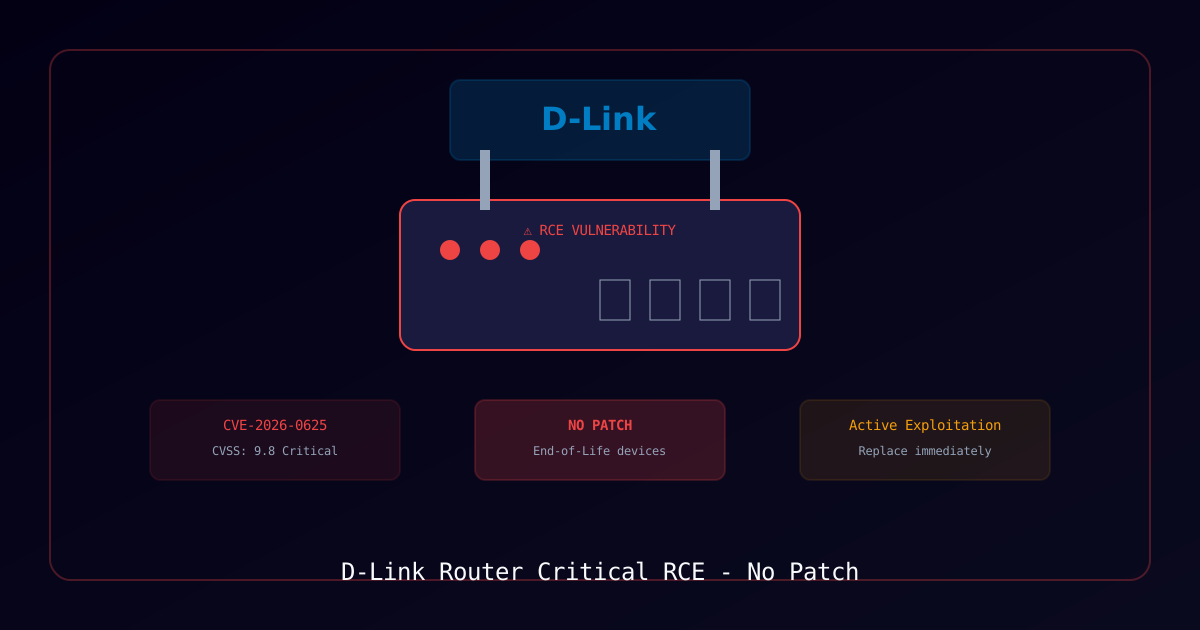
Critical D-Link Router Vulnerability Under Active Exploitation
A critical command injection vulnerability (CVE-2026-0625) affecting multiple D-Link DSL router models is being actively exploited in the wild. The affected devices have reached end-of-life status, meaning no security patches will be released.
Vulnerability Details
| Attribute | Value |
|---|---|
| CVE ID | CVE-2026-0625 |
| CVSS Score | 9.3 (Critical) |
| Attack Vector | Network |
| Authentication | None Required |
| Exploit Complexity | Low |
| Patch Status | None - EOL |
Technical Analysis
The vulnerability exists in the dnscfg.cgi endpoint, which fails to properly sanitize user input before passing it to system commands.
Vulnerable Code Path
HTTP Request → dnscfg.cgi → DNS Configuration Handler
                                    ↓
                           Command Construction
                                    ↓
                           system() call ← INJECTION POINT
                                    ↓
Shell Command ExecutionProof of Concept
The vulnerability is exploited by appending shell metacharacters (;, |, or $()) to the dnsPrimary CGI parameter of the /cgi-bin/dnscfg.cgi endpoint. The injected commands execute as root since the CGI handler passes unsanitized input directly to a system() call.
PoC details redacted — the exploit is trivial and targets EOL devices with no available patches. See the NVD entry for technical details.
Note: Unauthorized access to systems you do not own is illegal.
Exploitation Result
Successful exploitation grants:
- Root shell access on the router
- Full control of network traffic
- Ability to modify DNS settings (for MitM attacks)
- Pivot point for internal network attacks
- Persistence through firmware modification
Affected Models
The following D-Link DSL router models are confirmed vulnerable:
| Model | Firmware | EOL Date |
|---|---|---|
| DSL-2750U | All versions | 2022 |
| DSL-2740R | All versions | 2021 |
| DSL-2730U | All versions | 2020 |
| DSL-2640B | All versions | 2019 |
Active Exploitation
Threat actors are actively scanning for and exploiting this vulnerability:
Observed Attack Patterns
1. Mass Scanning
   - Shodan/Censys queries for vulnerable models
   - Port 80/8080 scanning for web interfaces

2. Exploitation
   - Automated exploitation scripts
   - DNS hijacking for credential theft
   - Botnet recruitment (Mirai variants)

3. Post-Exploitation
   - DNS poisoning → Banking trojans
   - Traffic interception → Credential harvesting
- Lateral movement into internal networksEstimated Exposure
Based on internet scanning data:
| Region | Exposed Devices |
|---|---|
| Asia-Pacific | ~45,000 |
| Europe | ~28,000 |
| North America | ~15,000 |
| South America | ~22,000 |
| Other | ~10,000 |
| Total | ~120,000 |
Immediate Actions Required
Option 1: Replace the Device (Recommended)
Replace affected routers with supported models:
Recommended Replacements:
- TP-Link Archer AX21 (Budget)
- ASUS RT-AX86U (Mid-range)
- Ubiquiti Dream Machine (Advanced)
Option 2: Temporary Mitigations
If immediate replacement isn't possible:
1. Disable Remote Management
   - Access router admin panel
   - Disable WAN-side management access
   - Disable all remote access features

2. Network Isolation
   - Place router behind another firewall
   - Block inbound access to ports 80, 443, 8080

3. MAC Filtering
   - Enable and configure MAC address filtering
   - Only allow known devices

4. Monitor for Compromise
   - Check DNS settings regularly
   - Monitor for unusual traffic patterns
- Review connected devices listCompromise Detection
Check if your router has been compromised:
# From a device on the network, check DNS settings
nslookup google.com
# If IP doesn't match Google's known IPs, DNS may be hijacked

# Check for unexpected DNS servers
# Windows:
ipconfig /all | findstr "DNS"

# Linux/macOS:
cat /etc/resolv.confIndicators of Compromise
DNS Hijacking Indicators
Malicious DNS Servers Observed:
- 185.XXX.XXX.XXX
- 91.XXX.XXX.XXX
- 103.XXX.XXX.XXX

Domains Used for C2:
- update-router[.]com
- dns-config[.]net
- router-admin[.]xyzNetwork Indicators
- Unexpected outbound connections to Eastern European IPs
- Increased DNS query volume
- Failed HTTPS certificate warnings on banking sites
- Slow internet speeds (traffic interception)
Long-term Recommendations
- Asset Inventory: Maintain inventory of all network devices
- Lifecycle Management: Replace devices before EOL
- Network Segmentation: Isolate IoT/network devices
- Monitoring: Deploy network detection tools
- Vulnerability Scanning: Regular scans for exposed management interfaces
References
- The Hacker News - D-Link DSL Router RCE
- D-Link Security Advisory
- CISA Alert - D-Link Vulnerabilities
- National Vulnerability Database - CVE-2026-0625
Last updated: January 18, 2026