COSMICBYTEZLABS
NewsSecurityHOWTOsToolsStudyTraining
ProjectsChecklistsAI RankingsNewsletterStatusTagsAbout
Subscribe

Press Enter to search or Esc to close

News
Security
HOWTOs
Tools
Study
Training
Projects
Checklists
AI Rankings
Newsletter
Status
Tags
About
RSS Feed
Reading List
Subscribe

Stay in the Loop

Get the latest security alerts, tutorials, and tech insights delivered to your inbox.

Subscribe NowFree forever. No spam.
COSMICBYTEZLABS

Your trusted source for IT intelligence, cybersecurity insights, and hands-on technical guides.

429+ Articles
114+ Guides

CONTENT

  • Latest News
  • Security Alerts
  • HOWTOs
  • Projects
  • Exam Prep

RESOURCES

  • Search
  • Browse Tags
  • Newsletter Archive
  • Reading List
  • RSS Feed

COMPANY

  • About Us
  • Contact
  • Privacy Policy
  • Terms of Service

© 2026 CosmicBytez Labs. All rights reserved.

System Status: Operational
  1. Home
  2. Security
  3. Critical Grandstream VoIP Vulnerability Allows
Critical Grandstream VoIP Vulnerability Allows

Critical Security Alert

This vulnerability is actively being exploited. Immediate action is recommended.

SECURITYCRITICALCVE-2026-2329

Critical Grandstream VoIP Vulnerability Allows

A critical CVSS 9.3 stack-based buffer overflow in Grandstream GXP1600 series VoIP phones allows unauthenticated remote code execution, enabling attackers...

Dylan H.

Security Team

February 18, 2026
3 min read

Affected Products

  • Grandstream GXP1610
  • Grandstream GXP1615
  • Grandstream GXP1620
  • Grandstream GXP1625
  • Grandstream GXP1628
  • Grandstream GXP1630

Enterprise Phones as Attack Vectors

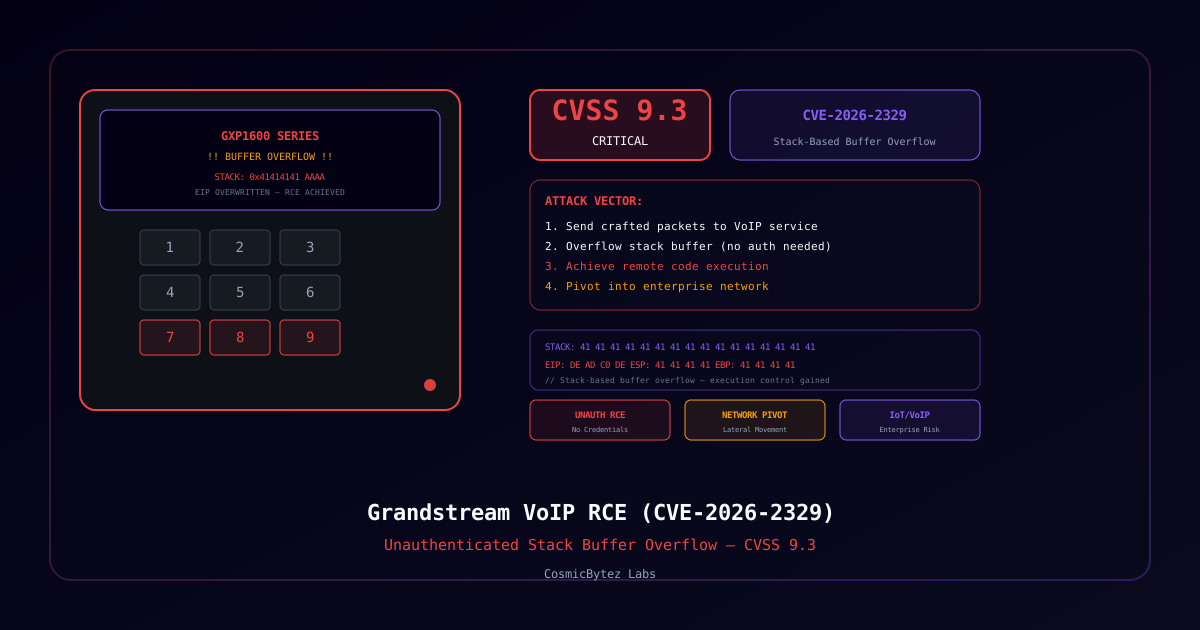
Security researchers have disclosed a critical vulnerability (CVSS 9.3) in Grandstream GXP1600 series VoIP phones that allows unauthenticated remote code execution via a stack-based buffer overflow. An attacker can send crafted network packets to seize full control of affected devices without any credentials.


Vulnerability Details

AttributeValue
CVECVE-2026-2329
CVSS9.3 (Critical)
TypeStack-Based Buffer Overflow (CWE-121)
Attack VectorNetwork — no authentication required
User InteractionNone
ImpactFull device compromise — RCE

Affected Devices

DeviceStatus
Grandstream GXP1610Vulnerable
Grandstream GXP1615Vulnerable
Grandstream GXP1620Vulnerable
Grandstream GXP1625Vulnerable
Grandstream GXP1628Vulnerable
Grandstream GXP1630Vulnerable

Why VoIP Phones Are High-Value Targets

VoIP phones are frequently deployed on enterprise networks with minimal security attention:

  • Internal network access — Often connected to both voice and data VLANs
  • Minimal monitoring — Rarely included in EDR or SIEM coverage
  • Long lifecycles — Firmware updates infrequently applied
  • Trusted position — Network security tools may whitelist VoIP traffic
  • Always on — Powered 24/7, providing persistent access

A compromised VoIP phone can serve as a pivot point for:

  • Network reconnaissance and lateral movement
  • Credential sniffing on voice/data VLANs
  • Persistent backdoor on the internal network
  • Call interception and eavesdropping

Remediation

Immediate Actions

  1. Check Grandstream's firmware portal for updated GXP1600 series firmware
  2. Apply firmware updates to all affected devices immediately
  3. Segment VoIP phones on a dedicated VLAN with strict ACLs
  4. Block unnecessary inbound traffic to VoIP phone ports
  5. Implement 802.1X for network access control on phone ports

If Patching Is Not Possible

  1. Restrict network access from trusted management subnets only
  2. Deploy IDS/IPS rules to detect buffer overflow exploitation patterns
  3. Monitor outbound connections from VoIP device IP ranges
  4. Consider device replacement for end-of-life models

IoT and VoIP devices remain among the most overlooked attack surfaces in enterprise networks. A CVSS 9.3 unauthenticated RCE in a widely deployed phone series is a reminder that every networked device is a potential entry point.

Sources

  • The Hacker News — Grandstream VoIP Critical RCE
  • Cybersecurity News — CVE-2026-2329 Disclosure

Related Reading

  • Critical Stack-Based Buffer Overflow in Delta Electronics
  • Apache Struts Critical RCE via OGNL Injection Returns
  • BeyondTrust Remote Support and PRA Critical RCE Under
#Grandstream#VoIP#CVE-2026-2329#RCE#Buffer Overflow#IoT Security

Related Articles

Tenda A15 UploadCfg Stack Buffer Overflow (CVE-2026-4567)

A CVSS 9.8 Critical stack-based buffer overflow in Tenda A15 firmware 15.13.07.13 allows unauthenticated remote attackers to execute arbitrary code by...

5 min read

D-Link DHP-1320 SOAP Handler Stack Buffer Overflow (CVE-2026-4529)

A CVSS 8.8 stack-based buffer overflow in D-Link DHP-1320 firmware 1.00WWB04 allows unauthenticated remote attackers to execute arbitrary code via a...

5 min read

Critical Stack-Based Buffer Overflow in Delta Electronics

A critical CVSS 9.8 stack-based buffer overflow in Delta Electronics COMMGR2 allows unauthenticated remote code execution, posing severe risk to...

5 min read
Back to all Security Alerts