Overview
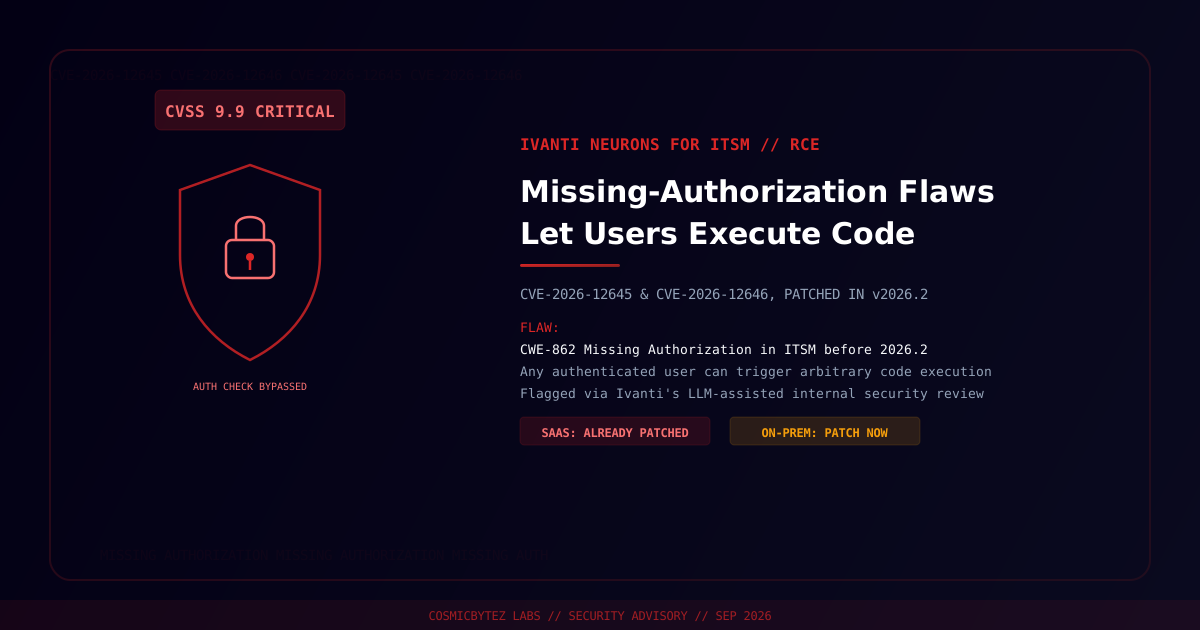
Ivanti disclosed a batch of security fixes for Neurons for ITSM on September 8, 2026, including three related missing-authorization vulnerabilities — CVE-2026-12645, CVE-2026-12646, and CVE-2026-12647 — that each carry a CVSS v3.1 score of 9.9 (Critical). All three stem from the same root cause: Ivanti Neurons for ITSM before version 2026.2 fails to properly check authorization on certain server-side operations, allowing a remote authenticated attacker to execute arbitrary code on the server.
Because exploitation only requires low privileges and no user interaction, any account on a vulnerable ITSM instance — including a low-tier helpdesk or end-user account — is a potential launch point for full server compromise.
| Attribute | Value |
|---|---|
| CVE IDs | CVE-2026-12645, CVE-2026-12646 (+ CVE-2026-12647) |
| CWE | CWE-862 — Missing Authorization |
| CVSS v3.1 | 9.9 (AV:N/AC:L/PR:L/UI:N/S:C/C:H/I:H/A:H) |
| Impact | Remote code execution as an authenticated user |
| Affected | Neurons for ITSM before 2026.2 (on-premises) |
| Fixed in | 2025.2, 2025.3, 2025.4, and 2026.1 September 2026 security updates; baked into 2026.2 |
What's Actually Broken
Both CVEs share Ivanti's own advisory language almost verbatim: a missing authorization check in Neurons for ITSM lets a remote, authenticated user execute arbitrary code on the server. The scope flag in the CVSS vector (S:C) means the impact isn't confined to the ITSM application itself — a successful exploit can affect resources beyond the vulnerable component.
This disclosure was part of a larger round of Ivanti Neurons for ITSM fixes — eight CVEs in total — that also included:
- Two unauthenticated deserialization flaws (CVE-2026-12744, CVE-2026-12745, both CVSS 9.8) that don't even require a valid login
- Three additional authenticated deserialization RCE bugs (CVE-2026-12648, CVE-2026-12650, CVE-2026-12651)
The same September update cycle also shipped fixes for Ivanti EPMM (CVE-2026-18851) and Ivanti Sentry (CVE-2026-83527).
Notably, Ivanti credits its own LLM-assisted internal security review process for surfacing this batch of flaws — an unusually explicit acknowledgment of AI-assisted vulnerability discovery in a vendor advisory.
Who's Affected
- Ivanti Neurons for ITSM Cloud/SaaS: Already patched across all landscapes as of August 9, 2026. No customer action required.
- Ivanti Neurons for ITSM on-premises, versions 2025.2, 2025.3, 2025.4, and 2026.1: Vulnerable until the September 2026 security patch is applied.
- Version 2026.2, scheduled for release September 21, 2026, ships with the fixes included.
There is currently no public evidence of active exploitation, but the low bar for exploitation — any authenticated account, no interaction needed — makes this a priority patch for any organization running ITSM on-premises, particularly instances with self-service portals or broad internal user access.
Recommendations
- On-premises customers: Apply the September 2026 security patch for your Neurons for ITSM version (2025.2 – 2026.1) immediately; do not wait for the 2026.2 release.
- SaaS/Cloud customers: Confirm your tenant received the August 9, 2026 patch — no further action should be needed, but verify with Ivanti support if uncertain.
- Audit authenticated-user access: Since exploitation only requires low-privilege authentication, review who holds ITSM accounts and tighten onboarding/offboarding hygiene in the interim.
- Monitor for anomalous server-side activity on ITSM hosts — unexpected process spawns or file writes triggered by helpdesk/end-user sessions — until patched.
References
- Ivanti Security Advisory
- SecurityWeek — Ivanti Patches Critical Flaws Across Enterprise Security Products
- NVD — CVE-2026-12645
- NVD — CVE-2026-12646