Executive Summary
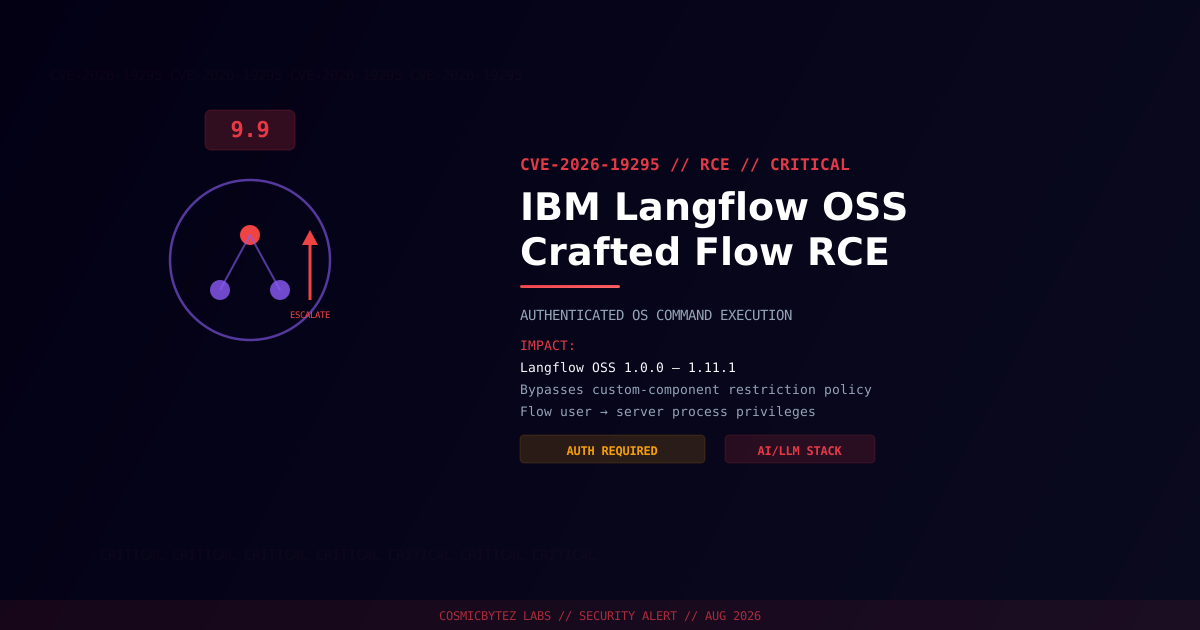
A second critical vulnerability disclosed alongside CVE-2026-19286, CVE-2026-19295 affects IBM Langflow OSS 1.0.0 through 1.11.1 and carries a CVSS score of 9.9. It allows an authenticated attacker to execute arbitrary operating system commands in the Langflow server process by saving a flow with a crafted type field value and then triggering a build of a wrapper flow that references it.
CVSS Score: 9.9 (Critical)
Critically, this flaw bypasses the LANGFLOW_ALLOW_CUSTOM_COMPONENTS=false policy control — the setting administrators use specifically to prevent low-privileged flow users from running arbitrary code. Any organization relying on that flag as a security boundary for multi-tenant or shared Langflow deployments should treat this as an active compromise path, not a theoretical one.
Vulnerability Overview
| Attribute | Value |
|---|---|
| CVE ID | CVE-2026-19295 |
| CVSS Score | 9.9 (Critical) |
| Type | Authenticated Remote Code Execution / Privilege Escalation |
| Attack Vector | Network (authentication required) |
| Privileges Required | Low — standard "flow user" account |
| User Interaction | None |
| Bypassed Control | LANGFLOW_ALLOW_CUSTOM_COMPONENTS=false |
Affected Versions
| Product | Affected Versions | Recommendation |
|---|---|---|
| IBM Langflow OSS | 1.0.0 through 1.11.1 | Upgrade to the latest patched release immediately |
Technical Details
The flaw lives in how Langflow validates flow definitions before building them. An attacker who holds any authenticated "flow user" account can:
- Save a flow containing a maliciously crafted value in its
typefield - Create a second "wrapper flow" that references the malicious flow
- Trigger a build of the wrapper flow
When the wrapper flow is built, the crafted type field is processed in a way that causes the server to execute arbitrary operating system commands under the identity of the Langflow server process — not the low-privileged flow user. This effectively escalates a standard user account into full command execution on the host, regardless of whether administrators have set LANGFLOW_ALLOW_CUSTOM_COMPONENTS=false to lock down custom code execution.
Because exploitation requires only a valid low-privilege account and no user interaction from an administrator, self-service or multi-tenant Langflow deployments — where any user can sign up or has standard flow-builder access — are especially exposed.
Attack Vector
1. Attacker authenticates to a Langflow OSS instance (1.0.0-1.11.1) with a standard account
2. Attacker saves a flow with a crafted 'type' field value
3. Attacker creates a wrapper flow that references the crafted flow
4. Attacker triggers a build of the wrapper flow
5. Langflow server executes the embedded command under the server process identity
6. Attacker gains OS-level command execution, bypassing custom-component restrictionsImpact of Successful Exploitation
| Impact | Description |
|---|---|
| Privilege Escalation | Standard flow user gains server-process-level command execution |
| Policy Bypass | Defeats the LANGFLOW_ALLOW_CUSTOM_COMPONENTS=false safeguard |
| Full Host Compromise | Arbitrary OS commands run in the Langflow server's execution context |
| Multi-Tenant Risk | Any authenticated user can act as an internal threat, not just external attackers |
| Credential & Data Exposure | Access to all secrets, model keys, and data reachable from the host |
Immediate Remediation
Step 1: Patch Langflow
pip install --upgrade langflow
langflow --versionConfirm the reported version falls outside the 1.0.0-1.11.1 affected range once IBM/the Langflow project ships a fix for this CVE.
Step 2: Tighten Access Until Patched
- Restrict who can register or hold flow-builder accounts on shared instances
- Do not rely solely on
LANGFLOW_ALLOW_CUSTOM_COMPONENTS=falseas a security boundary until patched - Review and revoke unused or low-trust user accounts
Step 3: Audit Existing Flows
# Review saved flows for unusual or unrecognized 'type' field values
# (inspect via the Langflow admin UI or the underlying flow store)

# Check server logs for build events tied to unfamiliar wrapper flows
grep -i "build" /path/to/langflow/logs/*.logIf Immediate Patching Is Not Possible
- Limit flow-builder accounts to trusted, known users only
- Disable self-service account creation on the instance
- Monitor build events for anomalous flow references
- Isolate the Langflow host from sensitive internal networks and secrets stores
Detection Indicators
| Indicator | Description |
|---|---|
Flows with unusual or malformed type field values | Possible exploitation attempt in progress |
| Wrapper flows referencing unfamiliar or recently created flows | Chained exploitation setup |
| Unexpected OS command execution originating from the Langflow process | Sign of successful exploitation |
| New accounts followed shortly by flow-build activity | Possible reconnaissance-to-exploit pattern |
Post-Remediation Steps
- Confirm the Langflow version is patched and out of the 1.0.0-1.11.1 range
- Audit all user accounts with flow-builder access and remove unnecessary ones
- Review all existing flows for malicious
typefield values or unauthorized wrapper flows - Rotate all credentials accessible from the Langflow host
- Reassess reliance on
LANGFLOW_ALLOW_CUSTOM_COMPONENTSas a sole security control - Track IBM's security bulletins for the confirmed fixed Langflow OSS version
References
- NVD — CVE-2026-19295
- Endor Labs — CVE-2026-55255: Langflow IDOR Vulnerability Allows Authenticated Attackers to Execute Arbitrary User Flows
- Endor Labs — CVE-2026-33017, Unauthenticated RCE in Langflow via Public Flow Build Endpoint