Zero-Click Email Attack Gives Full Control of FreeScout Servers
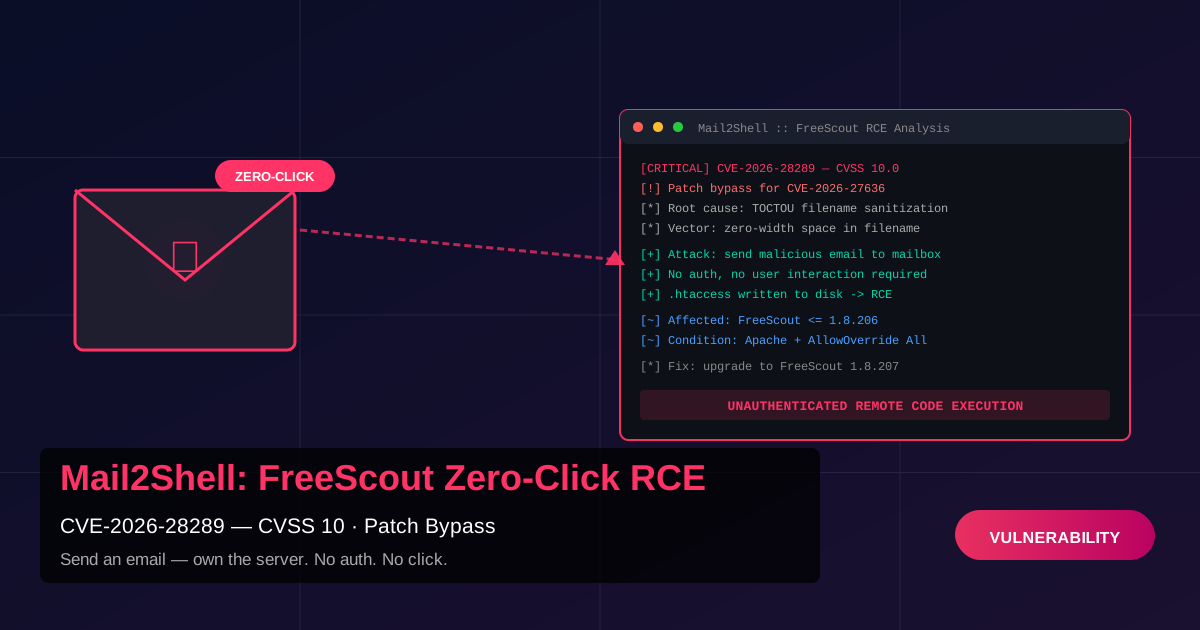
Security researchers at OX Security have disclosed Mail2Shell (tracked as CVE-2026-28289), a CVSS 10.0 zero-click, unauthenticated remote code execution vulnerability in FreeScout, a widely-used open-source helpdesk and mail management platform. The flaw requires no authentication, no user interaction, and no prior access — an attacker need only send an email to any mailbox configured in FreeScout to achieve full server compromise.
CVE-2026-28289 is a patch bypass for CVE-2026-27636, a high-severity authenticated RCE vulnerability patched in a prior FreeScout release. The bypass, a Time-of-Check to Time-of-Use (TOCTOU) flaw in the platform's filename sanitization routine, elevates the severity from authenticated to completely unauthenticated — and from interactive to zero-click.
The vulnerability was patched in FreeScout version 1.8.207, released alongside the disclosure.
Vulnerability Summary
| Detail | Value |
|---|---|
| CVE | CVE-2026-28289 |
| CVSS Score | 10.0 (Critical) |
| CWE | CWE-434: Unrestricted Upload of File with Dangerous Type |
| Type | Zero-click unauthenticated RCE |
| Root Cause | TOCTOU flaw — dot-prefix check precedes zero-width space sanitization |
| Attack Vector | Send malicious email to any FreeScout mailbox |
| Authentication Required | None |
| User Interaction Required | None |
| Affected Versions | FreeScout ≤ 1.8.206 |
| Required Condition | Apache with AllowOverride All enabled |
| Patched In | FreeScout 1.8.207 |
| Discovered By | OX Security |
| Prior Bypass Target | CVE-2026-27636 |
Technical Deep Dive
The Original Flaw: CVE-2026-27636
CVE-2026-27636 was an authenticated RCE vulnerability in FreeScout's file attachment handling. An authenticated user could upload a malicious .htaccess file disguised as an email attachment, which Apache would then interpret as a configuration file — enabling execution of arbitrary server-side commands.
FreeScout's maintainers patched CVE-2026-27636 by adding a filename validation check: any filename beginning with a dot (.) would be rejected, preventing .htaccess from being saved to disk.
The Patch Bypass: CVE-2026-28289
OX Security researchers discovered that the patch for CVE-2026-27636 contains a TOCTOU (Time-of-Check to Time-of-Use) vulnerability in the sanitization pipeline:
- Check phase: The code checks whether the filename begins with a
.(dot-prefix check) — the check passes if no leading dot is found - Sanitization phase: A subsequent sanitization step strips invisible Unicode characters, including zero-width spaces (U+200B)
- TOCTOU gap: If an attacker crafts a filename like
​.htaccess(zero-width space before the dot), the dot-prefix check sees no leading dot and passes the file, then sanitization strips the invisible character — leaving the filename as.htaccesswritten to disk - Execution: Apache reads the now-present
.htaccessfile containing attacker-controlled directives, enabling remote command execution
Zero-Click Escalation
CVE-2026-27636 required an authenticated user to upload the malicious file. CVE-2026-28289 eliminates this constraint entirely:
- FreeScout processes incoming emails automatically, including their attachments
- An attacker can construct a malicious email with a
​.htaccessattachment and send it to any mailbox configured in FreeScout - FreeScout's mail processing pipeline parses the attachment and attempts to save it, triggering the TOCTOU bypass
- The
.htaccessfile is written to disk without any authentication or user interaction - Apache reads the malicious
.htaccessand executes attacker-controlled commands — achieving full server compromise
Affected Configuration
The attack requires FreeScout running on Apache with AllowOverride All enabled in the server configuration — a setting that permits .htaccess files to override Apache directives. This is described as a common configuration for FreeScout deployments, particularly those following official setup documentation.
Affected Versions and Patch
| Version | Status |
|---|---|
| FreeScout ≤ 1.8.206 | Vulnerable |
| FreeScout 1.8.207 | Patched |
Organizations running FreeScout 1.8.206 or earlier on Apache with AllowOverride All should treat this as a critical emergency patch given the zero-click, unauthenticated nature of exploitation.
Current Threat Status
As of the time of disclosure, no active exploitation of CVE-2026-28289 has been observed in the wild. However, given:
- The CVSS 10.0 severity and zero-click nature of the flaw
- The trivial exploitation path — send an email, own the server
- The public disclosure of the vulnerability mechanics
- FreeScout's use by thousands of organizations globally as a self-hosted helpdesk solution
The window before weaponization is likely very short. Organizations should patch immediately.
Recommendations
Immediate Actions
- Upgrade to FreeScout 1.8.207 — the only complete remediation; do not delay
- Audit Apache configuration — if
AllowOverride Allis set, consider switching toAllowOverride Noneor a minimal allowlist as a defense-in-depth measure pending upgrade - Review recent email attachments saved to disk — check for unexpected
.htaccessor similarly named files in FreeScout's attachment directories - Scan for indicators of compromise — check Apache access logs for unusual requests consistent with
.htaccess-enabled code execution (e.g., unexpected PHP execution, unusual response patterns)
For Security Teams
- Prioritize patching internet-exposed FreeScout instances — these are directly exploitable via the public internet with no preconditions
- Enable Web Application Firewall (WAF) rules targeting file upload abuse as a temporary mitigation measure while patching is scheduled
- Monitor outbound traffic from FreeScout servers — a compromised server may beacon to attacker infrastructure; unusual outbound connections are an IOC
- Check for webshell artifacts — look for newly created PHP files or modified
.htaccessfiles in FreeScout's web root and attachment directories
Configuration Hardening (Longer Term)
- Restrict
AllowOverride— limit Apache'sAllowOverridedirective to only what FreeScout requires; avoidAllwhere possible - Run FreeScout as a non-root user with minimal filesystem permissions to limit blast radius if RCE is achieved
- Implement file integrity monitoring on FreeScout directories — detect unauthorized
.htaccesscreation in near-real-time
Key Takeaways
- CVSS 10 zero-click RCE via email — Mail2Shell requires no user interaction, no credentials, and no network access beyond being able to send email to the target; this is a worst-case vulnerability profile
- Patch bypasses are a growing problem — CVE-2026-28289 demonstrates that a patch fixing one authentication requirement can leave an invisible bypass vector; thorough patch validation is essential
- TOCTOU bugs in sanitization pipelines are insidious — the zero-width space technique exploits the ordering of security checks; developers must ensure sanitization occurs before, not after, security validation
- Self-hosted open-source platforms carry patch risk — unlike SaaS solutions, self-hosted tools like FreeScout depend entirely on operators to apply updates; this creates extended exposure windows in the wild
- Zero active exploitation — but only for now — the trivial exploitation path means weaponization is likely imminent; treat this as a critical emergency, not a routine patch cycle item
- Apache
AllowOverride Allis a significant amplifier — this common configuration turns a file upload vulnerability into arbitrary code execution; minimizingAllowOverridescope is a meaningful defense-in-depth measure
Sources
- Mail2Shell zero-click attack lets hackers hijack FreeScout mail servers — BleepingComputer
- Mail2Shell: FreeScout Patch Bypass Escalates to Zero-Click RCE (CVE-2026-28289) — OX Security
- Critical FreeScout Vulnerability Leads to Full Server Compromise — SecurityWeek
- FreeScout RCE: CVE-2026-28289 Patch Bypass via TOCTOU Flaw — TheHackerWire
- FreeScout 1.8.206 Security Advisory — GitHub (GHSA-5gpc-65p8-ffwp)