Executive Summary
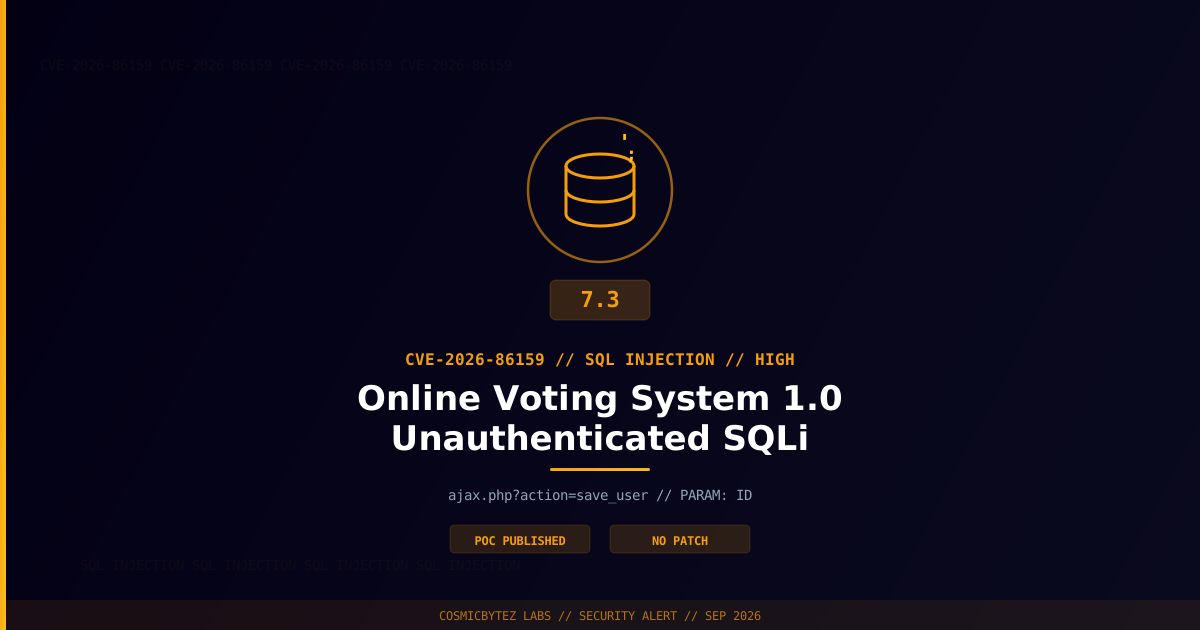
A SQL injection vulnerability (CVE-2026-86159) has been disclosed in SourceCodester's Online Voting System 1.0. The flaw affects an unnamed function reachable at /ajax.php?action=save_user, where the ID parameter is passed into a database query without sanitization. Exploitation requires no authentication and is described as easy to carry out; a public proof-of-concept exploit is already available.
CVSS Score: 7.3 (High, CVSS 3.1) / 6.9 (Medium, CVSS 4.0)
An attacker who successfully exploits this flaw can read, alter, or destroy application data — including voter records, administrator accounts, and voting configuration — putting both data confidentiality and the integrity of any hosted vote at risk.
Vulnerability Overview
| Attribute | Value |
|---|---|
| CVE ID | CVE-2026-86159 |
| CVSS 3.1 Score | 7.3 (High) |
| CVSS 4.0 Score | 6.9 (Medium) |
| CWE | CWE-89 (SQL Injection) |
| Endpoint | /ajax.php?action=save_user |
| Vulnerable Parameter | ID |
| Attack Vector | Network (no authentication required) |
| Exploit Status | Public proof-of-concept available on GitHub |
| Patch Status | No vendor fix available at time of writing |
Affected Versions
| Product | Affected Versions | Fixed Version |
|---|---|---|
| SourceCodester Online Voting System | 1.0 | None available |
This CVE is part of a cluster of related SQL injection flaws disclosed in the same product around the same date, including issues in delete_voting, delete_category, and login actions of the same ajax.php endpoint. Deployments of this codebase should treat the entire ajax.php action dispatcher as untrusted until a comprehensive fix lands.
Attack Vector
1. Attacker identifies a deployment of SourceCodester Online Voting System 1.0
2. Attacker sends a request to ajax.php?action=save_user with a crafted ID parameter
   containing SQL injection payloads (e.g. UNION-based or boolean-based injection)
3. The application concatenates the unsanitized ID value directly into a SQL query
4. The database executes the attacker-controlled query
5. Attacker extracts, modifies, or deletes data — voter records, admin
credentials, ballots, or configuration — depending on query usedImpact of Successful Exploitation
| Impact | Description |
|---|---|
| Data Exfiltration | Read voter, administrator, and configuration records |
| Data Tampering | Alter vote counts, candidate data, or user roles |
| Data Destruction | Delete records via injected DML statements |
| Authentication Bypass | Related login action injection could allow credential-less admin access |
| Loss of Election Integrity | Any hosted vote using this software has its trustworthiness undermined |
Immediate Remediation
Since this is unmaintained/demonstration software with no official patch, mitigation is compensating-control based:
- Take affected deployments offline if used for any live or planned voting process
- Place a WAF in front of the application with SQL injection rule sets enabled, if it must stay online for any reason
- Restrict access to
ajax.phpat the web server level to only the parameters/actions actually required - Migrate to parameterized queries / prepared statements for all
ID-driven actions if you maintain a fork of this codebase - Audit existing data for signs of prior tampering if the application has been internet-facing
Detecting Exploitation Attempts
# Watch access logs for SQL injection patterns targeting the save_user action
grep -i "ajax.php?action=save_user" /var/log/nginx/access.log | grep -iE "union|select|--|;--|or 1=1"Detection Indicators
| Indicator | Description |
|---|---|
SQL keywords in ID parameter values | Direct exploitation attempt |
| Unexpected changes to voter/candidate/admin tables | Successful data tampering |
Anomalous response timing on save_user requests | Possible blind/time-based injection |
| New or modified administrator accounts | Post-exploitation persistence |
Post-Remediation Steps
- Do not use this codebase for any real election or vote given the pattern of unpatched injection flaws across multiple actions
- If a fork must remain in production, rewrite all database access to use prepared statements
- Restore from a known-good backup if tampering is suspected
- Rotate all administrator credentials
- Add input validation and a WAF layer as defense in depth even after code-level fixes
References
- VulDB — CVE-2026-86159 SourceCodester Online Voting System ajax.php save_user SQL Injection
- RedPacket Security — CVE Alert: CVE-2026-86159
- OffSeq Threat Radar — CVE-2026-86159 SQL Injection in SourceCodester Online Voting System
- NIST NVD — CVE-2026-86159