Overview
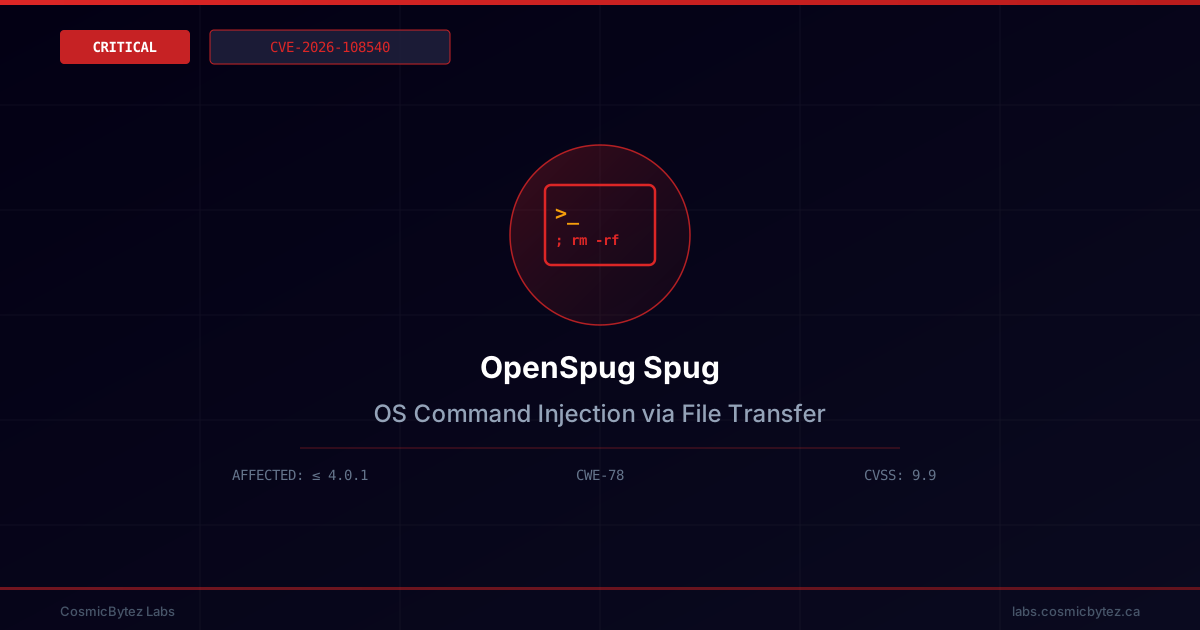
A critical OS command injection vulnerability, tracked as CVE-2026-108540, has been disclosed in OpenSpug Spug, a lightweight, open-source automated operations and deployment platform. The flaw lives in an unknown function of /exec/transfer, the File Transfer component, and allows an attacker to manipulate input that is passed into a system command without proper neutralization — classic CWE-78 territory.
The vulnerability carries a CVSS 3.1 score of 9.9 (Critical), with sources describing the exploit as remotely reachable, easy to execute, and already documented with a public proof of concept. Confidentiality, integrity, and availability are all rated as fully impacted.
Technical Details
| Field | Value |
|---|---|
| CVE ID | CVE-2026-108540 |
| CVSS 3.1 Score | 9.9 (Critical) — CVSS:3.1/AV:N/AC:L/PR:L/UI:N/S:C/C:H/I:H/A:H |
| CWE | CWE-78 — Improper Neutralization of Special Elements used in an OS Command |
| Vulnerable Component | /exec/transfer (File Transfer) |
| Affected Versions | Spug 3.0, 3.1, 3.2, 3.3, 3.4.0, 4.0.0, 4.0.1 |
| Exploit Status | Public proof-of-concept reported by multiple trackers |
| MITRE ATT&CK | T1202 — Indirect Command Execution |
| Reserved / Published | 2026-10-10 / 2026-10-11 |
How It Works
OpenSpug Spug's File Transfer feature constructs all or part of an operating-system command using externally influenced input without neutralizing shell metacharacters. Because the component is reachable with only low privileges and requires no user interaction, an attacker who can submit a transfer request can embed shell metacharacters or command separators into the input, causing the backend to execute attacker-controlled commands with the privileges of the Spug service process.
Some trackers note the underlying GitHub security advisory for Spug bundles this command injection alongside related issues (XSS, SQL injection, path traversal, CSRF, and missing authorization checks) in the same File Distribution code path — but CVE-2026-108540 itself is scoped specifically to the OS command injection in /exec/transfer.
Impact Assessment
| Impact Area | Description |
|---|---|
| Confidentiality | High — command execution exposes any file or secret the Spug service account can read |
| Integrity | High — attackers can modify deployed artifacts, configuration, or managed hosts |
| Availability | High — arbitrary command execution can be used to disrupt or disable managed infrastructure |
| Scope | Changed — successful exploitation can affect resources beyond the vulnerable component itself |
| Blast Radius | Spug is an ops/deployment tool, typically holding credentials and SSH access to many downstream servers it manages |
Who Is At Risk
- Organizations running OpenSpug Spug 3.0 through 4.0.1 with the File Transfer feature reachable from any network an attacker can access
- Deployments where Spug holds SSH keys or credentials for managed fleets — command execution on the Spug host can pivot into every host it administers
- Low-privilege (PR:L) accounts with any access to the transfer endpoint, since the attack requires only limited privileges, not full admin rights
Mitigation
Immediate Actions
- Upgrade OpenSpug Spug past 4.0.1 as soon as an official fixed release is available; monitor the project's release notes and GitHub advisories closely given the public PoC.
- Restrict network access to the Spug management interface and
/exec/transferendpoint to trusted, internal IPs only — do not expose it to the open internet. - Deploy a Web Application Firewall with rules to detect and block common OS command injection patterns (shell metacharacters, command separators, backticks) on requests to the File Transfer endpoint.
Detection Opportunities
- Review Spug server logs for transfer requests containing shell metacharacters (
;,|,&&,`,$() in parameters that are normally filenames or paths. - Monitor for unexpected outbound connections or process spawns from the Spug host, which would indicate a command injection payload executed successfully.
Defence-in-Depth
- Run the Spug service under a restricted, minimal-privilege service account rather than root, to limit the blast radius of any successful injection.
- Rotate SSH keys and credentials Spug holds for managed hosts if compromise is suspected, since those credentials are the real prize in an ops-tooling breach.
- Given the severity and public exploit availability, teams with strict risk tolerances should consider isolating or temporarily disabling the File Transfer feature until a patch is confirmed.
Background
OpenSpug Spug is an open-source, lightweight DevOps platform used for automated deployment, host management, and task scheduling — the kind of tool that, by design, holds broad administrative reach across the infrastructure it manages. That's exactly what makes an unauthenticated-adjacent, low-privilege OS command injection in its File Transfer component so dangerous: a single compromised Spug instance can become a launchpad into every server it was trusted to administer.