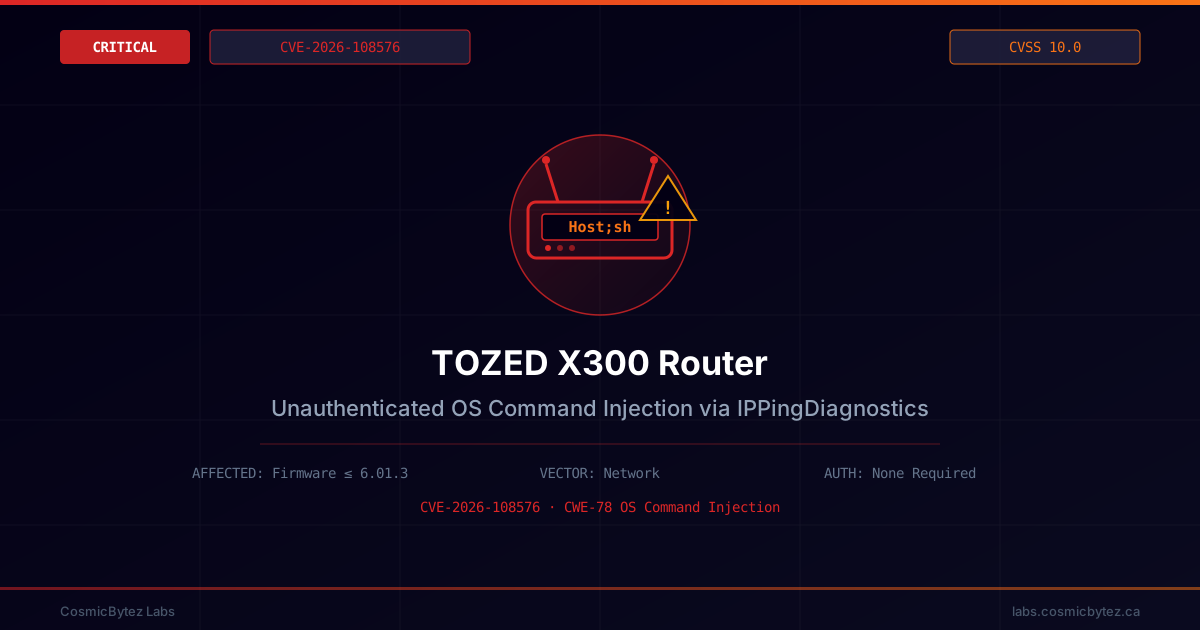
Maximum-Severity Command Injection in a Consumer/SMB 4G-5G Router
A critical, unauthenticated OS command injection vulnerability has been disclosed in the TOZED X300, a 4G/5G CPE (customer-premises equipment) router, affecting firmware versions 6.01.0 through 6.01.3. Tracked as CVE-2026-108576 and published on October 11, 2026, the flaw carries a maximum CVSS score of 10.0 (Critical) — the highest possible rating — because it requires no authentication, no user interaction, and no special privileges, and can be triggered entirely over the network.
The vulnerability lives in the process_ping function of the device's IPPingDiagnostics Handler, a network diagnostics component that is part of the standard TR-069/CWMP (CPE WAN Management Protocol) "IP Ping Diagnostics" data model used by ISPs and management platforms to remotely test connectivity on deployed CPE devices. The handler's Host argument is passed into an operating-system command without sanitizing shell metacharacters, allowing an attacker to append arbitrary commands to the value and have them executed with the privileges of the diagnostics process. According to the disclosing researcher, the vendor was contacted early about the issue but did not respond, and no patched firmware has been published as of this writing.
Vulnerability Details
| Attribute | Value |
|---|---|
| CVE ID | CVE-2026-108576 |
| Affected Product | TOZED X300 (4G/5G CPE router) |
| Affected Firmware | 6.01.0, 6.01.1, 6.01.2, 6.01.3 (≤ 6.01.3) |
| Vulnerable Component | IPPingDiagnostics Handler — process_ping function |
| Vulnerable Parameter | Host |
| CWE | CWE-78 (OS Command Injection), CWE-77 (Improper Neutralization of Special Elements) |
| CVSS Score | 10.0 — Critical (CVSS 3.1 and CVSS 4.0 both scored maximum) |
| CVSS Vector (3.1) | AV:N/AC:L/PR:N/UI:N/S:C/C:H/I:H/A:H (per VulDB scoring) |
| Attack Vector | Network — remote, no authentication required |
| Exploit Maturity | Technical details public; no proof-of-concept exploit code indexed at time of writing |
| CISA KEV Status | Not listed |
| Vendor Response | Contacted early in the disclosure process; did not respond |
| Patch Available | No — not confirmed as of October 12, 2026 |
| Published | October 11, 2026 (NVD) |
How the Vulnerability Works
Step 1: A Standard Diagnostics Feature
TR-069/CWMP (also referred to as TR-143) defines an IPPingDiagnostics data model object that ISPs and remote management platforms use to instruct a CPE device to run a network connectivity test — essentially a remote-triggered ping. The Host parameter specifies the target address or hostname the device should ping.
Step 2: Unsanitized Input Reaches a Shell Command
The process_ping function that handles this request builds an operating-system command using the value supplied in Host, but it does not neutralize shell metacharacters such as ;, |, &, backticks, or $() sequences before doing so. Because the diagnostics handler is reachable without authentication, any value an attacker supplies for Host is passed straight through to the underlying command interpreter.
Step 3: Arbitrary Command Execution
By appending a shell separator and a second command to the Host value — for example, a string shaped like a normal IP address followed by a semicolon and an arbitrary shell command — an attacker causes the device to execute that second command with whatever privileges the diagnostics process holds. No valid credentials, session, or user interaction are needed at any step, and the entire attack can be carried out remotely over the network.
Step 4: Full Device Compromise
Because the injected command runs in the context of the router's management/diagnostics process, successful exploitation gives an attacker a foothold on the device itself — enabling configuration tampering, traffic interception or redirection, use of the router as a pivot point into the connected LAN, or recruitment of the device into a botnet.
Impact Assessment
| Impact Area | Description |
|---|---|
| Confidentiality | High — an attacker can read device configuration, credentials, and potentially traffic traversing the router |
| Integrity | High — arbitrary command execution allows configuration changes, firmware tampering, or planting of persistent malware |
| Availability | High — a malicious command can disable networking, reboot the device, or brick it entirely |
| Authentication required | None — the flaw is exploitable pre-authentication |
| Network exposure | Any X300 unit with the management/diagnostics interface reachable from an untrusted network, including the public internet if WAN-side management is enabled |
| Downstream risk | Compromised CPE routers are commonly used as botnet nodes (e.g., Mirai-class malware) or as a pivot into home/office LANs |
| Deployment context | CPE routers are frequently deployed by ISPs at scale with limited end-user visibility into patch status, increasing the population of long-unpatched, internet-facing devices |
Recommendations
For ISPs and Device Administrators
- Disable WAN-side (internet-facing) management and TR-069/CWMP access on X300 units where it is not strictly required for remote provisioning.
- Restrict the management/diagnostics interface to trusted management VLANs or ACME server IP ranges only — it should never be reachable from the general internet.
- Inventory all deployed TOZED X300 units and their firmware versions; treat every unit running 6.01.0–6.01.3 as vulnerable until the vendor confirms a fix.
- Monitor vendor channels for a patched firmware release. As of this writing, TOZED has not responded to the disclosure or published a fix — check for updates regularly.
For Security Teams
- Scan for internet-exposed TR-069/CWMP endpoints (commonly ports 7547 and similar) across managed and customer-facing IP ranges.
- Add detection content for CVE-2026-108576 once vendor or community signatures become available, and watch threat intelligence feeds for exploitation reports given the CVSS 10.0 rating.
- Treat CPE/IoT routers as untrusted network citizens — segment them away from internal management and critical systems regardless of patch status.
- Flag this CVE for urgent tracking in vulnerability management platforms; a no-auth, network-reachable CVSS 10.0 issue with no vendor patch is a standing risk until mitigated.
For End Users
- Do not expose your router's management interface to the internet. Confirm remote/WAN management is disabled unless your ISP explicitly requires it.
- Check with your ISP or TOZED for firmware update guidance if you know or suspect you are running an X300 device.
- Place IoT and CPE devices on an isolated network segment where possible, separate from computers and other sensitive devices.
- Reboot and monitor your device for unusual behavior (unexpected reboots, configuration changes, unfamiliar connected devices) as a precaution.
Key Takeaways
- CVE-2026-108576 scores a maximum CVSS 10.0 — it requires no authentication, no privileges, and no user interaction, and is exploitable entirely over the network.
- The flaw lives in a standard TR-069/CWMP diagnostics feature (
IPPingDiagnostics/process_ping), meaning any management system or attacker able to reach the handler can trigger it. - The root cause is classic unsanitized input passed to a shell command (CWE-78/CWE-77) — the
Hostparameter is never neutralized before being used to build an OS command. - No vendor response and no patch are currently available. TOZED was contacted early in the disclosure process but did not respond, leaving network-level mitigation as the only available defense.
- CPE/router devices are high-value, often-overlooked targets. Their internet-facing management interfaces and typically slow patch cycles make them attractive for botnet recruitment and network pivoting.
- Immediate mitigation is network segmentation and disabling WAN-side management — not a firmware update, since none exists yet.