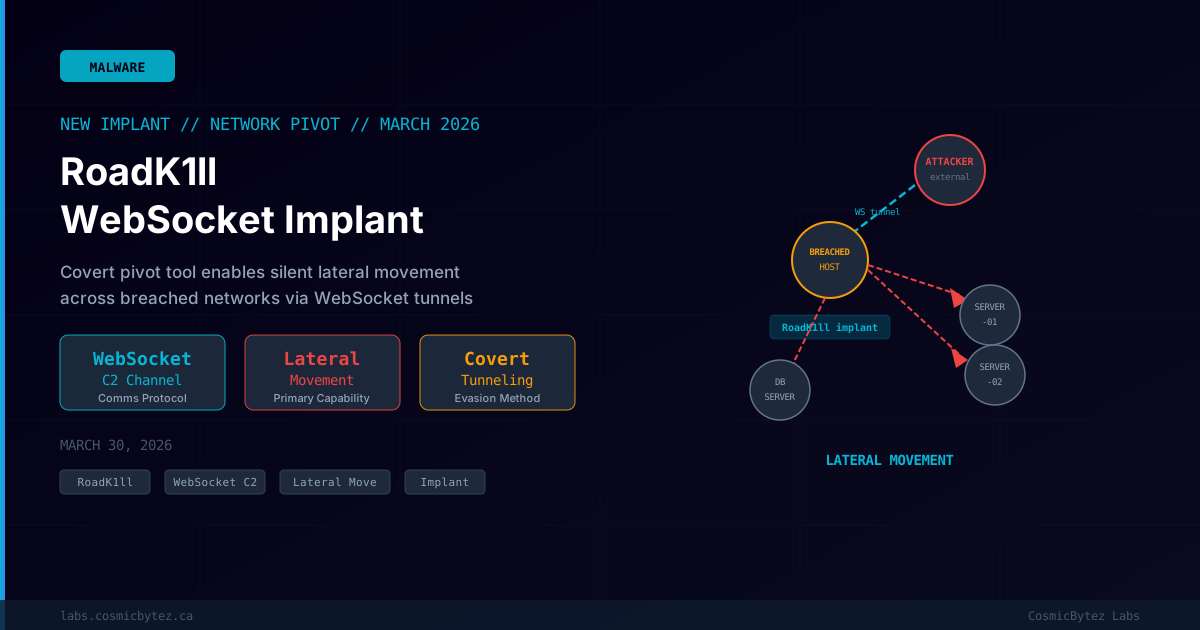
Security researchers have identified a newly discovered malicious implant named RoadK1ll that leverages WebSocket connections to enable quiet lateral movement from an initially compromised host to deeper systems on the same network. The implant represents a growing trend of threat actors using legitimate protocol mechanisms — in this case WebSocket — to blend malicious activity into normal web traffic and evade network-layer detections.
What Is RoadK1ll
RoadK1ll is a post-compromise implant — meaning it is deployed after an attacker has already established initial access to a host. Its primary function is network pivoting: creating a covert channel from an external attacker-controlled server through the compromised host to other internal systems that would otherwise be unreachable from the internet.
The implant's use of WebSocket as its command-and-control (C2) communication protocol is a deliberate design choice. WebSocket connections are indistinguishable from standard HTTPS traffic at the network layer, use port 443, and are permitted through most enterprise firewalls and proxies. This makes RoadK1ll-based C2 traffic extremely difficult to block without disrupting legitimate business applications.
Technical Capabilities
Based on reporting from BleepingComputer, RoadK1ll provides threat actors with:
- Bidirectional WebSocket tunnel: A persistent, full-duplex channel from the attacker's infrastructure through the compromised host
- Internal network reachability: Once the WebSocket tunnel is established, the attacker can use the compromised host as a relay to probe and attack internal hosts on segments not exposed to the internet
- Stealth profile: Traffic resembles normal browser or application WebSocket activity, complicating detection via simple port or protocol analysis
The implant is designed to be deployed on a host that already has network connectivity to both external internet and internal network segments — such as a DMZ web server, a remote access gateway, or an endpoint with split-tunnel VPN access.
Attack Scenario
1. Attacker gains initial access to an internet-facing host
   (e.g., via phishing, exploitation of a public-facing service)

2. RoadK1ll implant is deployed on the compromised host

3. Implant establishes outbound WebSocket connection to attacker C2
   (port 443, blends with HTTPS traffic)

4. Attacker uses the WebSocket tunnel to relay network traffic
   through the compromised host to internal systems:
     - Internal servers not exposed to internet
     - Databases, AD controllers, network devices
     - Other workstations on the same LAN segment

5. Attacker pivots deeper, escalates privileges, and achieves
broader network compromiseWhy WebSocket-Based C2 Is Dangerous
Traditional C2 detection relies on identifying unusual outbound connections — unexpected IP addresses, uncommon ports, or protocols that don't match baseline behavior. WebSocket-based implants defeat these heuristics:
- WebSocket runs over HTTP/HTTPS — it looks identical to legitimate web application traffic
- Most enterprises run dozens or hundreds of internal and SaaS applications that use WebSocket, making baseline profiling difficult
- WebSocket connections are long-lived, meaning they don't generate the repeated connection patterns that beacon-based C2 over HTTP often does
- The initial WebSocket handshake is a standard HTTP Upgrade request, which appears in logs as a normal web request
This technique places increased importance on endpoint-based detection and behavioral analytics rather than network signature matching.
Detection Guidance
Organizations should look for the following indicators:
Network-Level
- Unusual WebSocket connections (HTTP Upgrade requests) originating from servers that do not normally run web applications
- Long-lived outbound connections from hosts in sensitive network segments
- WebSocket traffic to unexpected external IP ranges or newly registered domains
Endpoint-Level
- Suspicious processes listening on or initiating WebSocket connections
- Processes with no legitimate business function establishing persistent outbound connections
- Unusual child process relationships involving scripting runtimes (Python, Node.js, PowerShell) spawning network-connected processes
Log Sources to Monitor
# Check for WebSocket upgrade requests in web proxy logs
grep "HTTP/1.1 101" /var/log/proxy/access.log | awk '{print $1, $7, $8}'

# Look for unusual long-lived TCP connections (proxy/SIEM)
# Sessions with duration > 10 minutes on port 443 to external IPs

# EDR: processes establishing outbound 443 connections from non-browser processes
# Alert on: python.exe, node.exe, powershell.exe → outbound 443 → external IPMitigation Recommendations
- Segment your network — ensure internet-facing hosts cannot directly reach sensitive internal segments; require explicit firewall rules for internal communication
- Inspect WebSocket traffic — deploy TLS inspection on egress proxies to allow inspection of encrypted WebSocket payloads from high-risk host categories (servers, not user endpoints)
- Monitor for unusual long-lived connections — alert on outbound TCP sessions exceeding a baseline duration threshold from server-class systems
- Harden initial access vectors — the most effective defense is preventing the initial compromise that allows RoadK1ll deployment; prioritize patch management for internet-facing systems
- Deploy endpoint detection — behavioral EDR solutions that baseline normal process network behavior can detect RoadK1ll's C2 activity even when network signatures fail
Context: WebSocket C2 as an Emerging Trend
RoadK1ll is not an isolated case. The use of WebSocket for C2 has been observed in multiple malware families and red-team tools over the past several years. The technique was popularized by legitimate penetration testing frameworks before being adopted by threat actors. Its continued appearance in newly discovered implants confirms that attackers are actively investing in evasion-capable infrastructure that can persist in monitored environments.
The identification of RoadK1ll as a distinct implant suggests ongoing threat actor investment in custom tooling designed to bypass network security controls that focus on protocol and port blocking rather than behavioral analysis.
Source: BleepingComputer — March 30, 2026