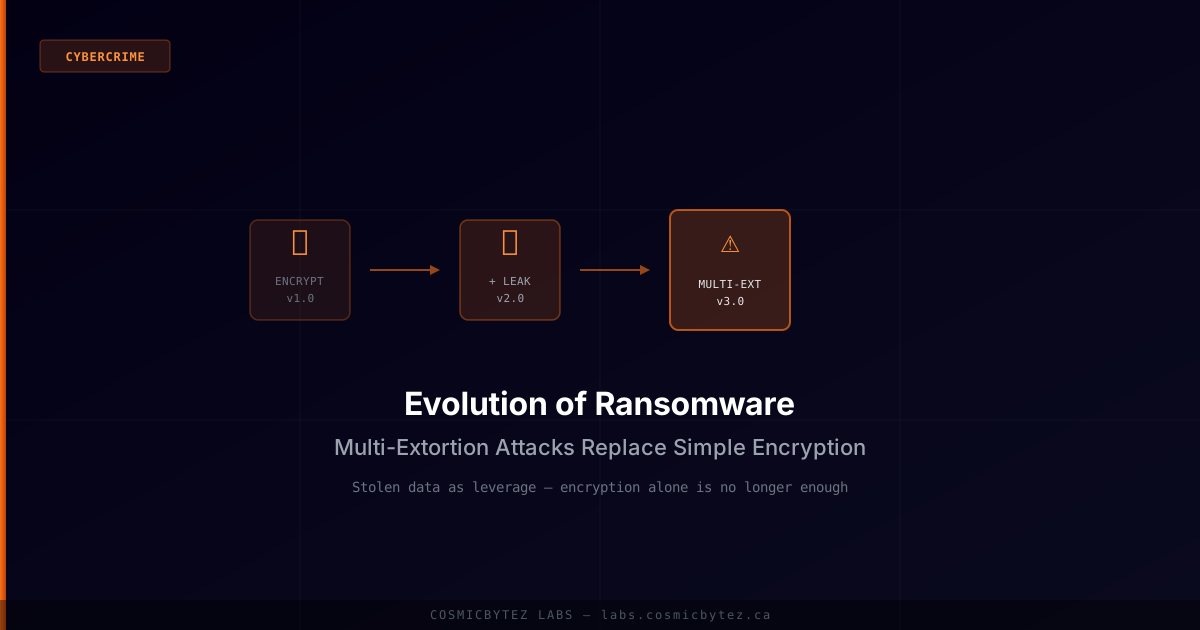
Ransomware has undergone a dramatic transformation over the past several years. What began as a blunt instrument — encrypt files and demand payment for decryption — has evolved into a sophisticated, multi-layered extortion engine that exploits stolen data as its primary lever. Understanding this evolution is essential for defenders in 2026.
The Evolution Timeline
Generation 1: Encryption-Only (2013–2017)
Early ransomware variants like CryptoLocker and WannaCry operated on a simple premise: encrypt the victim's data and demand a cryptocurrency ransom for the decryption key. Organizations with robust backups could often recover without paying.
Attacker problem: Victims with good backups simply restored and moved on.
Generation 2: Double Extortion (2019–2021)
Ransomware groups began exfiltrating data before encryption, threatening to publish stolen files on "leak sites" if the ransom was not paid. This tactic — pioneered by groups like Maze and later adopted by REvil, LockBit, and ALPHV/BlackCat — meant that backups no longer provided complete protection.
Attacker advantage: Even if a victim restores from backup, the threat of public data exposure creates independent extortion leverage.
Generation 3: Multi-Extortion (2022–Present)
Modern ransomware operations deploy multiple simultaneous pressure vectors:
- Encryption of production systems and backups
- Data exfiltration with leak site publication threats
- DDoS attacks against victim infrastructure to maximize disruption
- Direct contact with customers, regulators, and media to amplify pressure
- Harassment campaigns targeting executives and employees
Why Encryption Alone No Longer Defines the Threat
A critical insight from recent research is that many ransomware groups are deprioritizing encryption in favor of pure data extortion. Exfiltrating and threatening to release data is faster, harder to detect, and avoids the operational complexity of deploying and managing ransomware encryption infrastructure.
Groups operating in this "encryption-optional" model include actors behind recent healthcare and financial sector breaches where no encryption was deployed — only data theft and extortion threats.
The Role of Encrypted Data-at-Rest
Solutions like Penta Security's D.AMO platform address multi-extortion by ensuring that data remains encrypted even when exfiltrated. If the stolen data is already encrypted with keys that the attacker cannot access, the leak threat becomes hollow — the published data is useless without the decryption keys.
This approach inverts the attacker's leverage model: rather than paying to prevent publication, organizations can allow publication knowing the data is unreadable.
Attack Chain of a Modern Multi-Extortion Campaign
A typical multi-extortion attack in 2026 follows this pattern:
- Initial Access — Phishing, credential stuffing, or exploitation of unpatched vulnerabilities (VPN, RDP, firewall)
- Persistence and Lateral Movement — Establishing footholds, moving across the network using legitimate tools (living off the land)
- Data Discovery and Staging — Identifying high-value data (PII, financial records, IP, credentials)
- Exfiltration — Moving data out via cloud storage or covert channels, often over weeks
- Ransomware Deployment — Encryption deployed on a predetermined date, often weekends or holidays
- Multi-Channel Extortion — Ransom note + DDoS + media/regulator contact + customer notification
Defender Implications
Organizations must rethink their ransomware defense posture:
- Backups are necessary but not sufficient — data theft resilience requires data classification and encryption at rest
- Exfiltration detection is critical — large outbound transfers should trigger alerts regardless of known-good destinations
- Incident response must address public disclosure risk — legal, communications, and PR teams must be part of ransomware playbooks
- Cyber insurance policies are increasingly excluding pure extortion payments, changing the economics of paying
The Ransomware-as-a-Service Ecosystem
Most attacks in 2026 are executed by affiliates of Ransomware-as-a-Service (RaaS) platforms rather than the core ransomware developers. This affiliate model means:
- Attack quality and tooling vary significantly by affiliate
- Disrupting the RaaS platform (as law enforcement did with LockBit and ALPHV) only temporarily disrupts operations
- Affiliates migrate between platforms, maintaining continuity of attacks
Understanding this ecosystem is as important as understanding the technical attack chain — ransomware is fundamentally a business model, and disrupting the economics matters as much as disrupting the technology.
Source: BleepingComputer