Overview
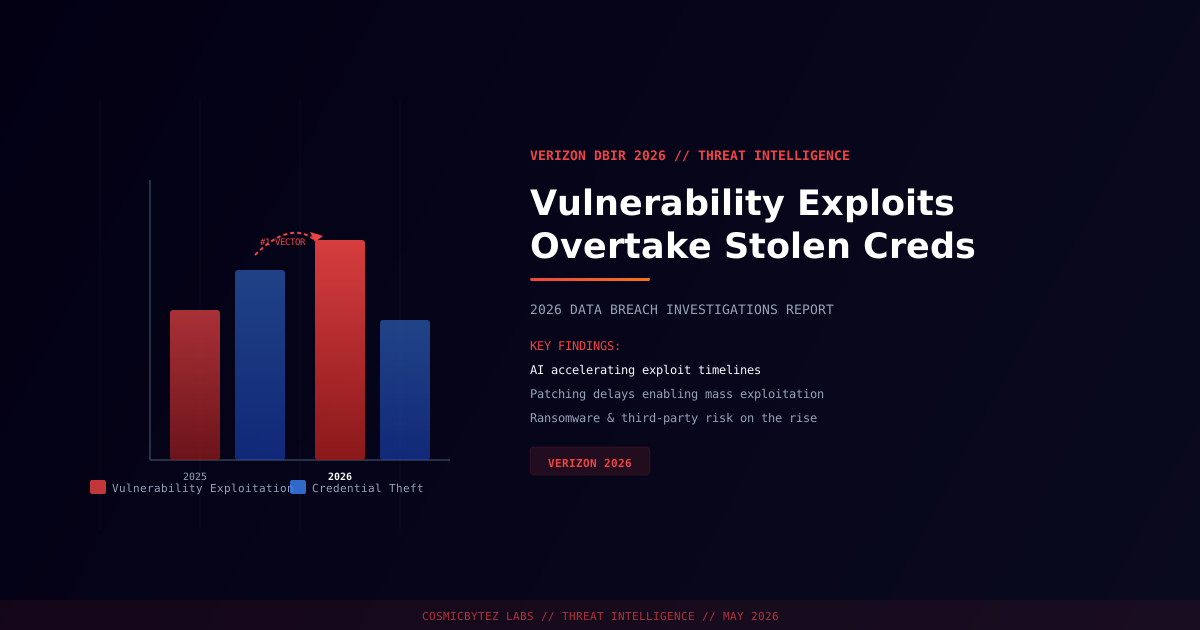
Verizon has released its 2026 Data Breach Investigations Report (DBIR), one of the most widely cited annual cybersecurity benchmarks in the industry. The headline finding marks a significant inflection point in the threat landscape: vulnerability exploitation has overtaken credential abuse as the number-one initial access vector in confirmed data breaches.
The shift underscores how rapidly the exploitation economy has evolved, with AI tools slashing the time between vulnerability disclosure and weaponized attack, and organizations continuing to struggle with patch deployment timelines.
Key Findings
Vulnerability Exploitation Takes the Lead
For years, stolen or phished credentials were the dominant path attackers used to gain initial access. The 2026 DBIR data shows that exploitation of unpatched vulnerabilities has now edged ahead, reflecting:
- AI-assisted exploit development compressing timelines from months to days
- Mass scanning enabling opportunistic exploitation at scale within hours of CVE publication
- Patching fatigue — security teams overwhelmed by CVE volume, leading to delayed remediation on critical systems
Ransomware Remains Dominant
Ransomware continues to be involved in the majority of financially motivated breaches. The report notes that:
- Ransomware gangs are increasingly leveraging exploited vulnerabilities (rather than phishing) as their initial foothold
- Double and triple extortion tactics are now standard, combining encryption with data theft and customer notification threats
- The median dwell time before ransomware deployment has continued to shrink
Third-Party and Supply Chain Risk Surges
The 2026 DBIR reports a significant uptick in breaches traced back to third-party vendors and software supply chain compromises, consistent with high-profile incidents like Mini Shai-Hulud, the Trivy supply chain attack, and multiple npm/PyPI compromises documented throughout early 2026.
AI Accelerates Both Attack and Defense
The report dedicates substantial coverage to AI's dual role:
- Offensive AI is being used to speed up phishing content creation, automate vulnerability scanning, and generate working exploit code
- Defensive AI is helping security teams surface anomalies and triage alerts faster — but adoption lags behind attacker use
Year-Over-Year Comparison
| Vector | 2025 Rank | 2026 Rank | Trend |
|---|---|---|---|
| Vulnerability Exploitation | #2 | #1 | ↑ Rising |
| Stolen Credentials | #1 | #2 | ↓ Still high |
| Phishing | #3 | #3 | → Stable |
| Social Engineering | #4 | #4 | → Stable |
| Supply Chain | #6 | #5 | ↑ Rising |
Industry Impact
The DBIR covers data from thousands of incidents and hundreds of confirmed breaches across multiple industries. Key sector findings include:
- Healthcare remains among the most targeted sectors, with ransomware and insider threats both prevalent
- Financial services sees credential theft remain high due to the value of account access
- Manufacturing experiences a surge in vulnerability-based attacks as OT/IT convergence expands the attack surface
- Public sector faces escalating nation-state exploitation activity
Recommendations for Security Teams
Given the DBIR's findings, security professionals should prioritize:
- Vulnerability management velocity — time-to-patch for critical CVEs should be measured in hours, not weeks
- Attack surface reduction — reduce exposed services and prioritize internet-facing system hardening
- MFA everywhere — credential stuffing remains highly effective against MFA-lacking systems
- Third-party risk programs — treat vendor software the same as internal code from a security posture standpoint
- Tabletop exercises — simulate ransomware scenarios using exploitation (not just phishing) as the entry point
Bottom Line
The 2026 DBIR's core message is clear: unpatched vulnerabilities are now the attacker's preferred front door. The organizations best positioned to weather the current threat environment are those that have invested in rapid patch deployment, continuous exposure management, and multi-layered defenses that don't rely on any single control.
Sources
- SecurityWeek — Verizon DBIR 2026: Vulnerability Exploitation Overtakes Credential Theft
- Verizon 2026 Data Breach Investigations Report