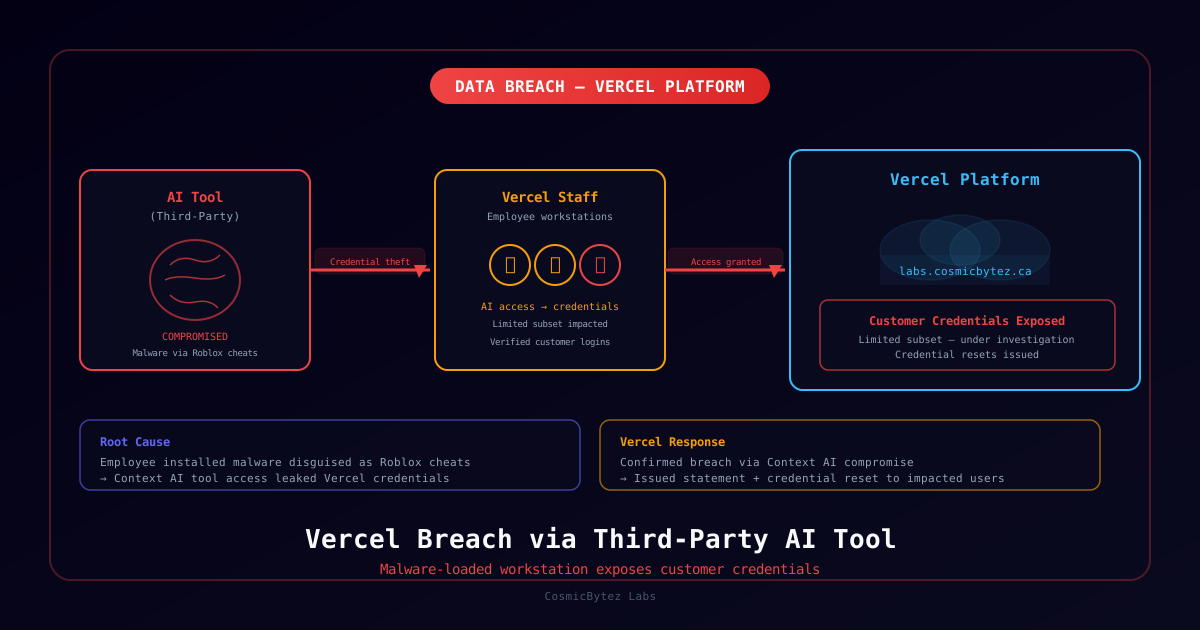
Vercel has released a formal statement acknowledging a security breach affecting a limited subset of customers, confirming that Vercel credentials were compromised after an attacker gained access through a third-party AI tool used by company employees. The breach represents another data point in the growing trend of AI developer tools becoming vectors for credential theft and supply chain attacks.
What Happened
The breach traces back to the Context AI compromise, in which malware was distributed to end users — including, apparently, Vercel employees. The infection vector involved malware disguised as Roblox cheat software installed on employee workstations. Once installed, the malware harvested credentials from the machine, including access tokens for the third-party AI coding tool.
With access to the AI tool's session, the attacker was able to extract Vercel-related credentials that Vercel employees had used or stored in the context of the tool, ultimately compromising a limited subset of customer accounts.
Attack Sequence
1. Vercel employee installs malware disguised as Roblox cheat software
2. Infostealer harvests browser credentials and session tokens
3. AI coding tool (Context AI) access token captured
4. Attacker accesses Context AI with stolen token
5. Vercel credentials extracted from AI tool context/memory
6. Attacker accesses limited Vercel customer accounts
7. Vercel detects breach, issues customer notificationsVercel's Response
Vercel's official statement acknowledged:
- A breach occurred through a compromised third-party AI tool
- A limited subset of customers had their Vercel credentials exposed
- Affected customers have been directly notified
- Credential resets have been issued to impacted accounts
- The investigation is ongoing
Vercel has not disclosed the number of affected customers, the specific AI tool involved beyond the Context AI link, or the full scope of what data the attacker was able to access.
The Context AI Connection
This incident is part of a broader Context AI breach that made headlines in the days prior. Context AI, a developer productivity tool that integrates with coding environments to provide AI assistance, was compromised in a way that exposed the credentials and session tokens of its users.
The Vercel breach demonstrates a compounding supply chain effect:
| Layer | Compromise |
|---|---|
| Malware (Roblox cheats) | Infects employee workstation |
| Context AI (AI tool) | Credentials/tokens stolen from infected machine |
| Vercel (cloud platform) | Customer credentials exposed via Context AI access |
| Vercel customers | Credentials potentially reused downstream |
This chain illustrates how a single endpoint infection can cascade through multiple trusted services before reaching the final victim — without the attacker ever needing to directly attack Vercel's infrastructure.
Broader Implications for AI Tool Security
The breach underscores a rapidly emerging risk category: AI coding tools as credential aggregators. These tools routinely interact with:
- Cloud platform APIs (Vercel, AWS, GCP, Azure)
- Source code repositories (GitHub, GitLab)
- CI/CD systems
- Database connection strings
- Internal tooling credentials
When an AI tool is compromised — whether through the tool itself, the vendor's infrastructure, or an employee's infected machine — it potentially exposes credentials across every integrated service. The breadth of access these tools accumulate makes them high-value targets.
Security Considerations for AI Developer Tools
Credential hygiene:
- Avoid storing long-lived credentials in AI tool contexts
- Use short-lived tokens with automatic expiration where possible
- Rotate API keys regularly, especially for tools with broad system access
Endpoint security:
- AI tools on developer machines are only as secure as the endpoint itself
- Enforce endpoint detection and response (EDR) on all developer workstations
- Prohibit personal/gaming software on corporate machines or use application allowlisting
Least privilege for AI integrations:
- Scope AI tool permissions to the minimum required
- Audit what credentials and data AI tools can access or retain
- Review OAuth consent grants for AI tools in your identity provider
What Vercel Customers Should Do
- Check your email for a notification from Vercel — if you were affected, you would have received a direct communication
- Rotate your Vercel credentials regardless of whether you received a notification, as a precautionary measure
- Audit API tokens — check active tokens in your Vercel dashboard and revoke any that are unused or unrecognized
- Review recent deployments for any unexpected activity in your project history
- Enable two-factor authentication on your Vercel account if not already active
Key Takeaways
- AI coding tools are becoming high-value targets due to the breadth of credentials they interact with
- The Vercel breach is part of a supply chain cascade — the attacker never needed to directly attack Vercel
- Endpoint security on developer machines is foundational — a compromised workstation can expose dozens of integrated services
- Organizations should audit AI tool integrations for excessive credential scope and revoke credentials proactively after any related vendor breach
- Vercel's response includes direct customer notification and forced credential resets — customers should take additional precautionary steps
Source: The Record — Cloud platform Vercel says company breached through third-party AI tool