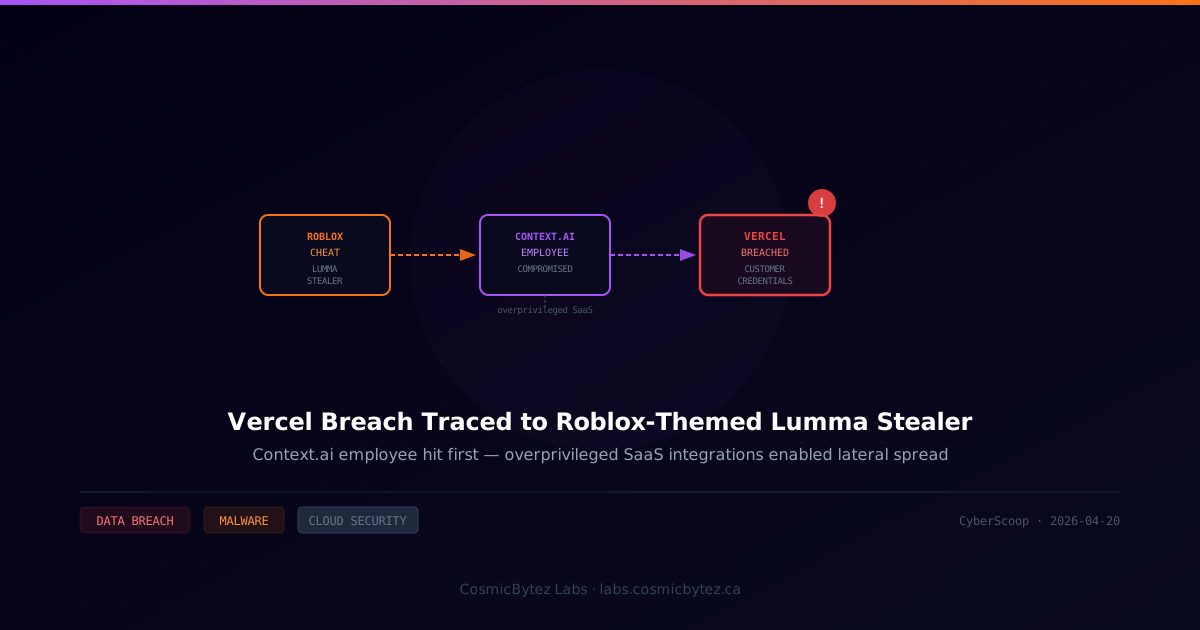
The full picture of the Vercel security breach is coming into focus — and it traces back not to a sophisticated nation-state attack, but to an employee at Context.ai downloading malware disguised as Roblox cheat software.
The incident, detailed by CyberScoop, illustrates a recurring pattern in modern cloud security incidents: attackers compromise a low-trust peripheral in an organization's SaaS ecosystem, then exploit overprivileged integrations to reach a more valuable target.
The Attack Chain
Step 1: Lumma Stealer via Roblox Cheats
The breach began when a Context.ai employee downloaded what appeared to be a Roblox cheat client from an unofficial source. The file was actually Lumma Stealer — a commodity information-stealing malware widely used by cybercriminals to harvest browser credentials, session cookies, and authentication tokens from infected machines.
Lumma Stealer is distributed through a variety of social engineering lures including fake software cracks, game cheats, and pirated content. Its low cost on underground markets and effectiveness at credential theft make it a staple of financially motivated attackers.
Step 2: Credential Exfiltration
Once installed on the employee's machine, Lumma Stealer harvested credentials and session tokens stored in the browser — including those used to authenticate to Context.ai's business SaaS applications.
Step 3: Pivot to Vercel
The stolen credentials provided the attacker with access to Context.ai's systems, which held an overprivileged integration with Vercel. This integration had permissions that extended beyond what was necessary for Context.ai's legitimate business function.
The attacker leveraged these permissions to gain access to limited Vercel customer credentials — turning a single compromised employee device into a breach affecting Vercel's customer base.
The Overprivileged SaaS Problem
The Vercel breach is a textbook example of what security researchers call the "overprivileged SaaS integration" problem:
| Risk Factor | What Happened |
|---|---|
| Third-party SaaS access | Context.ai held an integration with Vercel's systems |
| Excessive permissions | The integration had broader access than the business relationship required |
| Credential theft vector | A single employee device compromise was sufficient to activate the integration |
| Blast radius | Attacker pivoted from a small AI company to Vercel's customer data |
Modern cloud stacks are deeply interconnected. A company might have dozens or hundreds of third-party SaaS integrations — analytics platforms, support tools, AI providers, monitoring services — each holding some level of access to production systems or customer data.
What Was Exposed
Vercel confirmed the breach impacted limited customer credentials. The full scope of the exposure is still being assessed. Affected customers should:
- Rotate Vercel API tokens and access credentials immediately
- Review OAuth application permissions connected to your Vercel account
- Audit deployment logs for any unexpected activity in the period around the breach
- Enable audit logging on Vercel if not already configured
Broader Lessons
For Security Teams
The Vercel incident highlights that your security posture is only as strong as your weakest SaaS integration. Standard recommendations:
- Audit third-party integrations regularly — remove integrations that are no longer needed or have excessive permissions
- Apply least-privilege to OAuth scopes — grant integrations only the minimum permissions required
- Monitor for anomalous API activity — unusual access patterns from third-party integrations should trigger alerts
- Require phishing-resistant MFA — hardware security keys or passkeys would have prevented Lumma Stealer's session token theft from being directly useful
For Developers Using Vercel
# Audit Vercel team integrations via CLI
vercel integration ls

# Rotate all project-level tokens
vercel token ls
vercel token rm <token-id>

# Review recent deployment activity for anomalies
vercel logs --since 2026-04-01The Gaming Malware Vector
The use of a Roblox cheat as the malware delivery mechanism is notable — and increasingly common. Security researchers have documented a persistent trend of infostealer campaigns targeting:
- Game cheat clients and trainers
- Pirated software
- Fake AI tools and productivity apps
- Counterfeit browser extensions
These lures are particularly effective because they target employees' personal computing behaviors rather than corporate assets — exploiting the reality that many developers use personal machines or blur the line between personal and professional device use.
Source: CyberScoop