Overview
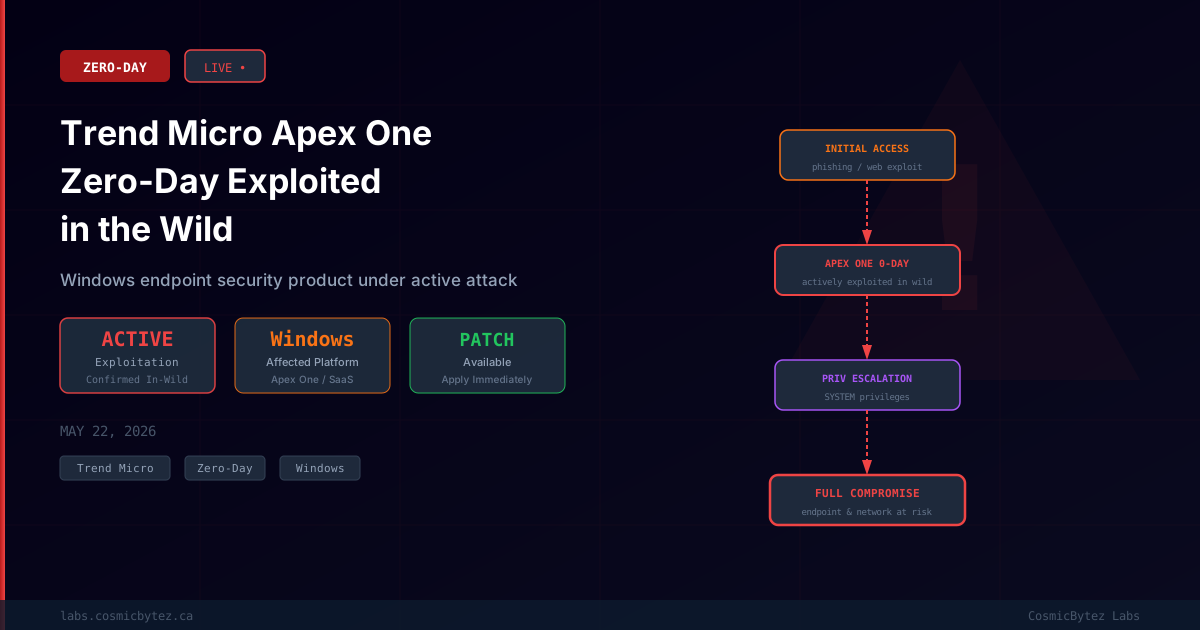
Trend Micro has issued an urgent security advisory warning customers that a zero-day vulnerability in Apex One is being actively exploited in the wild against Windows systems. The vulnerability was identified in Trend Micro's flagship enterprise endpoint protection platform, and exploitation was confirmed before a patch was available — the defining characteristic of a zero-day.
Trend Micro has now released fixes and is urging all Apex One customers to apply updates immediately.
The Vulnerability
The zero-day affects Trend Micro Apex One, the company's enterprise endpoint detection and response (EDR) platform deployed across organizations in financial services, healthcare, manufacturing, and government sectors.
| Attribute | Value |
|---|---|
| Product | Trend Micro Apex One |
| Platform | Windows |
| Exploitation Status | Confirmed active exploitation in the wild |
| Discovery | Identified during incident response / threat intelligence |
| Patch Status | Patch available — apply immediately |
| Severity | High |
The flaw was identified through Trend Micro's threat intelligence operations, consistent with the company's history of discovering attacks against its own products through analysis of customer incident data.
Why Attacking Security Products Is High-Value
The exploitation of endpoint security products like Apex One is a high-value tactic for sophisticated threat actors. Security software sits in a uniquely privileged position:
| Factor | Risk |
|---|---|
| Elevated privileges | Endpoint security agents run with kernel-level access on Windows |
| Exclusion from monitoring | Other security tools often exclude the AV/EDR agent from monitoring |
| Universal presence | A single product is deployed identically across thousands of endpoints |
| Trust by IT operations | Security products are inherently trusted — actions by these processes raise fewer alerts |
| SYSTEM-level access path | Exploiting the security agent can bypass the need for privilege escalation |
Attackers who successfully exploit a security product vulnerability can effectively use the defender's tool as the weapon — disabling protection, persisting in an environment, or pivoting laterally while appearing to be legitimate security software activity.
Attack Patterns
Zero-day vulnerabilities in endpoint security products are typically exploited by:
- Advanced Persistent Threat (APT) groups — nation-state actors with resources to identify and weaponize zero-days before disclosure
- Ransomware affiliates — sophisticated operators who purchase or develop exploits for security product bypasses to facilitate deployment
- Targeted intrusion operators — attackers with specific victim organizations in mind who invest in tools that work against that organization's specific security stack
The active exploitation of an Apex One zero-day before patch availability indicates this was likely used in targeted attacks against specific high-value victims rather than opportunistic mass exploitation.
Immediate Actions
1. Apply the Trend Micro Patch
Trend Micro has released a fix for the affected Apex One versions. Apply patches through the standard Apex One update mechanism:
Apex One Management Console:
  Administration > Updates > Manual Download > Apply
For Apex One as a Service (SaaS) customers, Trend Micro typically handles patch deployment automatically — confirm with your console that the latest version is active.
2. Verify Patch Deployment Across Fleet
# Check Apex One agent version on local system (Windows)
Get-WmiObject -Class Win32_Product | Where-Object {$_.Name -like "*Trend Micro*"} |
  Select-Object Name, Version

# For fleet-wide verification:
# Apex One Management Console > Agents > Agent Management
# Filter by build version to identify unpatched endpoints3. Audit for Indicators of Compromise
If Apex One zero-day exploitation was used against your environment, look for:
- Unexpected processes spawned by Trend Micro agent processes (
PccNTMon.exe,coreServiceShell.exe) - Unusual network connections originating from Apex One processes
- New scheduled tasks, services, or registry run keys created around the time of the suspected attack
- Modifications to Apex One exclusion lists (attackers add malware paths to bypass scanning)
# Check for recently modified Apex One exclusion settings
# (Compare against your baseline configuration)
Get-ItemProperty "HKLM:\SOFTWARE\TrendMicro\PC-cillinNTCorp\CurrentVersion\Real Time Scan Configuration"

# Review recently created scheduled tasks
Get-ScheduledTask | Where-Object {$_.Date -gt (Get-Date).AddDays(-7)} |
  Select-Object TaskName, TaskPath, Date

# Check for new services created recently
Get-WinEvent -LogName System |
  Where-Object {$_.Id -eq 7045 -and $_.TimeCreated -gt (Get-Date).AddDays(-7)} |
Select-Object TimeCreated, Message | Format-List4. Enable Enhanced Logging
Until the patch is fully deployed, increase logging verbosity on endpoints running Apex One to capture exploitation attempts:
- Enable Apex One's suspicious connection logging
- Enable behavior monitoring if not already active
- Forward all Apex One logs to your SIEM for correlation
Enterprise Response Considerations
For organizations running Apex One at scale:
Prioritize Patching Order
- Internet-facing systems first — servers, VDI, employee devices with public internet access
- Domain controllers and privileged access workstations — highest-value lateral movement targets
- Clinical/OT-adjacent systems in regulated environments — follow change management procedures
- Remote/offline endpoints — plan a recall or ensure automatic update on reconnect
Communication to SOC
If your SOC monitors Apex One alerts, inform analysts:
- A zero-day was disclosed and patched; exploitation was confirmed in the wild
- Increase alert priority for any Apex One-related process anomalies
- Temporarily increase scrutiny on endpoints that were recently accessed or showed network anomalies
Context: Trend Micro's Disclosure History
This is not the first time Trend Micro has disclosed zero-day exploitation of its own products. The company has previously issued similar advisories for:
- OfficeScan (predecessor to Apex One) — multiple zero-days over the years
- Deep Security — targeted attacks exploiting vulnerabilities in the agent
- Worry-Free Business Security — exploitation in the wild before patches
Trend Micro deserves credit for its transparency in disclosing active exploitation — not all vendors publicly confirm in-the-wild exploitation when issuing patches. The disclosure enables defenders to treat these updates with appropriate urgency.
Key Takeaways
- Trend Micro Apex One has an actively exploited zero-day — a patch is now available
- Apply the patch immediately — this was being used in real attacks before the fix was released
- Audit for compromise: Look for unexpected child processes, scheduled tasks, and exclusion list modifications
- Security products are high-value targets — zero-days in endpoint protection give attackers kernel-level access while bypassing detection
- Prioritize patching for internet-facing systems and high-privilege endpoints first