Overview
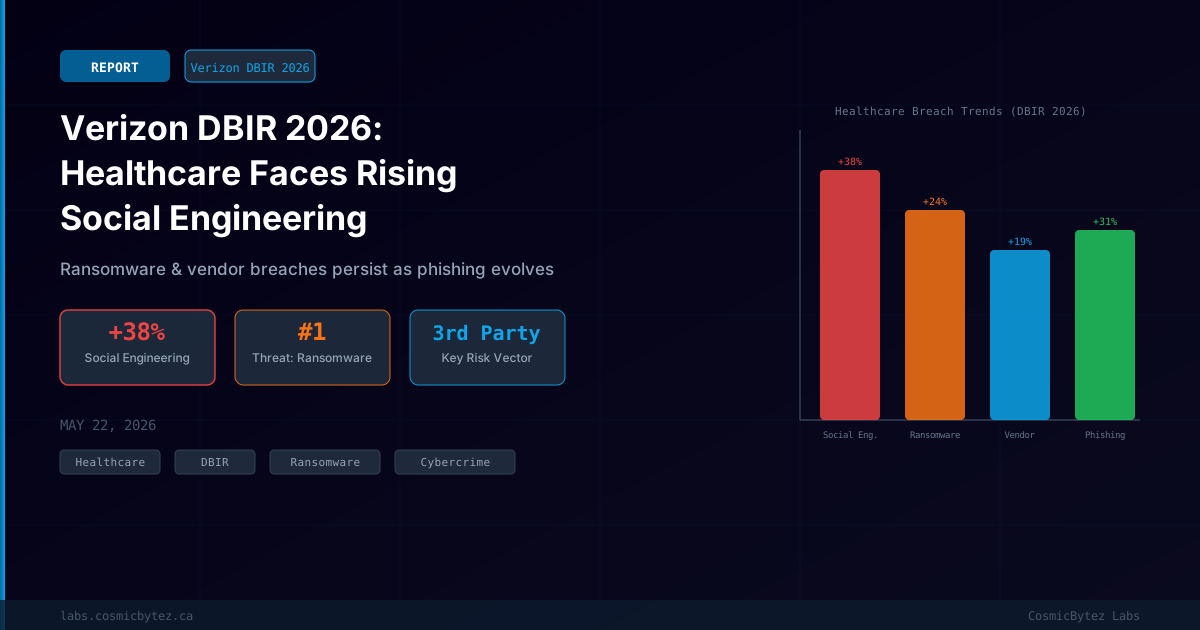
The 2026 Verizon Data Breach Investigations Report (DBIR) has spotlighted a troubling trend in the healthcare sector: social engineering attacks are on the rise, growing in sophistication and volume even as organizations improve their technical defenses. Healthcare remains a prime target due to the high value of medical records and the critical nature of its operations, which creates pressure to restore systems quickly — often at the cost of proper incident response.
The report emphasizes that while ransomware and third-party vendor breaches continue to drive the majority of healthcare incidents, the evolving social engineering landscape is expanding the attack surface and lowering the barrier to initial access.
Key Findings for Healthcare
Social Engineering Is Accelerating
Social engineering attacks targeting healthcare have seen significant year-over-year increases according to the 2026 DBIR:
| Attack Vector | Trend |
|---|---|
| Phishing (email) | Continued growth with AI-assisted personalization |
| Pretexting | Rising — attackers impersonate insurance companies, regulators, vendors |
| Vishing (voice) | Surge driven by AI voice cloning tools |
| SMS/Smishing | Targeting clinical staff with urgent patient-related lures |
Healthcare workers, especially those in clinical roles, are increasingly being targeted with highly contextual lures that reference real patient scenarios, specific physician names, or legitimate-sounding regulatory requirements.
Ransomware Remains the Primary Threat
Despite the growth in social engineering, ransomware remains the number one cause of major healthcare data breaches. Healthcare organizations face a uniquely difficult calculus: paying ransoms to restore patient care systems quickly, or risking extended outages that endanger lives.
The DBIR notes that healthcare ransomware attacks in 2026 are more likely to involve:
- Double extortion — data stolen before encryption and threatened for release
- OT/IoT targeting — medical devices and clinical systems increasingly in scope
- Faster deployment — time-to-encryption shrinking as attackers pre-position
Third-Party Vendor Risk Persists
A significant portion of healthcare breaches in the 2026 DBIR trace back to third-party vendor compromises. Electronic Health Record (EHR) vendors, billing systems, and healthcare IT managed service providers represent high-leverage targets — a single vendor breach can cascade to dozens of healthcare customers.
Key findings on vendor risk:
- Business Associate (BA) breaches now account for a substantial share of HIPAA breach notifications
- Vendor security assessment cadences are not keeping pace with the threat environment
- Credential sharing and overprivileged API access between healthcare orgs and vendors remain prevalent
Why Healthcare Is a Persistent Target
| Factor | Impact |
|---|---|
| High data value | Medical records fetch 10–40x more than credit card data on dark web markets |
| Operational criticality | Ransomware creates immediate patient safety pressure to pay |
| Complex IT environments | Legacy medical devices, diverse vendors, hybrid cloud architectures |
| Regulatory burden | HIPAA compliance overhead diverts resources from proactive security |
| Staff turnover | High clinical staff turnover complicates security training consistency |
| Mergers and acquisitions | Healthcare consolidation creates complex, partially integrated IT environments |
The Social Engineering Evolution: AI-Assisted Attacks
The 2026 DBIR dedicates significant analysis to the role of generative AI in lowering the quality bar for social engineering. Traditional phishing was often detectable by poor grammar, generic lures, and obvious red flags. AI-assisted attacks have dramatically reduced these indicators:
- Personalized spear-phishing at scale — AI can generate highly targeted emails using OSINT data about specific employees
- Deepfake voice/video — clinical leadership impersonation via voice cloning in vishing campaigns
- Document forgery — AI-generated insurance authorizations, regulatory notices, and vendor invoices with authentic formatting
- Multilingual attacks — attackers can now target non-English-speaking healthcare staff with native-quality lures
Defensive Recommendations
For Social Engineering
- Phishing-resistant MFA: Deploy hardware keys (FIDO2) or passkeys for all clinical staff, not just IT personnel
- Email authentication: Enforce DMARC, DKIM, and SPF — many healthcare organizations still lack strict DMARC policies
- Security awareness training: Move beyond annual compliance training to continuous micro-training with simulated attacks
- Verify high-stakes requests out-of-band: Wire transfers, credential resets, and system access changes should require callback verification via a known-good number
For Ransomware
- Immutable backups: Maintain air-gapped or immutable backup copies that ransomware cannot encrypt
- Segment clinical networks: Isolate medical devices and clinical systems from general IT networks
- Incident response playbooks: Pre-approved decision trees for clinical leadership on when to notify, when to restore, and when to engage law enforcement
- Cyber insurance review: Ensure policy covers ransomware and business interruption for clinical operations
For Vendor Risk
- Vendor security assessments: Move from annual questionnaire-based assessments to continuous monitoring
- Least-privilege API access: Audit and reduce vendor API permissions; revoke unused credentials
- Contract requirements: Require vendors to disclose breaches within 24–72 hours; include right-to-audit clauses
- Fourth-party risk: Assess your vendors' vendors for critical healthcare IT dependencies
Regulatory Context
The 2026 DBIR findings arrive as the HIPAA Security Rule undergoes its most significant update in over a decade. The proposed updates — anticipated to finalize in 2026 — would mandate:
- Annual penetration testing and vulnerability scanning
- Multi-factor authentication for all systems touching ePHI
- Incident response plan testing
- Specific requirements for vendor security monitoring
Healthcare organizations should treat the 2026 DBIR findings as validation of the direction of these regulatory requirements.
Key Takeaways
- Social engineering is surging in healthcare — AI assistance is making attacks more convincing and scalable
- Ransomware remains the top threat with faster deployment and more aggressive double extortion tactics
- Third-party vendor breaches continue to create cascading impacts across the healthcare sector
- Phishing-resistant MFA is the single most impactful control against the current threat landscape
- Regulatory pressure is increasing — the HIPAA Security Rule updates align with the DBIR's top recommendations