Overview
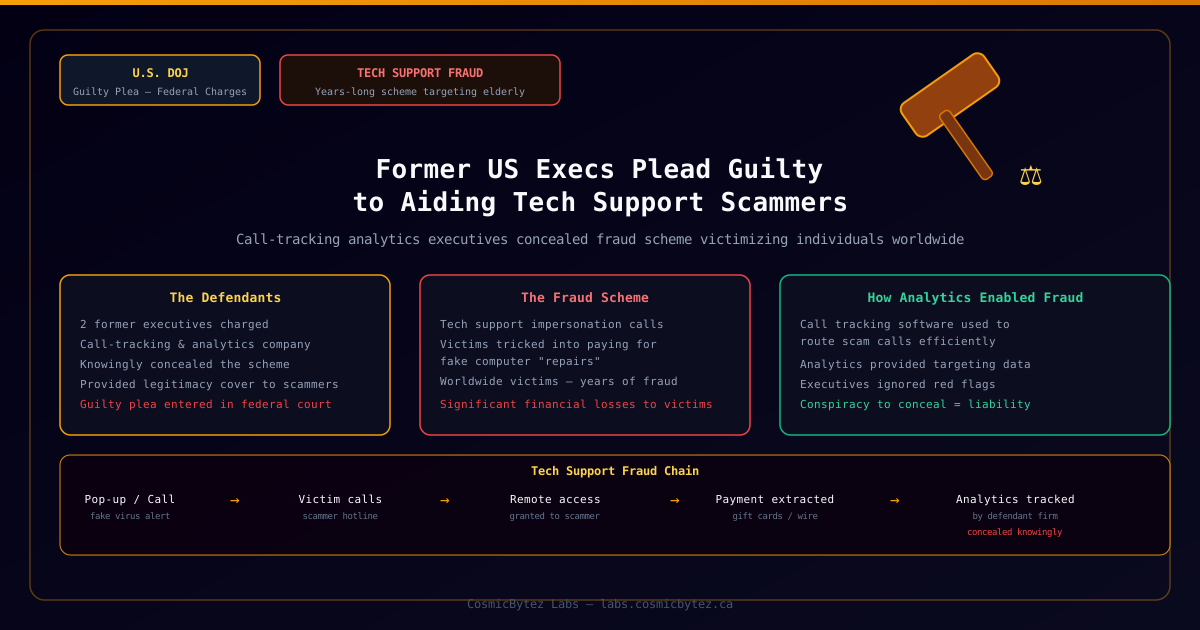
Two former executives of a call-tracking and analytics company have entered guilty pleas to federal charges for concealing a years-long tech support fraud scheme that systematically defrauded vulnerable individuals worldwide.
The case illustrates how legitimate-appearing technology businesses can be weaponized — knowingly or otherwise — to provide the operational backbone for large-scale criminal fraud targeting some of society's most vulnerable members.
The Case
| Attribute | Detail |
|---|---|
| Defendants | 2 former company executives |
| Charges | Conspiracy to conceal tech support fraud |
| Plea | Guilty — federal charges |
| Business type | Call-tracking and analytics company |
| Scheme duration | Multiple years |
| Victim scope | Individuals worldwide |
The executives worked for a company that provided call tracking and analytics services — tools legitimately used by businesses to measure the effectiveness of phone-based marketing and customer service. However, prosecutors allege the defendants knew these services were being used by tech support scammers and actively concealed that knowledge.
How Tech Support Scams Work
Tech support fraud is one of the most prevalent and financially damaging forms of consumer fraud, targeting primarily elderly individuals and those less familiar with technology:
Phase 1 — Initial Contact Victims encounter a pop-up warning or receive an unsolicited phone call claiming their computer has a virus, their Microsoft account is compromised, or law enforcement has detected illegal activity on their device. The message urges immediate contact with a fake "support" number.
Phase 2 — Social Engineering When the victim calls, scammers — often operating from overseas call centers — use high-pressure tactics to convince the victim they face an urgent, serious problem. They may impersonate Microsoft, Apple, the IRS, or the FTC.
Phase 3 — Remote Access Victims are convinced to install remote access software (like AnyDesk or TeamViewer), granting scammers full control of their computers. Scammers then stage fake "evidence" of infection or illegal activity.
Phase 4 — Payment Extraction Victims are pressured into paying for bogus services, often through:
- Gift cards (iTunes, Google Play, Amazon)
- Wire transfers
- Cryptocurrency
- In some cases, shipping cash in packages
Phase 5 — Repeat Victimization Victims are often re-targeted. Once identified as someone who pays, their information is shared among criminal networks.
The Role of Call Analytics in the Scheme
Call-tracking and analytics platforms serve legitimate business purposes — measuring which advertising channels generate phone calls, recording calls for quality assurance, and routing inbound calls efficiently. However, in the hands of tech support scammers, these tools provided:
Operational efficiency:
- Routing hundreds or thousands of incoming victim calls to available scammer agents
- Tracking conversion rates (how many callers were successfully defrauded)
- Geographic targeting — routing calls to agents who spoke the victim's language
- Callback scheduling — following up on victims who didn't complete payment
Evidence concealment: The executives' specific crime was concealing the use of their platform for fraud — not merely providing neutral services. Prosecutors alleged the defendants knew their clients were running scam operations and took steps to obscure this from law enforcement and financial partners.
Legal Framework
The guilty pleas likely cover charges under statutes including:
- 18 U.S.C. § 1343 (Wire Fraud) — using electronic communications to execute fraud
- 18 U.S.C. § 1349 (Conspiracy to Commit Wire Fraud)
- Potentially 18 U.S.C. § 1956 (Money Laundering) if the executives profited from proceeds
Corporate liability in fraud schemes extends beyond direct perpetrators. Executives who knowingly provide material support to criminal enterprises — even through otherwise-legitimate business tools — face the same conspiracy charges as the scammers themselves.
Impact on Victims
Tech support fraud causes substantial financial and psychological harm:
- FBI IC3 2025 data: Americans over 60 lost over $1 billion to tech support fraud in 2025 alone
- Individual losses often range from $500 to $50,000+ per victim
- Victims frequently lose life savings or retirement funds
- Psychological impact includes shame, anxiety, and distrust of legitimate technology
The scheme prosecuted in this case victimized individuals worldwide, suggesting an international operation with victims across multiple countries.
Prevention and Awareness
Tech support scams continue to evolve. Key red flags to share with friends and family:
- Legitimate companies do not send pop-up warnings with phone numbers — Microsoft, Apple, and others will never ask you to call them this way
- Never give remote access to someone who calls you unsolicited
- Gift cards are never a valid payment method for government agencies, tech companies, or utilities
- If you're unsure, hang up and call the company directly using a number from their official website
- Report scams to the FTC at reportfraud.ftc.gov and the FBI IC3 at ic3.gov
Sources
- BleepingComputer — Former US execs plead guilty to aiding tech support scammers