Overview
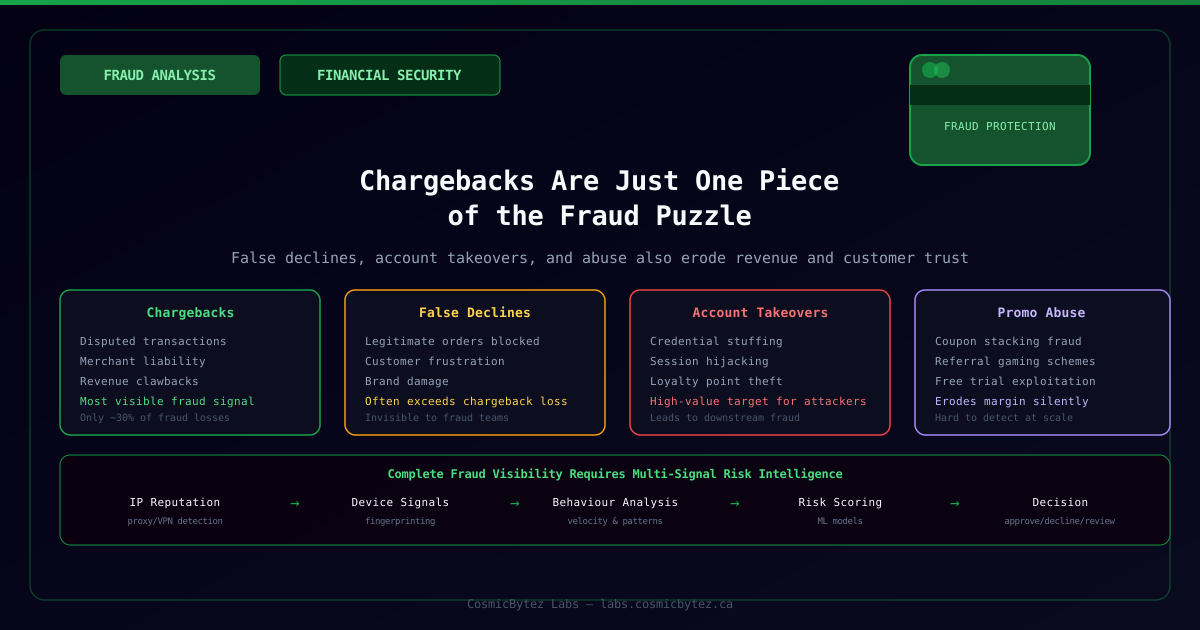
When organizations talk about online fraud, chargebacks are usually the first thing that comes up. They are visible, financially quantifiable, and directly impact merchant profitability. But chargebacks represent only a fraction of the true cost of fraud — and organizations that focus exclusively on chargeback rates are flying blind.
Fraud teams need broader visibility into the full spectrum of risk: from false declines that push legitimate customers away, to account takeovers that serve as staging grounds for downstream fraud, to promotional abuse that quietly erodes margins.
The Chargeback Trap
A chargeback occurs when a cardholder disputes a transaction with their bank, resulting in a forced reversal of the payment to the merchant. Chargebacks are costly:
- Merchants typically lose the transaction value plus a dispute fee
- High chargeback rates can result in merchant account termination by payment processors
- Dispute resolution consumes significant operational overhead
Because chargebacks are directly measurable and immediately financially painful, fraud teams optimize heavily to reduce them. But this narrow focus creates blind spots.
The Hidden Costs of Fraud
False Declines
False declines occur when a legitimate transaction is incorrectly flagged and rejected by fraud prevention systems. The financial and reputational impact is significant:
- The customer loses trust and often defects to a competitor
- Revenue from the blocked transaction is permanently lost
- Studies suggest false declines cost merchants more than actual fraud in many sectors
- Customers who experience a false decline rarely try again — they take their business elsewhere
False declines are particularly damaging because they are invisible in chargeback metrics. A fraud team that reduces chargebacks by aggressively declining borderline transactions may actually be increasing total losses when false decline costs are factored in.
Account Takeovers (ATO)
Account takeover fraud occurs when attackers gain unauthorized access to legitimate user accounts — typically through credential stuffing with breached password lists, phishing, or session hijacking.
ATO enables a wide range of downstream fraud:
| ATO Consequence | Description |
|---|---|
| Fraudulent purchases | Using saved payment methods to make purchases |
| Loyalty point theft | Draining accumulated rewards before detection |
| Personal data harvesting | Collecting PII for identity fraud or social engineering |
| Account resale | Selling high-value accounts on dark web markets |
| Refund fraud | Initiating false returns to extract cash or credits |
By the time a chargeback is filed from an ATO, the attacker may have already monetized the account multiple times.
Promotional and Incentive Abuse
Referral bonuses, first-order discounts, and free trials are designed to acquire customers — but they are routinely exploited:
- Multi-accounting: Creating dozens of fake accounts to claim bonuses repeatedly
- Coupon stacking: Combining discounts in ways the merchant never intended
- Trial abuse: Cycling through free trials to avoid ever paying
- Referral farming: Self-referrals or organized rings that extract referral payouts
Promotional abuse doesn't generate chargebacks, which means it can persist undetected for extended periods, silently draining marketing budgets and distorting acquisition metrics.
A Multi-Signal Approach to Fraud Risk
Effective fraud prevention requires visibility across all these vectors, not just chargeback rates. A multi-signal risk intelligence approach combines:
IP and Network Signals
- VPN and proxy detection
- Tor exit node identification
- IP reputation scoring based on historical fraud activity
Device Signals
- Device fingerprinting to detect multi-accounting
- Browser behavior anomalies
- Emulator and virtual machine detection
Behavioral Signals
- Transaction velocity — unusual frequency from a single account
- Geographic inconsistencies between account address and transaction origin
- Time-of-day patterns that differ from normal user behavior
Identity Signals
- Email address risk scoring
- Phone number carrier and VOIP detection
- Cross-platform identity correlation
By combining these signals into a real-time risk score, organizations can make smarter approve/decline/review decisions that balance fraud prevention against false decline costs.
Building a Complete Fraud Picture
Organizations serious about reducing total fraud losses should:
- Measure false declines alongside fraud metrics — track false decline rate as a core KPI
- Implement ATO detection independently from payment fraud controls
- Audit promotional programs for systematic abuse on a regular cadence
- Use risk-based step-up authentication to challenge suspicious sessions rather than flat-out declining
- Correlate signals across channels — web, mobile, and API touchpoints often reveal patterns invisible in any single channel
Sources
- BleepingComputer — Why Chargebacks Are Just One Piece of the Fraud Puzzle (IPQS)