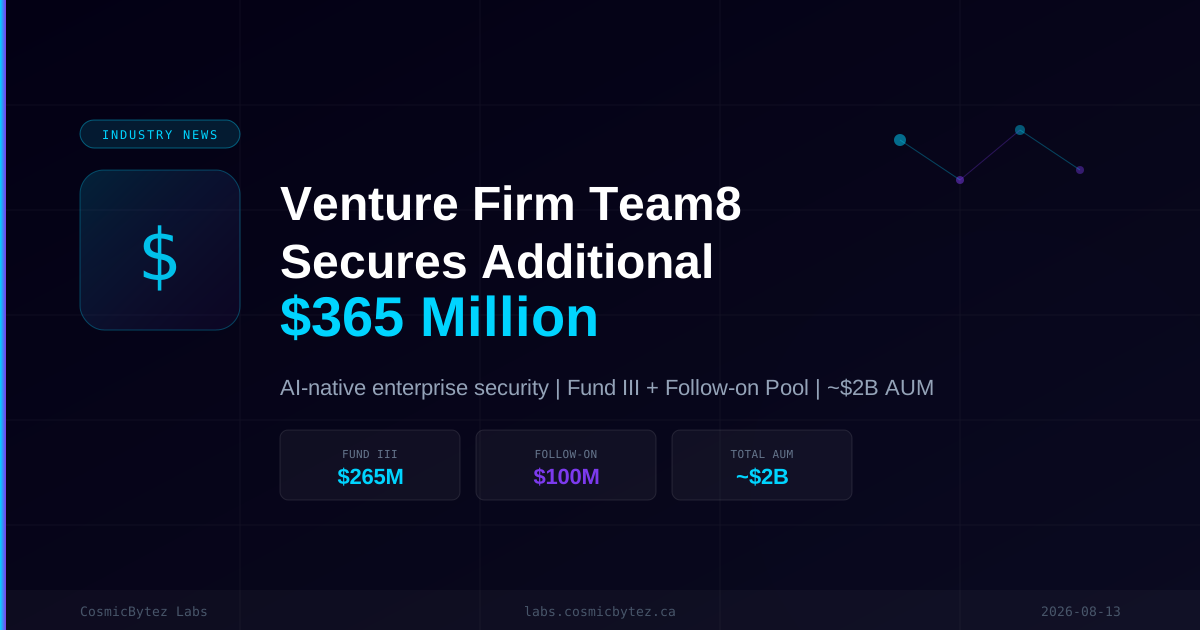
Israeli venture creation firm Team8 has raised $365 million in additional capital, split between a $265 million third fund (Team8 Capital Fund III) and a $100 million pool earmarked exclusively for follow-on investments in existing portfolio companies. The raise brings the firm's total assets under management to nearly $2 billion since its founding in 2014.
Beyond Traditional VC
Team8 operates a distinctive "venture-creation" model — rather than scouting externally funded startups, they co-found companies from the ground up, embedding go-to-market expertise and operational networks alongside capital. This approach has attracted repeat LP confidence evidenced by a third institutional fund, even as broader VC markets have tightened.
Managing Partner Sarit Firon framed the firm's core thesis in AI-native terms: "Competitive advantage won't come from the model underneath a product — it will come from solving fundamental enterprise problems that stay relevant across technology cycles."
AI-Native Enterprise Security as the Bet
Fund III targets new company creation in the AI-native enterprise space. Team8 is positioning its next cohort of companies to treat AI as a foundational layer rather than a bolt-on capability — directly aligned with where enterprise security budgets are flowing.
The $100 million follow-on pool supports existing portfolio companies scaling toward exits or later-stage funding rounds, reflecting confidence in the current pipeline's trajectory.
Exits and Active Portfolio
Team8 has produced three notable exits to Palo Alto Networks: Talon (enterprise browser security), Dig Security (cloud data security), and Koi. The 2026 active portfolio includes Frame Security, Act Security, Mate Security, Jazz, Fig Security, Astelia, and Lema AI — spanning identity, AI security, and next-generation enterprise protection.
Why This Matters
The raise signals sustained institutional appetite for cybersecurity-focused venture despite macro headwinds. With AI adoption accelerating across enterprises, Team8's co-creation model — building security-native companies from inception — positions it to address threats that existing tools weren't designed to handle. The $100 million follow-on commitment also suggests several portfolio companies are approaching significant milestones in the near term.
For the broader cybersecurity industry, Fund III is a leading indicator of where product-market fit is expected next: AI-native security platforms built to solve persistent enterprise problems across multiple technology cycles.