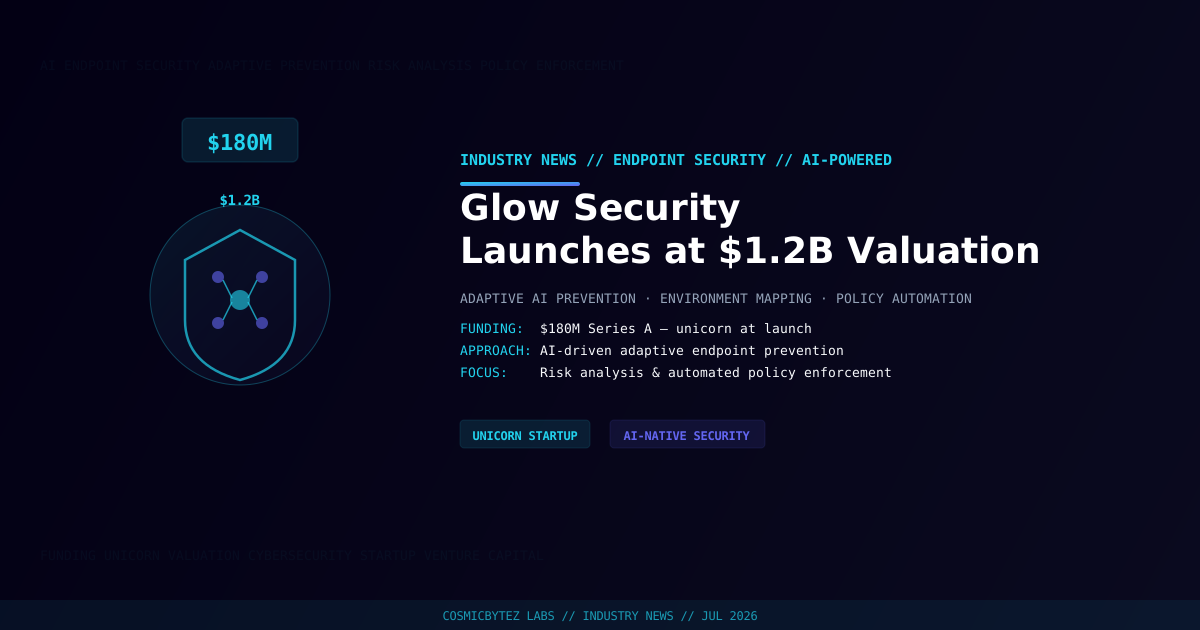
AI-Powered Endpoint Security Reaches Unicorn Status at Launch
Endpoint security startup Glow has emerged from stealth with one of the largest Series A rounds in cybersecurity history: $180 million at a $1.2 billion valuation. The company's debut positions it as a unicorn before most startups have shipped a production product — a milestone that underscores investor confidence in AI-driven, adaptive security approaches.
Glow's platform centers on adaptive prevention — a departure from the traditional detect-and-respond model that has dominated endpoint security for over a decade. Rather than waiting for known threat signatures or responding to alerts after the fact, Glow uses AI to continuously map the environment, assess risk, and automatically enforce security policies before an attack can establish a foothold.
How Glow's Approach Works
Three Pillars of Adaptive Prevention
| Pillar | Function |
|---|---|
| Environment Mapping | Continuously profiles the endpoint environment — applications, processes, network behavior, user activity — building a dynamic baseline of normal operation |
| Risk Analysis | AI models analyze deviations and correlate signals to assign real-time risk scores to processes, connections, and behaviors |
| Automated Policy Enforcement | Based on risk analysis, the platform automatically enforces or adjusts security policies without requiring manual analyst intervention |
This design targets one of endpoint security's most persistent problems: the gap between threat detection and human response time. By automating enforcement at the point of risk, Glow aims to eliminate the window attackers currently exploit between initial access and analyst remediation.
Why This Matters
The Incumbent Problem
Legacy endpoint detection and response (EDR) platforms generate high volumes of alerts that security teams must manually triage. In understaffed security operations centers — which describes most organizations — this creates a backlog that attackers routinely exploit. Dwell times (the gap between compromise and detection/containment) remain stubbornly high industry-wide.
AI-Driven Prevention as the Answer
Glow's bet is that AI can close this gap by making prevention proactive and continuous. Key aspects of the approach:
- No signature dependency — risk analysis operates on behavioral signals, not malware databases
- Environment awareness — policy decisions are contextual to what is normal for a specific organization, not generic
- Automated response — removes the analyst-in-the-loop bottleneck for high-confidence threats
The Funding Landscape
The $180M round makes Glow one of the most heavily funded endpoint security startups in recent memory. For context:
| Company | Funding Stage | Amount | Year |
|---|---|---|---|
| Glow | Series A | $180M | 2026 |
| CrowdStrike | IPO raised | ~$612M | 2019 |
| SentinelOne | Series F | $267M | 2021 |
Reaching a $1.2B valuation at Series A — without revenue numbers publicly disclosed — reflects both the perceived market opportunity in AI-native security and investors' appetite for category-defining bets in the current threat environment.
Market Context
The endpoint security market has been dominated by CrowdStrike, SentinelOne, and Microsoft Defender for Business in recent years. Glow's launch signals that investors believe there is room for an AI-native challenger — particularly one that prioritizes prevention automation over alert volume management.
The timing aligns with broader enterprise adoption of AI for security operations, including:
- Growth of AI-assisted SOC platforms (Palo Alto Cortex, Google Chronicle, Microsoft Sentinel with Copilot)
- Increasing enterprise demand for tools that reduce analyst burden as the talent shortage deepens
- Regulatory pressure in the US and EU pushing organizations toward more proactive security postures
What to Watch
- Customer traction: The real test for Glow will be enterprise adoption beyond the launch announcement. Watch for case studies and design partner announcements.
- Competitive response: CrowdStrike and SentinelOne have both been investing in AI-driven prevention capabilities. Glow's entry may accelerate that roadmap.
- False positive rates: Automated policy enforcement at scale risks disrupting legitimate workflows. How Glow manages this will determine enterprise fit.
- Series B trajectory: With $180M in the bank, the company has a long runway — but the next funding round will test whether the valuation is justified by real-world results.
Glow's launch is a bet that the endpoint security market is ready for a prevention-first, AI-native approach — and that $180M is enough to prove it.