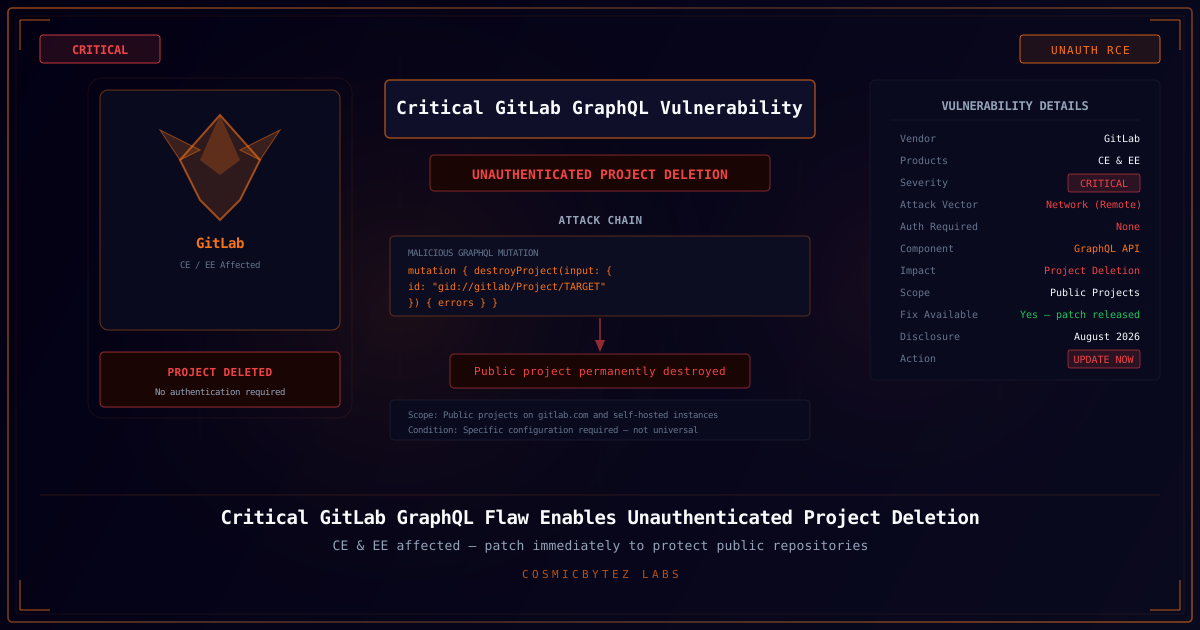
Critical Out-of-Band GitLab Patch — Immediate Action Required
GitLab has issued a critical out-of-band security release patching CVE-2026-19478, a critical vulnerability in the platform's GraphQL API that allows an unauthenticated attacker to delete or modify public projects remotely — with no credentials, no privileges, and no user interaction required.
The vulnerability carries a CVSS score of 9.4 and affects both GitLab Community Edition (CE) and Enterprise Edition (EE). GitLab.com and GitLab Dedicated are already running the patched versions; self-managed instance administrators must upgrade immediately.
Vulnerability Details
| Field | Details |
|---|---|
| CVE | CVE-2026-19478 |
| CVSS Score | 9.4 (Critical) |
| CVSS Vector | AV:N/AC:L/PR:N/UI:N/S:U/C:L/I:H/A:H |
| Component | GraphQL API — directive handling |
| Authentication Required | None |
| User Interaction | None |
| Discovery | hiimguardian via HackerOne bug bounty |
Affected Versions
All GitLab CE/EE versions from 18.2 up to (but not including):
| Branch | Fixed Version |
|---|---|
| 19.2.x | 19.2.4 |
| 19.1.x | 19.1.6 |
| 19.0.x | 19.0.8 |
| 18.x | 18.11.11 |
Technical Analysis
The GraphQL Directive Flaw
The vulnerability resides in GitLab's GraphQL directive handling. Under certain conditions, an unauthenticated attacker can send crafted GraphQL requests that remotely modify or delete public projects and user data. The flaw bypasses GitLab's access control layer at the GraphQL API level.
# Simplified representation of the attack surface
mutation {
  destroyProject(input: {
    id: "gid://gitlab/Project/TARGET"
  }) {
    errors
  }
}Full technical details — including specific mutation names and proof-of-concept payloads — are under GitLab's standard 30-day post-patch embargo. GitLab publishes full issue details on their tracker 30 days after the patching release to allow administrators time to upgrade.
Secondary Vulnerability (Same Release)
A second related flaw was patched simultaneously — CVSS 7.1, credited to researcher kreep: improper request validation in GraphQL multiplex query handling allowed unauthenticated users to execute GraphQL mutations via HTTP GET requests, bypassing the conventional POST-only constraint that GraphQL implementations rely on as an implicit CSRF guard.
Context: Broader GraphQL Audit
On August 12, 2026, GitLab's 19.2.2 release patched a separate unauthenticated GraphQL API DoS via malformed JSON parsing (CVE-2026-3988). The back-to-back GraphQL patches indicate an active security audit of the GraphQL attack surface is underway across the GitLab codebase.
Exploitation Status
No known active exploitation has been reported as of the patch release date. However, given:
- Zero authentication requirement
- CVSS 9.4 severity
- Fully network-exploitable
- Affects all GitLab versions since 18.2
Exploitation risk for unpatched self-managed instances is considered high. Public proof-of-concept code is expected to emerge within the 30-day embargo window, dramatically increasing exploitation likelihood.
Who Is Affected
Not Affected (Already Patched)
- GitLab.com (SaaS) — running patched versions
- GitLab Dedicated — running patched versions
Must Upgrade Immediately
- Self-managed GitLab CE/EE running any affected version (all 18.2+ through pre-fix)
Upgrade Instructions
# For Omnibus/package installations
sudo apt update && sudo apt install gitlab-ee
# or
sudo yum update gitlab-ee

# Verify version after upgrade
sudo gitlab-rake gitlab:env:info | grep "GitLab information" -A5

# Note: This update includes database migrations
# Single-node deployments should plan for brief downtimeFor Docker installations: Pull the updated image tag (19.2.4, 19.1.6, 19.0.8, or 18.11.11 depending on your branch).
Defensive Measures for Immediate Application
If immediate upgrade is not possible:
- Restrict public project visibility — temporarily set all public projects to internal while patching
- Enable GraphQL rate limiting — reduces attack throughput
- Deploy a WAF rule blocking unauthenticated GraphQL mutation requests
- Monitor GraphQL API access logs for anomalous destroy/delete mutation activity
- Restrict management interface access to trusted IP ranges
Sources
- GitLab Critical Patch Release: 19.2.4, 19.1.6, 19.0.8, 18.11.11
- CyberSecurityNews — GitLab patches 13 security flaws
- CCB Belgium — Warning: 11 new vulnerabilities in GitLab CE and EE