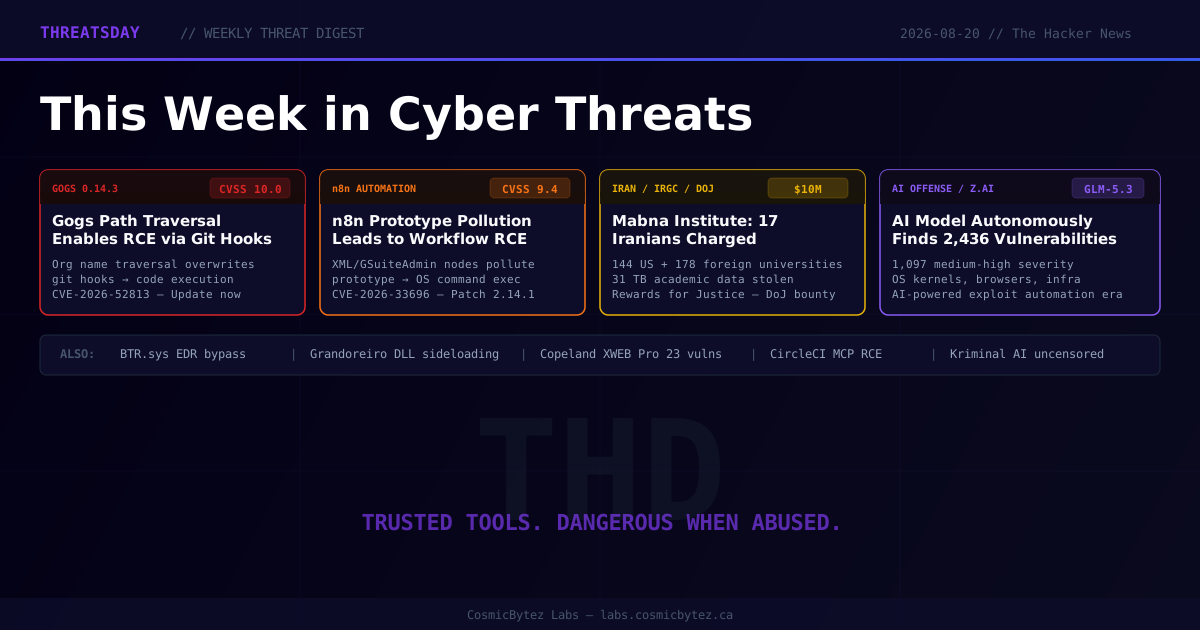
This Week's Theme: Trusted Tools Turned Against You
This week's threat landscape shares a common thread: trusted systems doing exactly what they were designed to do — just for the wrong people. A signed driver gets weaponized against the defenses it was supposed to support. Legitimate applications help malware blend into normal traffic. A weak header check opens the door to code execution. Add in nation-state credential theft at academic scale, an AI model autonomously hunting thousands of CVEs, and two more critical RCE chains in widely-deployed automation infrastructure, and it's been a dense week.
Gogs Path Traversal Enables RCE — CVE-2026-52813, CVSS 10.0
The self-hosted Git service Gogs has been hit with a maximum-severity vulnerability. CVE-2026-52813 is a path traversal flaw in how Gogs handles organization names: an attacker who can create or modify organization names can embed path traversal sequences to write arbitrary content to any location accessible by the Gogs process — including git hook scripts.
Git hooks execute automatically on repository events such as push, pre-receive, and post-receive. By overwriting a hook file, the attacker achieves arbitrary code execution on the Gogs server without any further interaction.
Two additional issues are bundled in the same advisory:
| CVE | Description | Severity |
|---|---|---|
| CVE-2026-52813 | Path traversal via org name → git hook RCE | CVSS 10.0 |
| CVE-2026-52810 | Logic bug allowing writes to read-only repositories | High |
| GHSA-6vxv-wg6j-5qwp | XSS in Jupyter notebook renderer | Medium |
Affected: Gogs prior to 0.14.3 Remediation: Update to Gogs 0.14.3 immediately. If you cannot update, restrict organization creation to trusted admins and monitor git hook files under all repositories for unexpected modifications.
n8n Prototype Pollution Leads to RCE — CVE-2026-33696, CVSS 9.4
n8n, the popular open-source workflow automation platform, has disclosed another RCE vulnerability. CVE-2026-33696 is a prototype pollution flaw in the XML and GSuiteAdmin nodes. An authenticated user with workflow creation or modification rights can craft a malicious workflow that pollutes the JavaScript prototype chain — ultimately enabling arbitrary OS command execution as the n8n process user.
This is the latest in a series of critical n8n RCE chains:
| CVE | CVSS | Description |
|---|---|---|
| CVE-2026-21858 | 10.0 | "Ni8mare" — unauthenticated file access via form workflows |
| CVE-2026-21877 | 10.0 | Authenticated RCE via Git node |
| CVE-2026-27493 | 9.5 | Unauthenticated expression evaluation via Form nodes |
| CVE-2026-27577 | 9.4 | Expression sandbox escape |
| CVE-2026-33696 | 9.4 | Prototype pollution in XML/GSuiteAdmin nodes → RCE |
As of early 2026, over 24,700 unpatched n8n instances remained exposed on the public internet.
Affected: n8n prior to 2.14.1 (also backported to 2.13.3 and 1.123.27) Remediation: Upgrade to the applicable patched branch (2.14.1 / 2.13.3 / 1.123.27). Limit workflow creation to trusted users. Disable unused nodes (XML, GSuiteAdmin) if not needed. For self-hosted deployments, restrict network access to the n8n editor.
$10 Million Reward: DOJ Charges 17 Iranians in IRGC Academic Espionage Campaign
The U.S. Department of Justice has charged 17 Iranian nationals linked to the Mabna Institute, a private company acting on behalf of Iran's Islamic Revolutionary Guard Corps (IRGC). The campaign has been active since 2013.
Campaign Scale
| Metric | Figure |
|---|---|
| U.S. universities targeted | 144 |
| Foreign universities targeted | 178 (21 countries) |
| U.S. companies targeted | 42+ |
| Professor accounts targeted | 100,000+ |
| Professor accounts compromised | ~8,000 |
| Data stolen | 31+ terabytes |
The stolen material — academic research and intellectual property across scientific disciplines — was sold to Iranian government customers, including the IRGC itself.
Method: Spear-phishing campaigns impersonating legitimate academic organizations, combined with credential harvesting portals designed to capture university login credentials. Once inside, attackers exfiltrated high-value research via automated scraping.
Reward: The U.S. Rewards for Justice program is offering up to $10 million for information leading to the identification or location of the charged individuals.
GLM-5.3: AI Model Autonomously Discovers 2,436 Vulnerabilities
Z.ai (formerly Zhipu AI) has released GLM-5.3, an enhanced AI model purpose-built for vulnerability research and exploitation. According to Z.ai, the model:
- Autonomously identified 2,436 vulnerabilities across 269 open source projects
- Of those, 1,097 were rated medium-to-high severity
- Targets include OS kernels, browsers, and infrastructure components
- Uncovered vulnerabilities dormant for up to 40 years
- "More than doubles" its predecessor on exploitation benchmarks
The Broader AI Offense Trend
GLM-5.3 is not an isolated development. A separate campaign by a Chinese-speaking threat actor (aliases "knaithe" / "KnYuan") was documented using DeepSeek via the Hermes Agent framework to autonomously orchestrate exploitation campaigns against:
- n8n
- Langflow
- Citrix NetScaler
- Apache Tomcat
- Palo Alto PAN-OS
Telegram was used as the command-and-control channel in those operations.
Takeaway: AI is now an active multiplier on the attacker side of the CVE lifecycle. The window between vulnerability disclosure and exploitation is shrinking. Patch aggressively, prioritize network-exposed services, and invest in post-exploitation detection — not just perimeter control.
Also in This Edition
| Story | Summary |
|---|---|
| BTR.sys Driver Abuse | Microsoft-signed driver weaponized to disable EDR solutions on targeted hosts |
| Grandoreiro Banking Malware | DLL sideloading campaign targeting financial institutions in Mexico and Latin America |
| Copeland XWEB Pro | 23 vulnerabilities in industrial refrigeration controllers, including RCE |
| Danfoss Controller Flaws | Multiple RCE vulnerabilities in Danfoss refrigeration control systems |
| CircleCI MCP Server | Unauthenticated RCE via Host header manipulation in the CircleCI MCP integration |
| Kriminal AI | Uncensored AI-as-a-service platform with 2,300+ users at $12.99–$99/month, no guardrails |
Patch Priority Summary
| Priority | Product | Action |
|---|---|---|
| Critical | Gogs | Update to 0.14.3 — CVSS 10.0 RCE in production |
| Critical | n8n | Update to 2.14.1 / 2.13.3 / 1.123.27 — CVSS 9.4 RCE |
| Critical | Termix | Update to 2.6.1 — three CVEs including CVSS 9.8 command injection |
| High | Copeland XWEB Pro | Apply vendor patches — 23 ICS vulnerabilities |
| Ongoing | All systems | Accelerate CVE patching — GLM-5.3 is automating exploitation at scale |
References
- ThreatsDay: Gogs 10.0 RCE, n8n Workflow-to-RCE, $10M Reward, GLM-5.3 AI Exploit (The Hacker News)
- New Gogs Zero-Day Flaw Lets Hackers Get Remote Code Execution (BleepingComputer)
- Critical n8n Flaws Allow Remote Code Execution (The Hacker News)
- NIST NVD — CVE-2026-52813
- NIST NVD — CVE-2026-33696