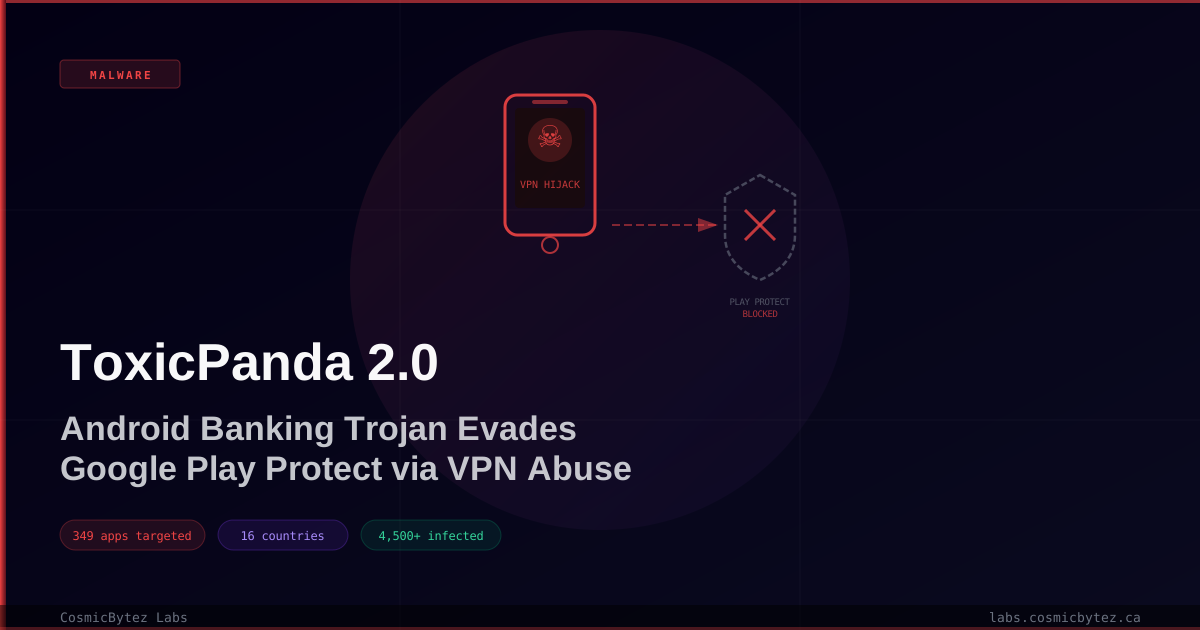
Zimperium's zLabs threat research team has published findings on ToxicPanda 2.0, a dramatically upgraded Android banking trojan that abuses VPN service permissions to sever Google Play Protect's cloud communications — effectively blinding one of Android's core defenses before deploying its payload.
What Is ToxicPanda 2.0?
ToxicPanda (also tracked as TgToxic) first emerged around mid-2022. The 2.0 variant, detailed in Zimperium's August 19, 2026 report, is assessed to be a Chinese-speaking threat actor operation — unusual since Chinese-linked groups rarely focus on European banking targets. The malware is an on-device fraud trojan: rather than just harvesting credentials for later use, it allows operators to remotely control the compromised device and initiate unauthorized bank transactions in real time.
The VPN Permissions Trick
The malware operates as a dropper app. During installation it presents victims with a fake system prompt requesting VPN service privileges. Once granted, ToxicPanda uses those permissions to intercept and block all network traffic to and from Google Play and Google Play Services. Since Play Protect depends on cloud-based lookups and telemetry to identify and remediate threats, severing that connection neutralizes it entirely. With Google's security infrastructure blinded, the malware decrypts and installs its real payload — concealed inside the dropper's own asset files.
New Capabilities in Version 2.0
Beyond the VPN evasion, version 2.0 introduces automated Android Wireless Debugging (ADB) abuse:
- The malware uses Accessibility Services to silently enable Developer Options on the victim's device through automated click sequences
- It then pairs with the local ADB daemon at
127.0.0.1, gaining a shell-level access channel without any physical device access - Through the ADB shell, it grants itself additional permissions, disables background activity restrictions, and entrenches persistence
Additional capabilities include:
- 167 documented remote commands for full device control
- Overlay attacks mimicking 349 financial institutions across 16 countries
- Transparent touch capture overlays to harvest PIN inputs while legitimate banking apps are open
- OTP/2FA interception to bypass two-factor authentication
- Device Administrator privilege escalation with forced lock-screen password reset
- Persistence via vendor-specific settings navigation to prevent the OS from killing background processes
Scale and Targeting
Zimperium's 2026 Banking Heist Report tracks 4,500+ confirmed infections primarily on Samsung, Xiaomi, and Oppo devices in Europe. The campaign has expanded significantly since its 2024 origins:
| Phase | Primary Regions |
|---|---|
| 2024 | Italy (56.8%), Portugal, Spain, Hong Kong, Peru |
| Early 2025 | Portugal and Spain became primary targets |
| 2026 | 16 countries including Pakistan, South Africa, Mexico, Nigeria, India, Indonesia |
The C2 infrastructure uses persistent WebSocket connections encrypted with AES-ECB, with malware payloads distributed via Amazon AWS S3 buckets. The replacePinTargets command allows operators to remotely swap target app package names without recompiling a new malware build.
Distribution
ToxicPanda does not spread through the Google Play Store. Infection vectors include:
- Sideloaded APKs from phishing sites, deceptive advertising, and social media
- Smishing (malicious SMS links)
- Malicious files hosted on attacker-controlled AWS buckets
Mitigation
For enterprises:
- Block sideloading on MDM-enrolled devices
- Treat Accessibility Service grants as privileged access events requiring logging
- Alert on any device enabling Developer Options or Wireless Debugging
- Deploy mobile threat defense (MTD) solutions with behavioral detection
For end users:
- Only install apps from the official Google Play Store
- Deny VPN permissions to any app that is not a known, trusted VPN provider
- Be suspicious of Accessibility Service permission requests from non-accessibility apps
- Keep Android OS and all apps updated
- Monitor bank accounts for unauthorized transactions
Key Takeaway
ToxicPanda 2.0 represents a meaningful escalation in mobile banking threat sophistication. By weaponizing VPN permissions — a feature users often grant without scrutiny — and combining it with automated ADB shell access, the malware achieves deep device control while systematically disabling the defenses most Android users rely on. Organizations with bring-your-own-device policies should treat this as a prompt to review mobile security posture.