Hiding in Plain Sight
Microsoft has disclosed a "high-volume phishing campaign" that repurposed an AI-era prompt-injection trick for old-fashioned email fraud: hiding invisible Unicode tag characters (in the U+E0000 to U+E007F range) inside ordinary words to defeat filters that match on literal text strings.
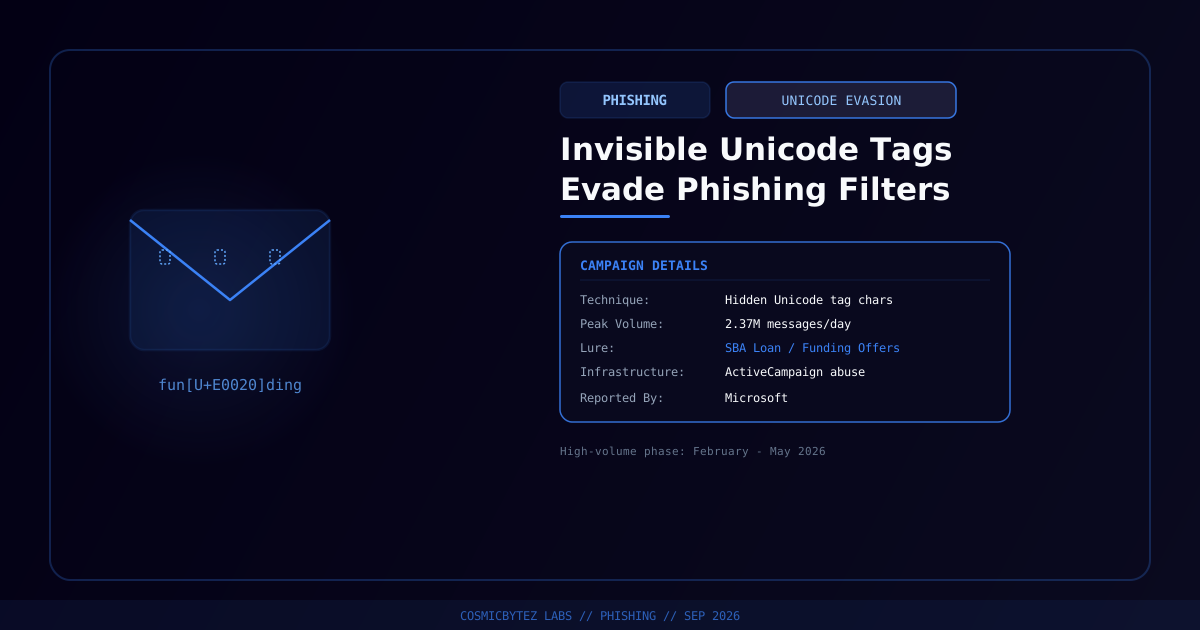
Where prompt-injection attacks typically use invisible tag characters to smuggle hidden instructions past an AI model while a human sees clean text, this campaign flipped the technique around. Financial lure words such as "funding" were split by an invisible character — for example, "fun[U+E0020]ding" — so that a human reader and most rendering pipelines still see "funding," while filters doing literal string matching miss the flagged keyword entirely.
As Microsoft put it: "To a recipient, and to parsing pipelines that drop or normalize these characters, the word still reads as funding."
Scale and Timeline
| Detail | Value |
|---|---|
| First observed | Early February 2026 |
| High-volume phase | ~3 months (February – mid-May 2026) |
| Peak daily volume | Up to 2.37 million messages |
| Typical weekday volume | 1M – 2.37M messages |
| Peak date | February 26, 2026 |
| Drop-off | Sharp decline after May 15, 2026 |
The campaign followed a distinct weekly rhythm — volume dropped to near-zero on weekends and resumed at full intensity every Monday, suggesting a semi-automated sending operation running on a business schedule.
The Lure: SBA Loan Offers
The primary targets were Small Business Administration (SBA) loan applicants, with phishing emails mimicking business loan offers, lines of credit, and advance-funding pitches. Top sender domains identified in the campaign include:
guardiangrowthfunding[.]comdigitalcapitalboost[.]comthebusinessloanexpress[.]comyourlocfunding[.]comadvancefundingboost[.]comguardiancapitalway[.]comharboradvancefunding[.]comunitedfundingwave[.]comdirectcapitalboost[.]comonlinedirectfinance[.]com
Laundering Links Through a Legitimate Platform
Beyond the Unicode obfuscation, the operators routed all outbound links through ActiveCampaign's marketing automation click-tracking infrastructure — domains acemlnd[.]com and activehosted[.]com — rather than hosting redirects themselves. Because those domains carry the reputation of a legitimate, widely used marketing platform, reputation-based email filters had a harder time flagging the links as malicious.
This isn't the first sighting of this actor's tradecraft: Fortra's FIRE team reported in September 2025 that the same group used ActiveCampaign to distribute thousands of AI-generated phishing emails targeting SBA applicants, complete with tailored landing pages built for each illegitimate domain.
Why This Matters
Invisible Unicode tag characters have mostly been discussed in the context of AI prompt injection — hiding instructions from a human reviewer while an LLM still parses them. This campaign shows the same character range being weaponized for a much older problem: defeating keyword- and pattern-based email filtering at scale. Any detection pipeline that normalizes or strips these code points before matching against blocklists — rather than flagging their mere presence as suspicious — is blind to this technique.
Recommended Actions
- Test email security pipelines with content containing invisible Unicode tag characters (U+E0000–U+E007F) to confirm detection, not just normalization.
- Treat the presence of tag characters in message bodies as a suspicious signal in itself, regardless of what word they're embedded in.
- Scrutinize links routed through third-party marketing/automation platforms (ActiveCampaign and similar) rather than trusting them by association with a reputable vendor.
- Flag high-volume, business-hours-only sending patterns from newly registered lookalike finance domains as an additional detection heuristic.
- Educate SBA loan applicants and small-business finance teams specifically, given this campaign's targeting focus.