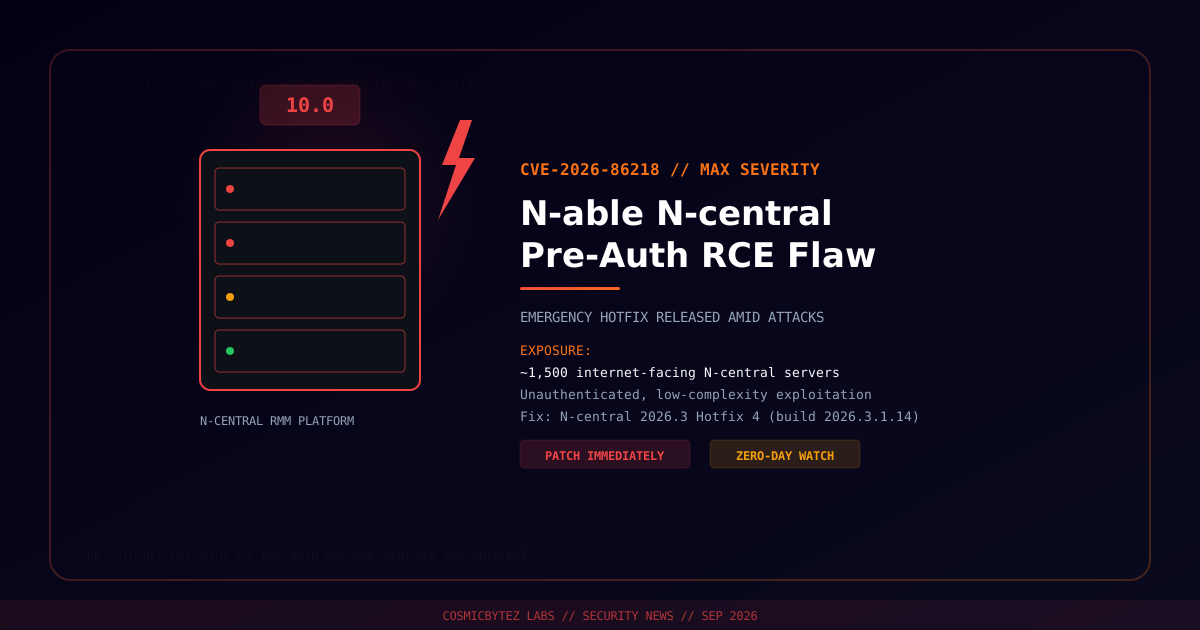
Emergency Hotfix for a Maximum-Severity Flaw
N-able has released an emergency hotfix for a maximum-severity remote code execution vulnerability, tracked as CVE-2026-86218, affecting its N-central remote monitoring and management (RMM) platform. The flaw carries a CVSS score of 10.0 and allows an attacker with no privileges to execute arbitrary code on exposed, unpatched N-central instances through a low-complexity, unauthenticated attack.
RMM platforms like N-central sit at the center of managed service provider (MSP) operations, typically holding privileged access to every endpoint they manage — making a pre-authentication RCE here a supply-chain-grade risk for every downstream customer of an affected MSP.
What Happened
N-able says the vulnerability was responsibly disclosed through its security disclosure program by a third party. The company shipped N-central 2026.3 Hotfix 4 (build 2026.3.1.14) over the weekend, which supersedes Hotfix 3 (build 2026.3.1.13) and addresses CVE-2026-86218 directly.
This hotfix arrived just one day after N-able patched two separate, high-severity authentication bypass flaws — CVE-2026-86206 and CVE-2026-86207 — in Hotfix 3.
| Attribute | Value |
|---|---|
| CVE ID | CVE-2026-86218 |
| CVSS Score | 10.0 (Critical / Maximum) |
| Type | Pre-authentication Remote Code Execution |
| Privileges Required | None |
| Attack Complexity | Low |
| Fixed In | N-central 2026.3 Hotfix 4 (build 2026.3.1.14) |
| Related Flaws | CVE-2026-86206, CVE-2026-86207 (auth bypass, fixed in HF3) |
Signs of Exploitation
Officially, N-able states: "At this time, we have no confirmations that this vulnerability has been exploited in production environments, but unpatched systems remain at risk."
Cybersecurity firm Huntress takes a more cautious view. It has flagged CVE-2026-86218 as a potential zero-day and found evidence suggesting the two related auth-bypass flaws (CVE-2026-86206 / CVE-2026-86207) may have been exploited in at least one customer environment — though Huntress noted that logs on the compromised server had already rotated, making it impossible to confirm whether this specific RCE was the vulnerability used.
The Shadowserver Foundation identified roughly 1,500 internet-exposed N-central servers, concentrated primarily in the United States and Europe — a substantial attack surface for opportunistic scanning once exploit details circulate more widely.
Who Needs to Act
- On-premises N-central deployments are the priority — administrators should patch immediately.
- N-central hosted instances (NCOD) have already had the patch applied by N-able.
- Simply confirming you're on "2026.3" is not enough — the original 2026.3 build predates all four hotfixes, and Hotfix 3 alone remains vulnerable to CVE-2026-86218. You need Hotfix 4 specifically.
- Direct upgrades to Hotfix 4 are supported from 2025.4, 2026.1, 2026.2, 2026.3, and 2026.3 HF1–HF3. Older installations require an intermediate supported build first.
Recommended Actions
- Patch now — upgrade all on-premises N-central instances to 2026.3 Hotfix 4 (build 2026.3.1.14).
- Verify hosted instances received the patch automatically if using NCOD.
- Audit exposure — confirm whether your N-central instance is reachable from the public internet and restrict access where possible.
- Review logs for unusual authentication or admin activity predating the patch, keeping in mind Huntress's finding that log rotation can erase evidence.
- Treat N-central credentials and API keys as potentially exposed if the instance was internet-facing and unpatched, and rotate them as a precaution.
References
- BleepingComputer — N-able Patches Max Severity N-central Flaw Amid Ongoing Attacks
- Huntress — Critical N-able N-central Vulnerability and Active Exploitation
- N-able Status — N-central 2026.3 Hotfix 4 – CVE-2026-86218