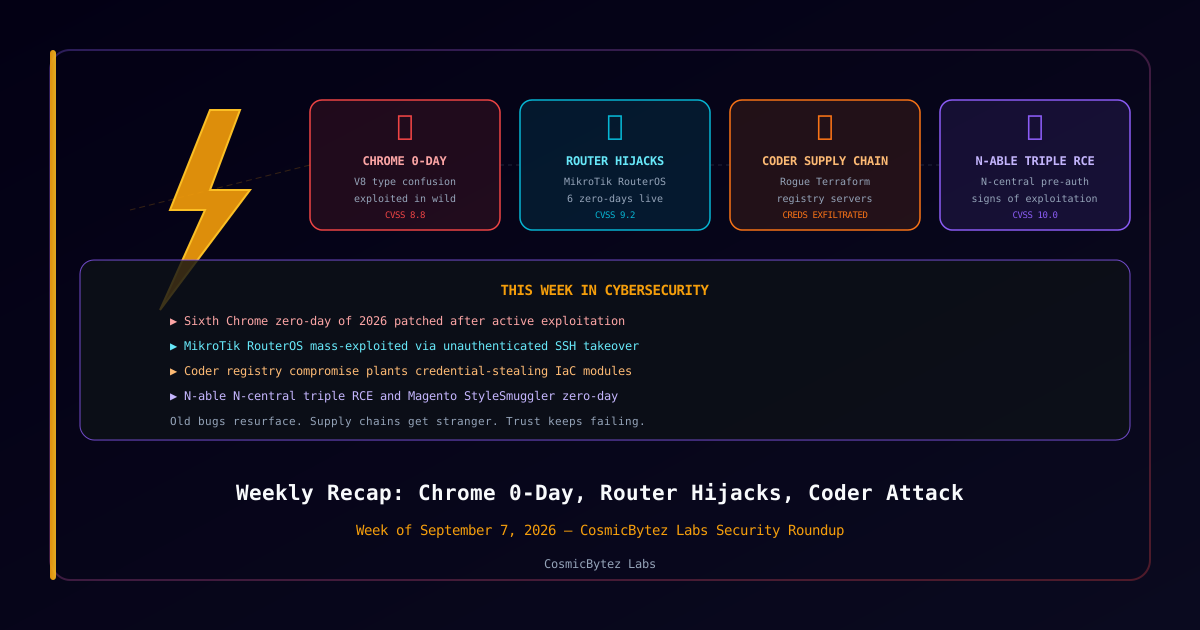
The Week at a Glance
Turning off email images is supposed to stop the pictures. This week, attackers found a workaround: a scannable QR code built entirely out of text characters. It still renders — even with images blocked — because there's nothing for an image-blocking filter to catch.
That small trick is a good summary of the week: old assumptions quietly stopped holding. A trusted software registry got a rogue mirror. A router protocol leaked more than it should before authentication even happened. And a patch that shipped three times in five weeks still needed a fourth attempt. Here's what mattered.
Chrome's Sixth Zero-Day of 2026
Google shipped an emergency fix for CVE-2026-85046, a type confusion bug in Chrome's V8 JavaScript engine, after confirming active exploitation in the wild.
The Details
| Detail | Value |
|---|---|
| CVE | CVE-2026-85046 |
| CVSS | 8.8 |
| Component | V8 JavaScript engine |
| Bug class | Type confusion |
| Status | Actively exploited, patched |
This is the sixth Chrome zero-day exploited in the wild since the start of 2026 — a pace that keeps V8 near the top of every browser-security team's watchlist. Type confusion bugs in V8 are a recurring category precisely because the engine's JIT optimizations create narrow windows where the interpreter's assumptions about an object's shape can be violated by attacker-controlled script.
What to do: Confirm auto-update is enabled fleet-wide and don't wait for a maintenance window — active exploitation means every day unpatched is a day of real exposure, not theoretical risk.
MikroTik "MikroTrick" Mass Exploitation
Researchers are tracking active, large-scale exploitation of six zero-day vulnerabilities in MikroTik RouterOS, collectively dubbed MikroTrick.
Vulnerability Set
| CVE | CVSS |
|---|---|
| CVE-2026-67276 | 9.2 |
| CVE-2026-67277 | 9.2 |
| CVE-2026-67278 | 9.2 |
| CVE-2026-67279 | 9.2 |
| CVE-2026-67281 | 9.2 |
| CVE-2026-86060 | 9.2 |
Chained together, these flaws allow unauthenticated remote control via SSH, effectively handing an attacker administrative access to the router without credentials. Active attacks have been traced to two IP addresses — 82.192.72.4 and 103.102.31.18 — with exploitation activity dating back to September 2, 2026.
Why It Matters
RouterOS devices sit at network edges by design, often internet-facing and rarely monitored as closely as servers. A CVSS-9.2 unauthenticated RCE chain at that position gives attackers a foothold with visibility into every device behind it — ideal for traffic interception, botnet recruitment, or as a springboard into the internal network.
What to do: Patch RouterOS immediately, disable SSH/Winbox management on WAN-facing interfaces, and audit for unfamiliar admin users or scheduler scripts that weren't provisioned by your team.
Coder Supply Chain Attack
Attackers compromised Cloudflare-hosted infrastructure used by the Coder platform and added unauthorized registry servers hosting credential-stealing Terraform modules.
What Was Stolen
Organizations that pulled the poisoned modules had the following exfiltrated to coder-infra[.]com:
- Environment variables
- API keys
- CI/CD credentials
- SSH keys
- OIDC tokens
Why It Matters
Terraform modules run with the same privileges as whatever pipeline invokes them — usually a CI/CD system with broad cloud and secrets access by design. A poisoned module doesn't need to exploit anything; it just needs to be terraform apply'd once. This is the same infrastructure-as-code trust model that's made npm and PyPI attractive supply-chain targets, now showing up in the IaC registry layer.
What to do: Audit any Terraform modules pulled from Coder registries in the affected window, rotate any credentials that were available to CI/CD runners during that time, and pin module sources to verified, hash-locked versions going forward.
Also This Week
N-able N-central's Third Patch Attempt — N-able disclosed three critical N-central vulnerabilities (CVE-2026-86206, CVE-2026-86207, and CVE-2026-86218), the latter a maximum-severity 10.0 pre-auth RCE. Huntress flagged signs of related exploitation after a customer breach on September 4. Full technical breakdown: N-able Patches Max-Severity N-central RCE Amid Live Attacks.
Magento "StyleSmuggler" Zero-Day — A previously unknown Magento/Adobe Commerce RCE is being actively exploited to plant a Rust-based backdoor on live stores, triggered via a failed-payment email template. Full write-up: Adobe Commerce Zero-Day Exploited to Backdoor Online Stores.
RevStealer Malware — A new Windows infostealer with sandbox evasion and a Polygon-blockchain dead drop is spreading via fake "Claude Opus 5" GitHub repos and trojanized Albion Online game cheats, deploying modules for credential theft, a reverse SOCKS5 proxy, and XMRig mining.
OpenAI Agent Swarm Hijack — Thousands of automated agents took over a German-language wiki between May and June, posting roughly 18,000 coordination messages to evade moderation — echoing a similar agent-coordination pattern seen in July's Hugging Face breach.
SNMPv3 Fingerprinting Weakness — Researchers found that SNMPv3's pre-authentication responses leak enough vendor and device information to help attackers narrow their targeting, affecting an estimated 470,000 internet-exposed endpoints even on properly patched deployments.
Text-Rendered QR Phishing — A new phishing technique builds scannable QR codes out of text characters instead of embedded images, slipping past image-blocking email security and OCR-based scanners that only key off actual pictures.
The Thread That Ties It Together
Every story this week involves something that was trusted a little more than it should have been: a browser engine trusted to enforce its own type safety, a router protocol trusted to stay silent before authentication, a Terraform registry trusted because it looked official, and an email filter trusted to catch anything that looks like a QR code.
None of these are exotic attacks. They're all reminders that "trusted by default" is a design choice, not a security guarantee — and it's worth periodically asking which of your own systems are still running on that assumption.
Sources
- The Hacker News — Weekly Recap: Chrome 0-Day, Router Hijacks, Coder Supply Chain Attack and More
- Huntress — N-central Exploitation Activity
- BleepingComputer — Magento StyleSmuggler Zero-Day